#OpenAI Codex Chrome extension
53 related articles

·2 min
Claude Desktop's Record Skill: Demonstrate Once, and AI Handles the Repetitive Work Automatically
Claude Desktop's new Record Skill: no prompt writing needed—just record a demo once, and AI learns and reuses the entire workflow. Two real-world cases explained.
Read more →

·3 min
The AI Coding Landscape: Model Tiers, Tool Camps, and a Deep Dive into MCP/Skills/CLI
A systematic map of today's AI coding landscape: the evolution from ChatGPT to Claude Code, LLM capability tiers, tool camps like Cursor/Copilot, and the three key weapons of the Agent era — MCP, Skills, and CLI.
Read more →

·3 min
Installed Codex But Don't Know What to Build? Find Real Needs with the "Friction Point" Mindset
Installed Codex or Claude Code but don't know what to build? This real-world browser extension case reveals the core methodology of the AI coding era: start from your own and others' "friction points" to find projects worth doing.
Read more →

·3 min
Got Codex but Don't Know What to Build? Use 'Friction Point Thinking' to Find Real Needs
Installed Codex or Claude Code but don't know what to build? This hands-on browser extension case reveals the core methodology of the AI coding era: start from your own and others' 'friction points' to find worthwhile projects.
Read more →

·7 min
Getting Started with Codex: Installation and Usage Guide for OpenAI's AI Coding Agent
A comprehensive guide to OpenAI's new AI coding agent Codex: from concept and comparison of its four forms, to installing Git/Node.js/VS Code, configuring the API Key, and creating a workspace.
Read more →

·4 min
OpenAI Reveals Agent Sandbox Cloud: Design Philosophy from microVMs to Global Orchestration
A deep dive into OpenAI's Agent sandbox cloud architecture: the security evolution from Fork and containers to gVisor and microVMs, plus copy-on-write snapshots and global orchestration.
Read more →

·5 min
Browser Use: A Deep Dive into the Event-Driven Browser AI Agent Framework
Browser Use is an open-source AI Agent framework that lets LLMs autonomously drive browser operations via natural language. This article breaks down its four-layer architecture, core Agent loop, CDP perception layer, dynamic Tools dispatch, and its Skills, Sandbox, and MCP extension capabilities.
Read more →

·2 min
OpenAI GPT-5.6 Released: Three Versions Compared — Full Breakdown of the All-in-One Super App
OpenAI releases GPT-5.6 in three tiers (SOUL/TERA/LUNA) and a unified ChatGPT desktop app with Chat, Work, and Codex modes. Learn how to choose the right version.
Read more →

·4 min
Complete Guide: Connecting Claude Code to DeepSeek — Local Setup + VS Code Integration
A step-by-step guide to installing Claude Code locally on Windows and swapping its underlying model for the DeepSeek API—enabling low-cost AI coding with no VPN required. Covers Node.js setup, Claude Code config, and getting a DeepSeek API Key.
Read more →

·3 min
GPT-5.6 Released: Sol, Terra, and Luna Reshape AI Programming and Office Automation
OpenAI launches GPT-5.6 with three models — Sol, Terra, and Luna — plus ChatGPT Work, a new desktop app, and Hosted Sites. Codex now autonomously trains models.
Read more →

·6 min
GPT-5.6 Hands-On Deep Dive: ChatGPT and Codex Merge, Full Analysis of the Sol Model
GPT-5.6 is officially released, merging ChatGPT and Codex into one app and launching the three-tier Sol, Terra, and Luna models. A detailed breakdown of 16 hands-on tests plus Worker mode and Codex dev upgrades.
Read more →

·8 min
OpenAI Merges Codex with ChatGPT: A Deep Dive into the Unified Desktop App Overhaul
OpenAI officially merges its coding agent Codex with ChatGPT into a unified desktop app, adding new coding workflows, a Chrome extension, a built-in browser, and GPT-5.6-powered Computer Use capabilities.
Read more →

·6 min
Playwright's Three Test Agents: A Deep Dive into Planner, Generator, and Healer
Playwright's three new Test Agents—Planner, Generator, and Healer—cover the full pipeline from test design to script generation and auto-repair, integrated with VS Code, Claude Code, and more.
Read more →

·4 min
Kimi Agent Cluster in Practice: One Person Commanding 300 AIs to Collaboratively Build a Website
Deep dive into Kimi Work Agent cluster's three collaboration architectures, with a hands-on demo of 300 AI agents building a website in parallel, covering requirements breakdown, multi-Agent coding, and auto-deployment.
Read more →

·3 min
Claude Code + CC Switch Deployment Guide: Connect to DeepSeek Without an Overseas Account
Complete guide to deploying Claude Code with CC Switch proxy to connect DeepSeek V4 Pro — no overseas account needed. Covers Node.js, VS Code, and API setup.
Read more →

·3 min
Beginner's Guide to Claude Code and Codex: AI Coding Agent Plugins Explained
A detailed guide to Claude Code and Codex AI coding agent plugins — their features, installation, and use cases in VSCode and Cursor for AI-assisted programming.
Read more →
·2 min
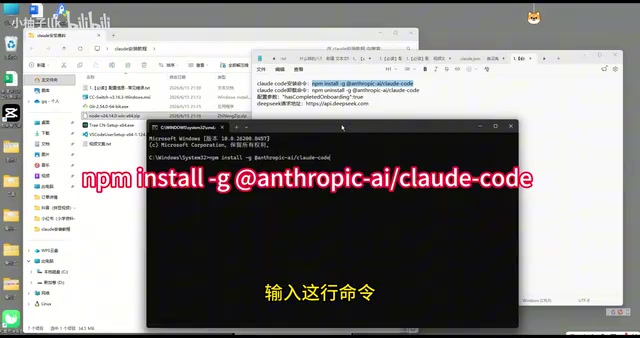
Claude Code Installation Guide: Complete Tutorial for Connecting to the DeepSeek Model
Step-by-step guide to installing Claude Code and connecting it to DeepSeek V4 Pro via CC Switch proxy, covering setup, API configuration, and troubleshooting.
Read more →

·3 min
Tutorial: Connecting Codex to Third-Party API Proxies for Low-Cost GPT-5.5 Access
Step-by-step tutorial on connecting GPT-5.5 to Codex via API proxy using CC Switch plugin. Complete setup in minutes with Fast mode and cost optimization tips.
Read more →

·3 min
OpenAI Codex Deep Dive: Core Capabilities and Engineering Design Philosophy
Deep dive into OpenAI Codex's core capabilities and engineering design philosophy, covering multi-task parallelism, code review, Agent Loop, Spec-Driven Development (SDD), and context engineering.
Read more →

·4 min
Claude Code Practical Guide: From Installation & Configuration to Production-Ready Business Projects
Complete guide to Claude Code + Opus setup via CCSwitch for unified model management. Real-world case: payment system built in 4 hours with zero hand-written code, covering installation, Prompt engineering, and model selection.
Read more →