#OpenCode open source
186 related articles

·3 min
Connecting Zotero to AI via MCP: A Complete Zero-Cost Guide to Generating Real Literature Reviews
Connect your local Zotero library to AI via MCP protocol to eliminate hallucinated citations. Full guide covering UV, Zotero setup, and OpenCode with free DeepSeek.
Read more →

·2 min
Daedalus: A Deep Dive into the Ollama-Based Local AI Engineering Runtime
Daedalus is an open-source local AI engineering runtime built on Ollama, covering architecture, debugging, and security. Zero token costs, full privacy, integrates with Claude Code and OpenCode.
Read more →

·3 min
Free Claude Opus 4.6 Access: Complete Guide to Connecting Antigravity via CLIProxyAPI
Use CLIProxyAPI to connect Antigravity's free models to Claude Code, Cline, and more. Access Claude Opus 4.6 Thinking and Gemini 3 Pro at zero cost. Full setup guide included.
Read more →

·2 min
Claude Code with Open-Source Models: Why Cache Misses Happen and How to Fix Them
Why Claude Code cache misses occur with DeepSeek and MiniMax, how Prompt Cache and KV Cache work, and practical solutions including API proxy layers and stable prefix strategies to cut AI coding costs.
Read more →

·4 min
AI-Powered Automated Testing: Using Pytest + MCP to Tackle Non-Determinism
Deep dive into AI-era automated testing: using Pytest + Playwright + MCP for stable automation, constraining code conventions with Skills, avoiding non-determinism and high token costs. Includes real debugging war stories.
Read more →

·3 min
Multica: An Open-Source Tool for Managing Multiple AI Coding Agents from a Single Dashboard
Multica is an open-source AI Agent management tool that unifies Claude Code, Codex, Cursor and more into one visual dashboard with kanban, task queues, and cloud deployment support.
Read more →

·4 min
MiniMax M2 Local AI Knowledge Base Test: Source Tracing, Deduplication, and Fact Verification
Build a local AI knowledge base with MiniMax M2 in OpenCode: source tracing, fact vs. opinion separation, conflict preservation, and timeliness management.
Read more →

·3 min
Pi Agent Review: A Minimalist Coding Agent That's Lightweight, Efficient, and Highly Customizable
Pi Agent hands-on review: ~1,200 token overhead, no built-in system prompts, supports Codex/Grok and more. Compared to Claude Code and OpenCode, Pi Agent wins with minimalist design and full customizability.
Read more →

·3 min
Zero Brand Loyalty Among AI Users: They'll Use Whoever Gets the Job Done
Reddit discussions reveal a new AI user mindset: no brand loyalty, no ideological allegiance — just results. Explore how over-refusal, API standardization, and composable tool strategies are reshaping the AI market.
Read more →

·2 min
Forge: Adding Reliability Guardrails to Local Model Tool Calling
Forge is an open-source Python middleware for local models (Ollama, llama.cpp, vLLM) that boosts tool-calling reliability via three-layer guardrails: validation, rescue parsing, and retry.
Read more →
·3 min
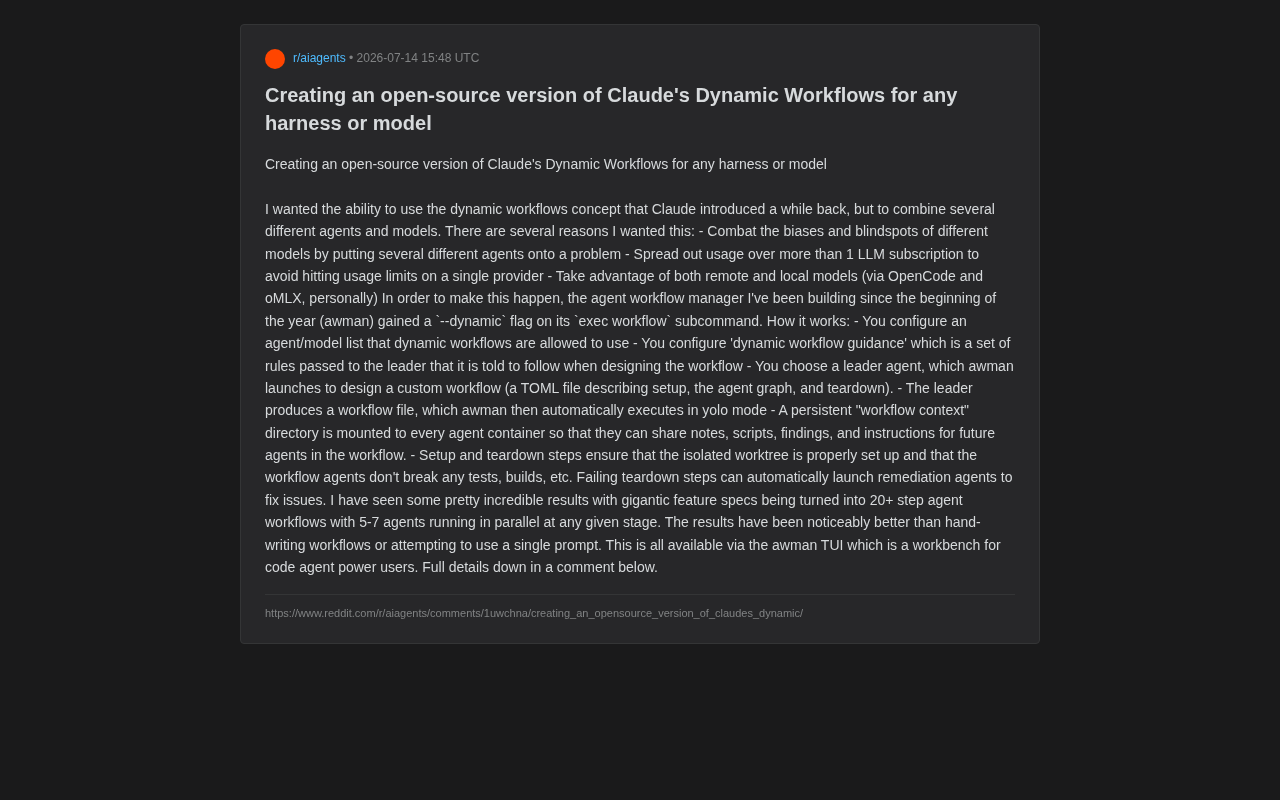
Open-Source Dynamic Workflows: How awman Enables Multi-Model Collaborative AI Programming
awman's --dynamic flag enables cross-framework dynamic workflows with multi-model collaboration. Explore its leader agent architecture, shared context design, and auto fault-tolerance mechanisms.
Read more →

·2 min
Running Qwen 122B on 8GB VRAM: A Complete Guide to Quantized Local Deployment
A Bilibili creator ran Qwen 122B with 256K context on just 8GB VRAM + 64GB RAM using llama.cpp. Full breakdown of quantization, deployment params, performance, and cost-effective alternatives.
Read more →

·2 min
Apple in Talks to Acquire PrismML: Can Extreme Quantization Really Run AI on an iPhone?
Apple is reportedly in talks to acquire AI startup PrismML, whose 1-bit extreme quantization could run large models on iPhone. Community tests reveal tool-calling failures and high hallucination rates.
Read more →

·2 min
Claude Code Beginner's Guide: A Deep Dive into the Most Powerful AI Coding Tool
Claude Code is the most powerful AI coding assistant available — local install, full project context, auto-debugging. See how it compares to Copilot, Cursor, and Trae.
Read more →

·3 min
Privacy Risks in Claude Code? Use Docker Sandboxes to Fully Isolate Your AI Coding Tools
Claude Code found to contain user monitoring logic, raising AI tool privacy concerns. Learn how to isolate Claude Code, Codex & Copilot with Docker Sandboxes — full setup and escape testing included.
Read more →

·2 min
Why I Gave Up on Claude Code's Full-Auto Mode: Real-World AI Agent Experience and Safety Reflections
Real-world insights on Claude Code vs. OpenCode, practical tool combinations, and security risks of full AI Agent automation — with strategies for safe, stable workflows.
Read more →

·6 min
A Deep Dive into OpenAI Codex: How AI Engineers Are Reimagining Software Development with Agents
OpenAI Codex is redefining how AI engineers work: from code completion to autonomous Agents, from single-threaded to parallel Value Maxing. A deep dive into the Codex App architecture, open ecosystem, and Manager of Agents practice.
Read more →

·4 min
Six Layers of Defense: Engineering Reliable Structured Output from LLMs
LLM JSON output unstable in your Agent? This guide covers 6 engineering layers: constrained decoding, validation retry, fake tool calls, Logit Masking, Schema contracts, and anti-pattern locking.
Read more →

·2 min
Hombre: An Open-Source Visual Dashboard for Honcho AI Memory Server
Hombre is an open-source web GUI for self-hosted Honcho AI memory servers. Features workspace management, semantic search, real-time sync, and RBAC — built with FastAPI and native frontend, MIT licensed, Docker-ready.
Read more →
The Hidden Costs of AI Coding Tools: A…
·2 min
The Hidden Costs of AI Coding Tools: A Deep Dive into Claude Code's 33k Token Overhead
Claude Code consumes up to 33,000 tokens per request before reading your prompt, vs. 7,000 for OpenCode. We break down why this 5x gap matters for cost, latency, and context windows.
Read more →