#SEO content strategy
90 related articles

·2 min
GEO Optimization in Practice: A Guide to Querying and Interpreting AI Search Visibility Reports
A practical guide to generating and interpreting GEO visibility reports — covering brand setup, competitor benchmarking, sentiment analysis, and keyword strategy for AI search platforms like ChatGPT and Perplexity.
Read more →

·6 min
The Three-Layer GTM Agent Architecture: Enabling AI to Truly Recognize Buyer Intent and Identity
An in-depth analysis of the three-layer GTM Agent architecture—the Signal, Buyer Intelligence, and Action layers—revealing how context graphs identify anonymous visitors and capture purchase intent.
Read more →

·6 min
Vue3 from Scratch: A Hands-On Journey to Building an AI Health Monitoring System
A Vue3 beginner tutorial centered on "learn just enough, apply immediately." A three-stage path covers reactivity, Composition API, Element Plus, and data visualization, culminating in an enterprise-grade AI health monitoring system with blood sugar management, RAG consultation, and doctor-patient collaboration.
Read more →

·2 min
Vibe Coding on a Budget: The Brain-vs-Hands Multi-Agent Strategy for Saving Tokens
Always burning through your AI coding quota? This guide breaks down a brain-vs-hands multi-agent strategy: use strong models only for planning, and cheap models like DeepSeek for execution.
Read more →

·4 min
Cross-Platform AI Agent Setup Guide: Breaking Free from Vendor Lock-In for Good
Model performance gaps are closing. Real competitive advantage lies in portable AI agent architecture. Learn how to build a workspace that works across Claude Code, Codex, and beyond — no vendor lock-in.
Read more →

·7 min
Claude Code Practical Tutorial: A Complete Beginner's Guide to Automating Your Entire Workflow
No coding required! This guide breaks down the complete Claude workflow: custom Projects, batch SEO content, one-sentence tool building with Artifacts, and Claude Code terminal ops—with real traffic-growth cases.
Read more →

·4 min
WebMCP in Practice: A Complete Guide to Making Your Website AI Agent-Ready
A deep dive into the WebMCP proposal: how AI agents read websites, how to expose structured tools via imperative and declarative APIs, and how to audit agentic readiness with Lighthouse.
Read more →
·3 min
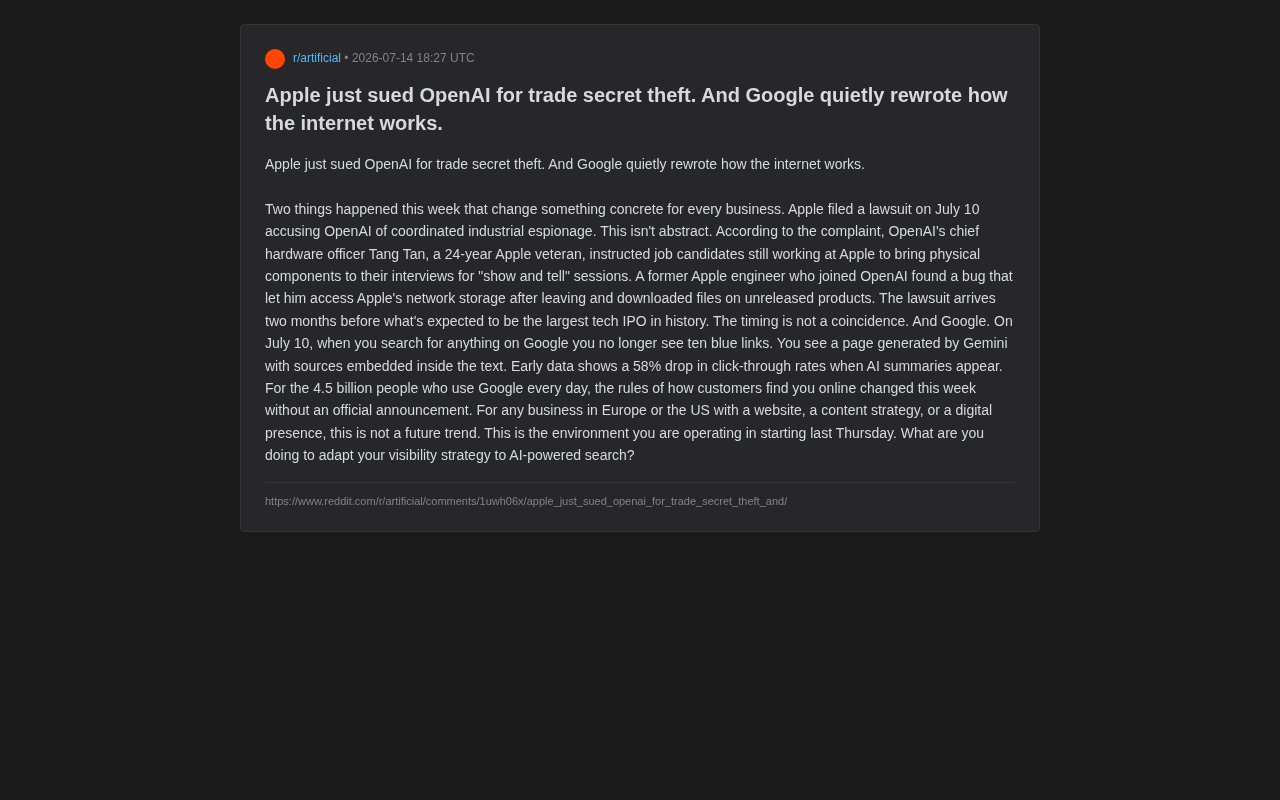
Apple Sues OpenAI for Trade Secret Theft, Google Rewrites Search Rules: A Complete Guide to Enterprise Visibility Strategy
Apple sues OpenAI for trade secret theft; Google quietly shifts to AI-generated search pages, causing a 58% drop in click-through rates. Here's what it means for your business visibility strategy.
Read more →

·3 min
Chrome Built-in AI in Action: Six APIs for Building a Smart Blog Editor
Deep dive into Chrome Built-in AI's six core APIs — Summarizer, Prompt API, Translator and more — applied to a real blog editor. Local, private, no server needed.
Read more →

·4 min
Next.js Deep Dive: A Full-Stack Framework Selection Guide Behind 140K+ Stars
A deep dive into Next.js: SSR, React Server Components, App Router, and Turbopack. Learn the key differences from plain React, ideal use cases, and how to make the right framework decision.
Read more →

·3 min
Disney+ Considers a Free Tier: Can It Win Back Screen Time from YouTube?
Disney is considering a free ad-supported tier for Disney+, challenging YouTube and Tubi. A deep dive into the business logic, risks, and industry implications.
Read more →

·6 min
GPT-5.6 Now Widely Available: The Era of Three-Tier Models and Multi-Agent Orchestration Arrives
OpenAI releases GPT-5.6 (SOUL/TERRA/LUNA), with Ultra mode running four agents in parallel; Meta launches Muse Spark 1.1 with million-token context; ChatGPT desktop unifies Chat, Work, and Codex.
Read more →

·6 min
Tencent Hunyuan HY3 Official Version Open-Sourced: The Strongest Under 300B, at 1 Yuan per Million Tokens
Tencent Hunyuan HY3 official version is open-sourced under Apache 2.0, priced as low as 1 yuan per million input tokens, with major gains in agents, reasoning, coding, and long context. On the same day, Meituan open-sourced its trillion-parameter LongCat 2.0.
Read more →

·4 min
Google Search Console's New Feature: Track Cross-Platform Search Traffic from Instagram and YouTube
Google Search Console's new "platform properties" feature lets creators track which Google search terms drive traffic to Instagram, YouTube, and other social accounts — no standalone website required.
Read more →

·6 min
Rust AI Agent System Prompt Engineering in Practice: A Seven-Dimensional Design Guide
An in-depth analysis of the four core roles of AI Agent system prompts and the four-step tool-calling method, covering behavioral boundaries, autonomous execution principles, and trigger pattern design—helping Rust developers build high-quality agents.
Read more →

·4 min
$398 Quantum Dot TV: How Vizio Accidentally Built the Best 'Dumb TV' on the Market
Vizio's sub-$398 65-inch Mini LED quantum dot TV has accidentally become the market's best 'dumb TV.' We break down its pricing logic, smart TV data monetization, and why less is more.
Read more →

·7 min
The Trap of AI Visibility Dashboards: Why Most Metrics Are Meaningless
Can a brand's "visibility" in AI answers really be quantified? This article deeply dissects the methodological flaws of AI visibility dashboards—from LLM output randomness and black-box mechanisms to vanity metric traps.
Read more →

·6 min
Reverse-Engineering ChatGPT's Source Selection: What Network Traffic Analysis Reveals About AI Citations
By capturing and analyzing ChatGPT's real network traffic during web retrieval, this article reveals the underlying logic of AI source selection—covering the layered mechanisms of retrieval recall and content filtering, domain preference patterns, and practical insights for content creators and SEO professionals.
Read more →

·6 min
Does AI Adoption Actually Lead to More Hiring? Explaining This Counterintuitive Phenomenon
Growing data shows companies aggressively adopting AI are actually hiring more. This article explores the overlooked complex relationship between AI and employment through the Jevons Paradox, new job creation, and competitive divergence.
Read more →

·2 min
AI Marketing Backlash: Why Obsessing Over 'AI-First' Is Starting to Backfire
Why "AI-First" branding is backfiring: how over-marketing AI erodes brand trust, triggers consumer fatigue, and what brands should do instead to rebuild credibility.
Read more →