#Stable Diffusion setup guide
25 related articles

·4 min
MiniMax H3 Local Deployment Hands-On: An AI Video Generation Workflow Without ComfyUI
Hands-on review of Sign Open AGI's local packaging of MiniMax H3 open-source video model, covering text-to-video parameters, generation speed, quality comparison with Seedance 2.0, multimodal agent features, and hardware recommendations.
Read more →

·2 min
MiniMax H3 Open-Source Deployment Guide: Generate AI Videos Locally with Low VRAM
MiniMax H3 is now open-source, supporting synchronized audio-video generation, text-to-video, and image-to-video. This guide covers local deployment with as little as 16GB VRAM, plus a one-click ComfyUI setup.
Read more →

·2 min
AI Art Cyber Ruins Red Monolith: Prompt Analysis and Dark Sci-Fi Aesthetic Breakdown
Deep analysis of an AI-generated cyber ruins red monolith concept art piece, breaking down dark sci-fi AI art creation techniques from color, lighting, narrative tension to prompt engineering.
Read more →

·3 min
No Python Required: A Unified Multimodal Local AI Generation CLI Tool
A CLI tool that enables local text, image, video, music, and 3D generation without Python. Explore its technical approach, advantages, limitations, and the growing trend of local AI tooling.
Read more →

·4 min
Deep Dive into AI Short Drama "Nido de Villanas": How AIGC Mass-Produces Binge-Worthy Content
Using AI-generated Spanish short drama Nido de Villanas as a case study to analyze AIGC script generation, character consistency, multilingual dubbing, and the commercial logic of scaled AI drama production.
Read more →

·4 min
Deep Dive into AI Short Drama "Nido de Villanas": How AIGC Mass-Produces Binge-Worthy Content
Using AI-generated Spanish short drama "Nido de Villanas" as a case study, this deep dive analyzes AIGC script generation, character consistency, multilingual dubbing, and the industry trends of scaled AI drama production.
Read more →

·3 min
Flux 3 Hands-On: Generating Dual-Camera Synchronized Video from a Single Prompt — How Good Is It?
Flux 3 demo generates dual-camera synchronized video from one complex prompt, featuring fluid dynamics, multi-view consistency, and precise temporal control.
Read more →
·3 min
Flux 3 Hands-On: Generating Dual-Camera Synchronized Video from a Single Prompt — How Good Is It?
Flux 3 demo generates dual-camera synchronized video from a single complex prompt, featuring fluid dynamics, multi-view consistency, and precise temporal control.
Read more →

·7 min
The Complete AI Character LoRA Training Workflow: Hands-On Multi-Character Consistency Generation with Local Deployment
A detailed guide to a complete local AI character generation workflow: from the five golden rules of LoRA training and automated ComfyUI dataset construction to hands-on comparisons of Crea2, Ideogram4, and Wan for multi-character same-frame interaction—all running free on personal hardware.
Read more →

·3 min
AI Manga Series Production: A Complete Guide from Script to Storyboard
A complete guide to AI manga production: from scriptwriting to storyboard generation. Learn the universal formula, avoid common pitfalls, and launch your first episode.
Read more →

·4 min
AMD Ryzen AI Halo Real-World Test: Can a Non-Programmer Use Local AI to Write Code?
A non-programmer tests AMD Ryzen AI Halo by deploying local AI models to tackle a real dev task. After testing Ollama and Qwen3, the verdict: AI amplifies developers, it doesn't replace them.
Read more →

·4 min
Hands-On with GPT-5.6: A Single Prompt Builds a Real-Time Voice Anime App
Hands-on with GPT-5.6 Sol: auto-generate real-time voice anime characters from one prompt, write physics engines from scratch, and build unfamiliar toolchains autonomously. In-depth review of coding, agentic tasks, benchmarks, and its hallucination weakness.
Read more →

·3 min
Depth Map and OpenPose Extraction Workflow: A Practical Guide to Controllable AI Video Generation
A deep dive into the principles and applications of the Depth Map and OpenPose pose extraction workflow, combined with Seedance 2's reference video feature, helping creators precisely control camera movement and character poses in AI video.
Read more →

·4 min
ByteDance Open-Sources Bernini Video Editing: Local Deployment Guide for Character Replacement
ByteDance open-sources Bernini, a video editing model supporting character replacement, outfit swapping, and video blending via ComfyUI. Full local deployment guide.
Read more →

·4 min
Ideogram 4 Local Deployment Test: Cinematic Quality on 8GB VRAM
Ideogram 4 open-source image model tested: runs locally on 8GB VRAM + 32GB RAM, Midjourney-level aesthetics, stable text rendering. Learn the 3-part prompt structure and automated ComfyUI workflow with Qwen3 VL.
Read more →

·4 min
How to Use Claude Code for Free Without Limits: A Zero-Cost Full Multimodal AI Solution
Use Claude Code for free with Agnes AI's free models and the CC Switch open-source tool. Full setup guide for zero-cost AI coding, image, and video generation.
Read more →

·2 min
The Golden Age of the Early Internet: What Did We Really Lose?
From GeoCities homepages to algorithmic filter bubbles, the early internet's spirit of openness and creativity is fading. Can the AI era bring it back?
Read more →
 Tutorials
·3 min
Z-Image Model in Practice: Generate Cinema-Quality Ancient Chinese Beauty Portraits in 3 Minutes
Complete guide to Z-Image model variants and ComfyUI workflow setup, using Doubao for prompt reverse-engineering to generate cinema-quality ancient Chinese beauty portraits in minutes.
Read more →
 Tutorials
·3 min
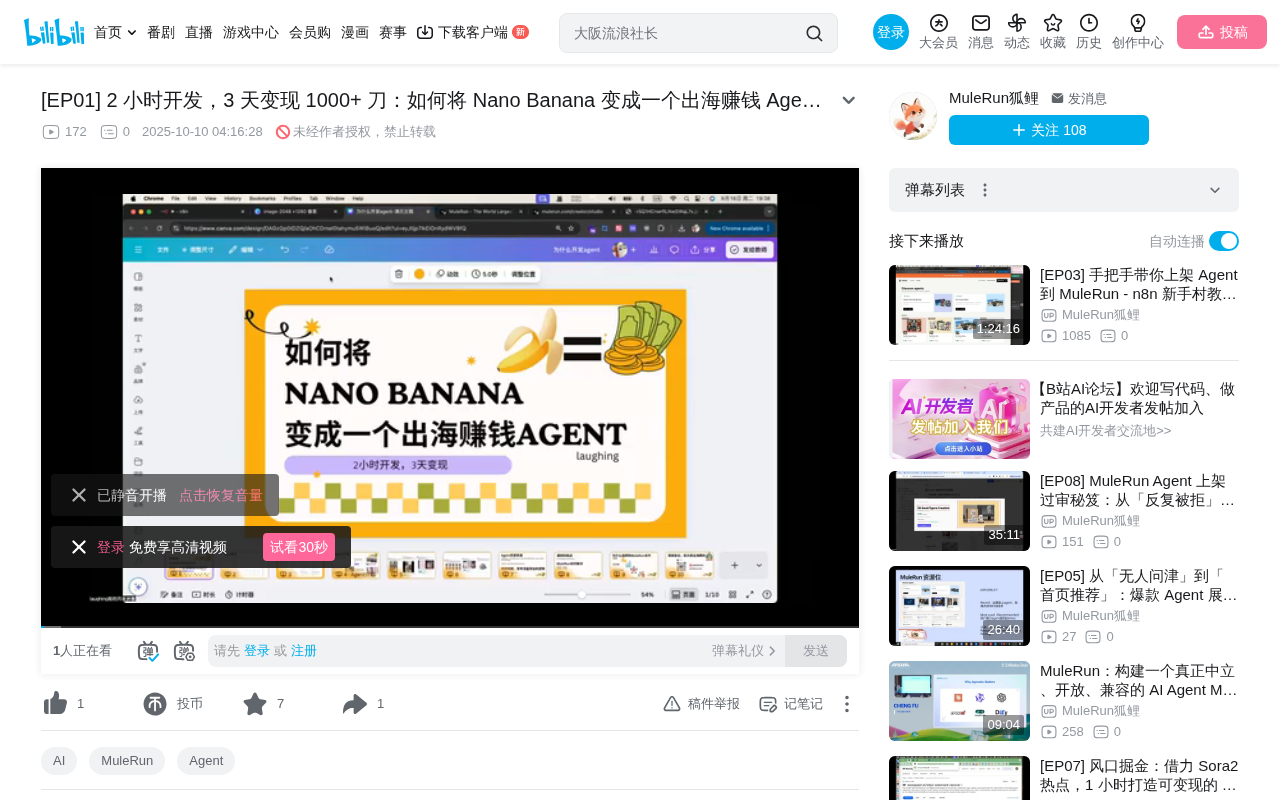
2 Hours to Build, 3 Days to Earn $1000: Building AI Agents for Global Markets with Nana Banana
Bilibili creator Luffin used Nana Banana to launch 9 AI Agents in two weeks, earning $1000+. Learn the complete methodology using N8N workflows and Mirror platform for AI global monetization.
Read more →
 Tutorials
·3 min
Stable Diffusion Local Deployment Guide: Free and Unlimited AI Image Generation
Complete guide to deploying Stable Diffusion locally, covering hardware requirements, one-click installation, and model management. Free, unlimited, fully offline AI image generation for creators and privacy-conscious users.
Read more →