#TTFT
70 related articles

·3 min
Google Gemma 4 On-Device Model: Optimized for Pixel 10 TPU — Offline Multimodal Capabilities Tested and Analyzed
Google's Gemma 4 E2B for TPU runs offline on Pixel 10's Tensor G5 chip, enabling local AI chat, image recognition, and audio transcription. We break down the features and real-world test results.
Read more →
Bonsai 27B: The First 1-bit LLM That R…
·3 min
Bonsai 27B: The First 1-bit LLM That Runs on Your Phone — A New Milestone for On-Device AI
Bonsai 27B is the first 27B-parameter LLM that runs on smartphones via 1-bit quantization, compressing to 3–4GB. We break down the tech, privacy benefits, and community debate.
Read more →

·3 min
Distributed AI Systems in Practice: A Complete Guide to Training, Inference, and Production Deployment
A deep dive into Distributed AI Systems: a new book distilling 10 years of AI engineering experience covering distributed training, inference optimization, and production model serving.
Read more →

·2 min
Grok 4.5 Hands-On Review: Speed, Accuracy, and Value in a Three-Way Evaluation
A power-user developer tests Grok 4.5: blazing-fast responses, high accuracy, and great value. A deep dive into Grok 4.5's real-world AI coding performance in Cursor.
Read more →

·3 min
The Rise of Diffusion Language Models: DiffusionGemma Crushes Autoregressive Models in Speed Tests
Diffusion language model DiffusionGemma dramatically outpaces autoregressive Deepseek Flash in speed tests. Explore the tech behind diffusion vs. autoregressive models and their challenges.
Read more →

·6 min
GPT-5.6 vs Grok 4.5 on the Same Day: A Packed Week of Flagship AI Model Launches
OpenAI's GPT-5.6 launches with Sawa, Terra, and Luna sub-models the same day as Musk's Grok 4.5, while Anthropic, Meta, and NVIDIA make their moves. A packed week of flagship AI launches.
Read more →

·3 min
SlickToken: A Deep Dive into GPU Fleet and Agentic Workflow Planning
SlickToken is a GPU fleet and agentic workflow planning tool for AI teams, supporting offline simulation, load testing, and capacity planning—no internet required to protect enterprise data.
Read more →

·4 min
Four Major LangChain Updates: OpenWiki, Voice Agents, and Sub-Agent Orchestration Explained
LangChain releases four major updates: OpenWiki for auto-generating codebase docs, voice agent tutorials, Harbor evaluation integration, and deepagents programmable sub-agents.
Read more →
·5 min
GPT-5.6 Triple Launch: Understanding the Positioning and Key Differences of Sol, Terra, and Luna
OpenAI released three GPT-5.6 models—Sol, Terra, and Luna—covering everything from flagship reasoning to lightweight speed. A deep dive into their positioning, performance differences, pricing, and industry signals.
Read more →

·6 min
A Deep Dive into the vLLM Inference Framework: Core Principles of Throughput Optimization and Interview Guide
An in-depth analysis of the vLLM inference framework's core principles: from the meaning of throughput (tokens/s), to the bottlenecks of autoregressive generation, to KV Cache, PagedAttention, and continuous batching.
Read more →

·4 min
Dify Getting Started: A Complete Guide to Building AI Workflows Without Code
A complete guide to Dify's core features and 1.8.0 deployment. Covers 5 app types, Docker setup, Workflow vs Chatflow differences, and RAG knowledge bases for beginners.
Read more →

·3 min
GPT-5.6 Released: Codex Takes Over ChatGPT, Ushering in the Era of AI Agents
OpenAI releases the GPT-5.6 series, deeply merging ChatGPT with Codex as the Agent engine takes over the underlying architecture. A deep dive into its impact on AI coding toolchains and Agent applications.
Read more →

·6 min
GPT Live Full-Duplex, Grok 4.5 Coding, Seedream 5.0 Images: AI Accelerates Across Three Tracks Simultaneously
OpenAI's GPT Live full-duplex voice model, Grok 4.5 coding model with Cursor, and ByteDance's Seedream 5.0 Pro image generation launched together. A deep dive into three AI releases.
Read more →

·2 min
AI Agents for SGLang Kernel Optimization: Real-World Performance Gains and Engineering Methodology
SGLang's team converted expert knowledge into agent skills, achieving 71.4% throughput gains, TTFT reduced from 456ms to 168ms. A deep dive into agent-assisted kernel optimization methodology.
Read more →

·5 min
Real-World Comparison of 6 Open-Source LLMs for On-Premise Deployment: A Selection Guide to Avoid Pitfalls
A hands-on comparison of 6 open-source LLMs (DeepSeek, Qwen3, Zhipu GLM, Kimi K2, MiniMax M3, Tencent Hunyuan 3) for on-premise deployment—covering hardware cost, inference efficiency, and deployment difficulty.
Read more →

·6 min
Tencent Hunyuan HY3 Official Version Open-Sourced: The Strongest Under 300B, at 1 Yuan per Million Tokens
Tencent Hunyuan HY3 official version is open-sourced under Apache 2.0, priced as low as 1 yuan per million input tokens, with major gains in agents, reasoning, coding, and long context. On the same day, Meituan open-sourced its trillion-parameter LongCat 2.0.
Read more →

·6 min
Unsloth Major Update: DeepSeek-V4 Support and a Deep Dive into NVFP4 Quantized Export
Unsloth v0.1.481-beta adds full DeepSeek-V4-Flash support, NVFP4/FP8/imatrix GGUF quantized export, 1.3x faster GRPO, 3-5x faster MoE training, and an OpenAI-compatible API service in Studio.
Read more →
In-Memory Layer Mapping: How to Effect…
·2 min
In-Memory Layer Mapping: How to Effectively Solve LLM Context Overload
Context overload is a core pain point for LLM deployment. This article breaks down In-Memory Layer Mapping, compares it with RAG, and offers practical architecture insights for AI engineering teams.
Read more →
·2 min
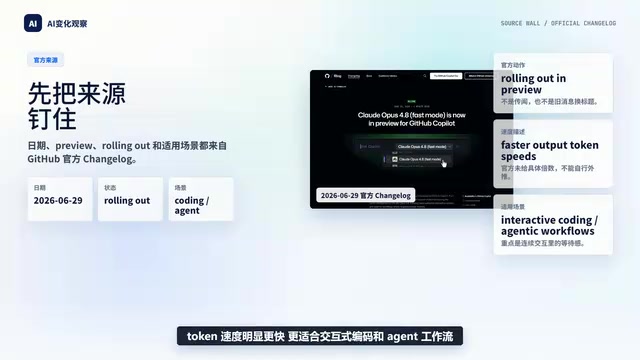
GitHub Copilot Integrates Claude Opus 4.8 Fast Mode: AI Coding Tools Are Now Competing on Response Speed
GitHub Copilot adds Claude Opus 4.8 Fast Mode to preview. Learn how it boosts Token speed for interactive coding and agent workflows, plus pricing and enterprise management details.
Read more →

·7 min
AI Agent Development: A Four-Stage Competency Model from 15K to 40K RMB Salary Growth Path
A detailed four-stage competency model for AI Agent development: from Python/RAG basics (15K) to workflow orchestration (20K), inference optimization (30K), and Agent cluster governance (40K RMB).
Read more →