#Tracea
664 related articles

·2 min
AgentConnect: A Deep Dive into the Open-Source Framework for Cross-Platform AI Agent Collaboration
AgentConnect is an open-source AI agent collaboration platform supporting cross-platform integration with Slack, GitHub, and Discord, featuring granular role permissions and multi-agent coordination.
Read more →
·3 min
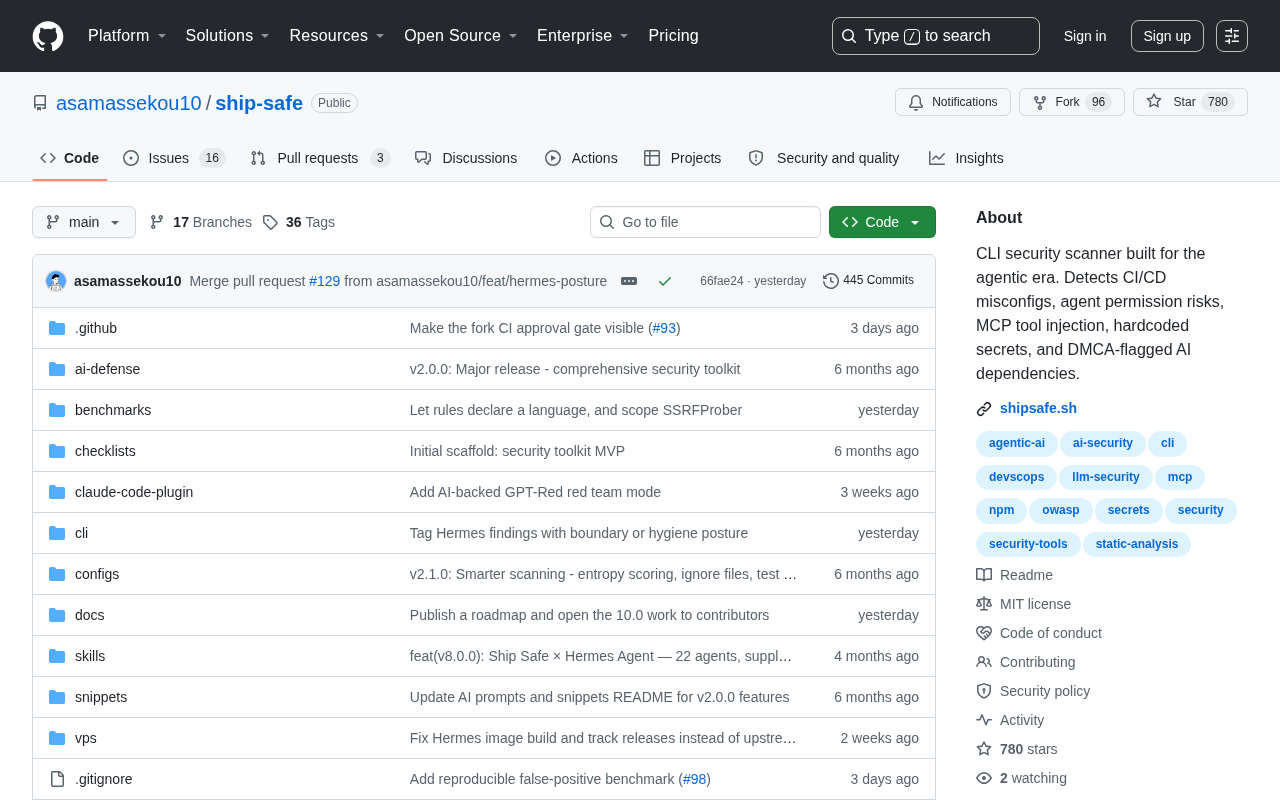
Ship Safe: A Deep Dive into the Open-Source Security Scanner for AI Coding Agents
Deep dive into how Ship Safe provides security scanning for AI coding agents, exploring agent security challenges, closed-loop feedback, and enterprise guardrails.
Read more →

·3 min
The Scaling Dilemma of Vertical AI Engine MLOps: Engineering Practices from Prototype to Scale
Exploring MLOps scaling challenges for vertical AI engines moving from prototype to production, covering model iteration pipelines, data drift detection, and inference cost optimization.
Read more →

·3 min
Safety Architecture for Medical AI: A Hybrid Design Combining Rule Engines and Machine Learning
Exploring hybrid architecture design combining rule engines and machine learning in medical AI, analyzing how deterministic rules, CSP, and scoring mechanisms ensure safety in exercise prescription systems.
Read more →

·3 min
Real-World Reliability Test of AI Model GitHub Connectors: Kimi vs Perplexity — Which One Can You Actually Trust?
Real-world comparison of Kimi and Perplexity GitHub Connector reliability. Kimi offers automatic graceful degradation; Perplexity suffers from silent failures. Analysis of tool-call transparency and fault tolerance in AI code review workflows.
Read more →

·3 min
From Notebook to Production: A Full-Stack MLOps Practice Guide for No-Show Prediction Systems
A detailed guide on building a patient no-show prediction system from model selection to production, covering LightGBM recall optimization, FastAPI deployment, MLflow tracking, SHAP explainability, and CI/CD automation.
Read more →

·3 min
ChinaTextbook Open-Source Textbook Repository: Deep Dive into the GitHub Project with 70K+ Stars
ChinaTextbook has earned 76K+ GitHub stars by aggregating Chinese PDF textbooks. This deep dive analyzes why it went viral, the educational equity demand behind it, copyright risks, and future directions.
Read more →

·1 min
Hexis: Managing AI Agent Skills and Knowledge Bases with Git
Hexis is an open-source AI agent management tool using Git for version control and access management of skills, tools, and context, with MCP protocol for cross-platform interoperability.
Read more →

·2 min
AstraPixels: A Pixel-Art Real-Time Solar System Map Powered by Actual Orbital Data
AstraPixels is a pixel-art real-time solar system web app that calculates 171 celestial body positions from actual orbital data, with continuous zoom from inner planets to the Kuiper Belt and a six-month astronomical event preview.
Read more →

·3 min
AI Digital Creatures Spontaneously See Through Virtual Worlds: An Awakening Experiment in Reinforcement Learning
Researchers placed AI digital creatures in worlds with tampered physics rules. When fake environments affected foraging goals, creatures spontaneously evolved detection ability, jumping from 50% to 73% accuracy—revealing how cognition emerges from need.
Read more →

·3 min
GPT-6 Release Delayed: What It Means When Cybersecurity Capabilities Reach a Critical Threshold
Community reports suggest OpenAI delayed GPT-6 due to cybersecurity capabilities reaching a critical threshold. We analyze what this means for AI safety governance and industry regulation.
Read more →

·3 min
Carbon Offset Scam Exposed: Why Carbon Credits Fail to Deliver on Emission Reduction Promises
Deep analysis of carbon offset flaws: from forest carbon accounting traps to additionality verification challenges, revealing how carbon credits enable greenwashing and whether technology can rebuild market trust.
Read more →

·3 min
Reference: A Local Semantic Search Engine Built for AI Agents
Reference is a local semantic search tool for AI Agents that uses tree-sitter code-aware chunking, real-time indexing, and MCP Server integration to eliminate inefficient grep loops in AI coding assistants—all data stays on your machine.
Read more →

·2 min
AI Company Uses Social Engineering to Attack Open Source Maintainers and Inject Malicious Code: A Supply Chain Security Wake-Up Call
Analysis of how Mythos used social engineering to attack open source maintainers to inject malicious code, exploring supply chain security trust crisis and defense strategies in the AI era.
Read more →

·6 min
Stimma: An Open-Source Creative Workbench Built on Top of ComfyUI, Solving Media Management and Multi-GPU Scheduling
A veteran user spent a year building Stimma, an open-source desktop app on top of ComfyUI that solves media asset management, multi-GPU load balancing, and agent-driven creation with local-first design.
Read more →

·3 min
GPT-5.6 Released: A Deep Dive into the Sol and Luna Dual-Model System
OpenAI launches GPT-5.6 dual-model system: Sol delivers instant response and deep reasoning for paid users, while Luna offers unlimited text chat for free users. A detailed breakdown of capabilities, tiering strategy, and real-world impact.
Read more →

·2 min
Grok 4.6 Potentially Launching Tomorrow? Decoding xAI's Rapid Iteration Strategy
Community rumors suggest Grok 4.6 may launch soon. This article analyzes xAI's rapid iteration strategy, the competitive logic behind minor updates, and implications for users.
Read more →

·2 min
The Community Governance Challenge of AI-Generated Content: From Copyright Dilemmas to Enforcement Strategies
Exploring how developer communities tackle AI-generated content governance, covering vibe-coding copyright issues, AI detection challenges, and viable policy directions.
Read more →

·3 min
OpenAI Prepaid Credits Vanish Without Records: An Analysis of API Billing Transparency Issues
A developer found OpenAI prepaid credits marked consumed with no usage records available. We analyze API billing transparency issues and offer practical self-protection tips.
Read more →

·3 min
Open-Source Agentic CRM: The New AI-First Paradigm for Customer Relationship Management
Deep analysis of open-source Agentic-first CRM design philosophy and architecture. How AI agents reshape CRM, compared to Salesforce, with open-source advantages in data sovereignty and cost control.
Read more →