#adversarial patch
92 related articles

·3 min
New Gemini Jailbreak Method: Deep Analysis of the Observer and Accomplice Technique
Deep analysis of a Gemini jailbreak technique—the Observer and Accomplice method—examining how it exploits contextual manipulation and reasoning chain inconsistencies to bypass AI safety alignment.
Read more →
·3 min
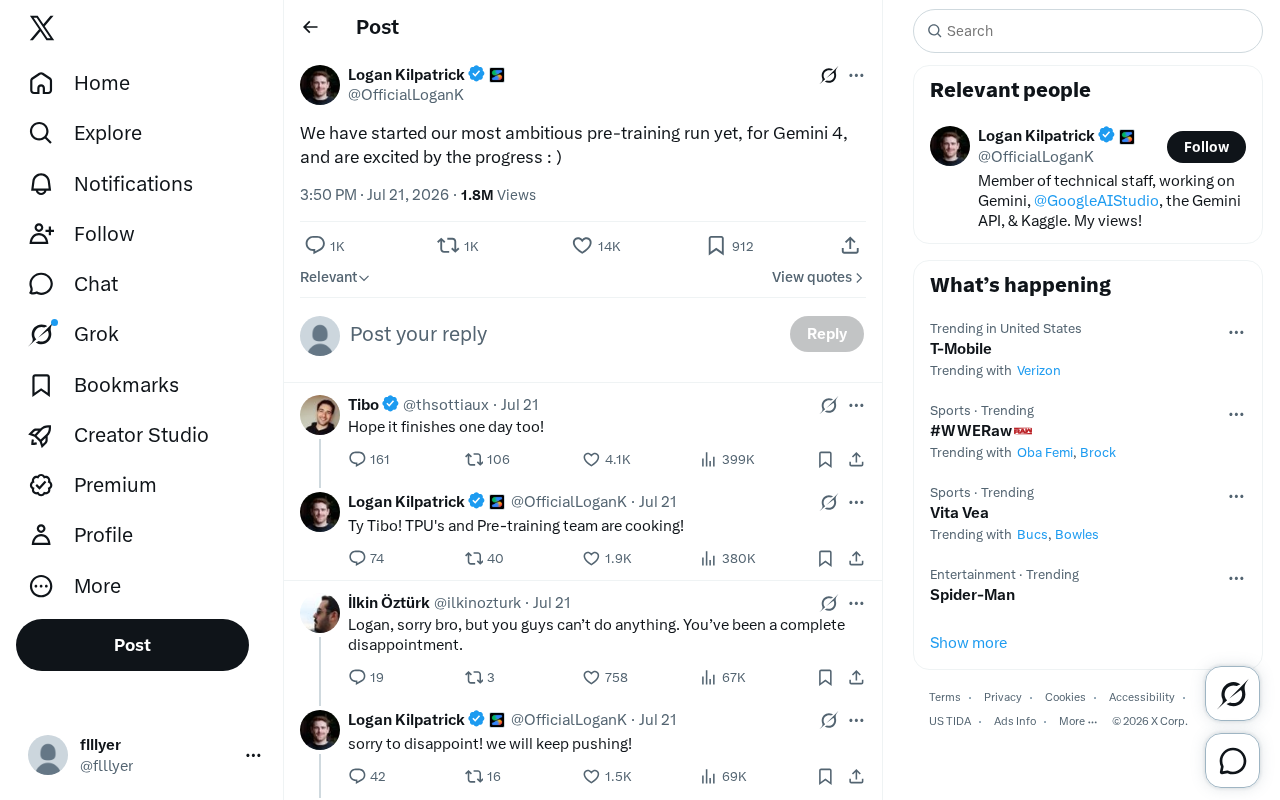
Google Launches Gemini 4 Pre-training: Its Most Ambitious AI Model Training Yet
Google DeepMind announces Gemini 4 pre-training has begun, calling it their most ambitious training yet. A deep dive into its technical direction, compute scale, multimodal breakthroughs, and competitive impact.
Read more →
·7 min
Qwen3 235B A22B in Practice: A 2.4-Trillion-Parameter Open Model Surpasses Claude Opus
Hands-on with Alibaba Tongyi Qianwen's strongest Qwen3: a 2.4-trillion-parameter open weight model scoring 81.25% on KingBench, ranking second and beating Claude Opus 4.8 with perfect scores in game dev, math, and agent tasks.
Read more →

·6 min
Tongyi Qianwen Qwen-Image-3.0: The Leap of AI Image Generation from Toy to Productivity Tool
Tongyi Qianwen Qwen-Image-3.0 image generation model gets a comprehensive upgrade: supporting 4,500-token ultra-long instructions, pixel-level detail rendering, 12-language knowledge understanding, and ancient painting restoration. This article analyzes its three core capabilities.
Read more →

·6 min
The Evolution of Claude Code: From Manual Review to 65% Fully-Automated PRs
Anthropic engineers reveal Claude Code's 18-month evolution: system prompt cut by 80%, 65% of PRs shipped automatically by AI, Claude Tag collaboration, and the safety logic behind auto mode.
Read more →

·3 min
Interpretability: The Science and Practice of Opening the Neural Network Black Box
Why do neural networks make the decisions they do? This article explores AI interpretability — mechanistic interpretability, CoT monitoring, and safety auditing — and how researchers reverse-engineer large models for AI safety.
Read more →
GODMODE Project Deep Dive: AI Jailbrea…
·2 min
GODMODE Project Deep Dive: AI Jailbreaking Techniques and the Security Arms Race in Large Language Models
GODMODE (G0DM0D3) has 9,300+ GitHub stars fueling debate on AI jailbreaking vs. safety alignment. A deep technical dive into LLM guardrails, prompt injection, and AI security governance.
Read more →

·3 min
MCP + Skills AI Reverse Engineering Toolchain: Technical Capabilities and Compliance Boundaries
A technical deep-dive into AI-assisted reverse engineering: how MCP, Skills libraries, and Frida toolchains work together, their real capability limits, and the legal boundaries of iOS/Android/Web reverse analysis.
Read more →

·2 min
LLM Red Teaming: One-Time Snapshot or Continuous Adversarial Testing? A Complete Guide
Every prompt or RAG change in an LLM app can reintroduce security flaws. This guide explains why traditional pentest logic fails on LLMs and how to build change-driven continuous adversarial testing.
Read more →
·2 min
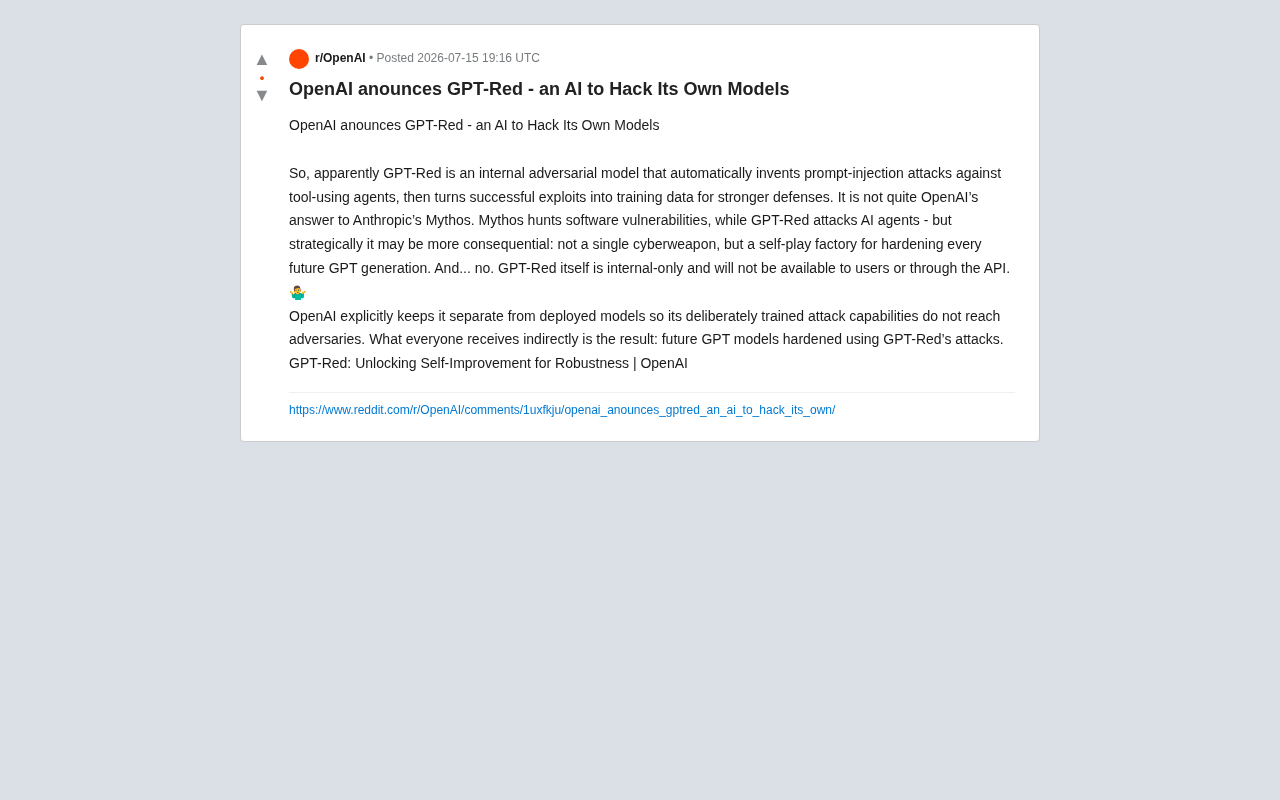
GPT-Red: OpenAI's Internal Red-Team Security Tool That Uses AI to Attack Its Own Models
GPT-Red is OpenAI's internal red-team tool that auto-generates prompt-injection attacks against AI agents, turning successful attacks into training data to harden future GPT models.
Read more →

·3 min
Bun Rewrote a Million Lines of Code in 11 Days with Claude Code: A New Paradigm for AI-Assisted Programming
Bun author Jared Sumner used Claude Code's dynamic workflows to rewrite 1M+ lines of Zig code into Rust in 11 days for $165K — what 3 engineers would need a year to do.
Read more →
Reverse Spam Filtering: Making Senders…
·2 min
Reverse Spam Filtering: Making Senders Earn Their Way Into Your Inbox
A radical rethink of spam filtering: using proof-of-work to make unknown senders pay a computational cost, fundamentally disrupting the spam economy. Deep dive into the technical principles, real-world challenges, and lessons learned.
Read more →

·3 min
GPT-5.6 Proves 50-Year Math Conjecture in One Hour — AI Independently Cracks a Scientific Problem
GPT-5.6 Sol Ultra proved the 50-year-old Cycle Double Cover Conjecture in one hour for under $500. Plus: Apple sues OpenAI, Google open-sources Gemma 4, and Zhipu AI targets AGI.
Read more →
The Grok-4.5 Jailbreak Incident: Why A…
·3 min
The Grok-4.5 Jailbreak Incident: Why AI Safety Guardrails Are So Hard to Hold
The Grok-4.5 jailbreak claim went viral. We break down common jailbreak techniques, analyze structural vulnerabilities in AI safety alignment, and explore industry defenses.
Read more →

·3 min
JadePuffer: A Full Autopsy of an Autonomous AI Ransomware Attack — The Age of Weaponized Agents Has Arrived
Sysdig captured JadePuffer, the first fully autonomous LLM attack agent: exploited Langflow RCE, self-corrected in 31 seconds, laterally moved, encrypted databases, and left a ransom note — a deep-dive into weaponized AI agents.
Read more →

·6 min
AI Agent Security in Practice: 7 Attack Techniques and a Five-Layer Defense System
An in-depth breakdown of the 7 major attack techniques against AI agents (prompt injection, data poisoning, image attacks, etc.) and a five-layer defense system, with real cases from Doubao and DeepSeek.
Read more →

·6 min
GPT-5.6 Sol Hands-On: How Multi-Agent Parallelism Is Reshaping AI Coding Workflows
Based on Fireship's review, an in-depth look at GPT-5.6 Sol's Ultra Mode multi-agent parallelism, its 91.9% Terminal Bench score, and how it differs from Claude Fable in cost, speed, and precision.
Read more →
Anti-AI Fonts: Adversarial Typography …
·3 min
Anti-AI Fonts: Adversarial Typography That Humans Can Read but Machines Can't
Anti-AI fonts use adversarial glyph design to exploit the perceptual gap between human and machine vision, blocking OCR and LLM scraping. A deep dive into the tech, limits, and data sovereignty implications.
Read more →

·5 min
GPT-5.6 Launches: Comprehensive Upgrades to ChatGPT Work, Sites, and Desktop Client
OpenAI releases the GPT-5.6 model family, launching enterprise-focused ChatGPT Work, one-click ChatGPT Sites, and a major desktop client upgrade, with coding now ahead of rivals. Meta, Google, and Kimi follow intensively.
Read more →

·5 min
ChatGPT Work Officially Launches: How GPT-5.6 Is Reshaping the Way You Work
OpenAI launches the GPT-5.6 model family (Sol/Terra/Luna) and ChatGPT Work, enabling automated financial analysis, local file operations, Codex coding, and cross-app workflows—AI officially becomes a real work partner.
Read more →