#camera calibration
22 related articles
·3 min
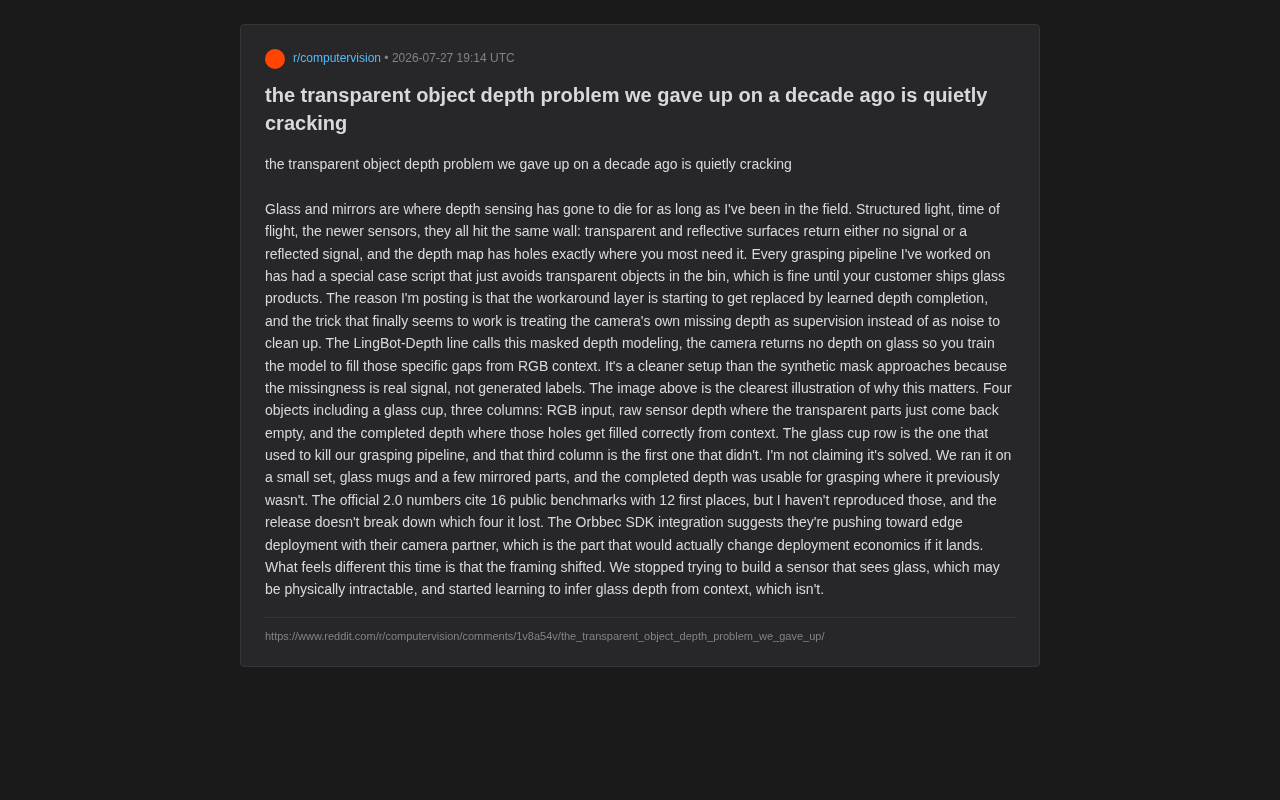
The Depth Perception Challenge for Transparent Objects: How LingBot-Depth Breaks Through with Masked Depth Modeling
Transparent and reflective object depth perception is a core challenge in robotic grasping. LingBot-Depth uses masked depth modeling to turn sensor failure into supervision, inferring glass depth from RGB context.
Read more →

·3 min
Can MVTec Merlic Handle Robot Pick-and-Place Tasks? A Comparative Selection Analysis
Analysis of MVTec Merlic's capabilities for robot pick-and-place tasks, comparing it with Halcon for hand-eye calibration and 3D pose estimation, with practical selection guidance.
Read more →

·7 min
DIY Companion Robot: Building Your AI Desktop Buddy with Jetson Orin
A maker builds a DIY companion robot with NVIDIA Jetson Orin and 4S LiPo battery. Explore the full development journey from first power-up to AI interaction, including edge computing, power design, and companion robot trends.
Read more →
·6 min
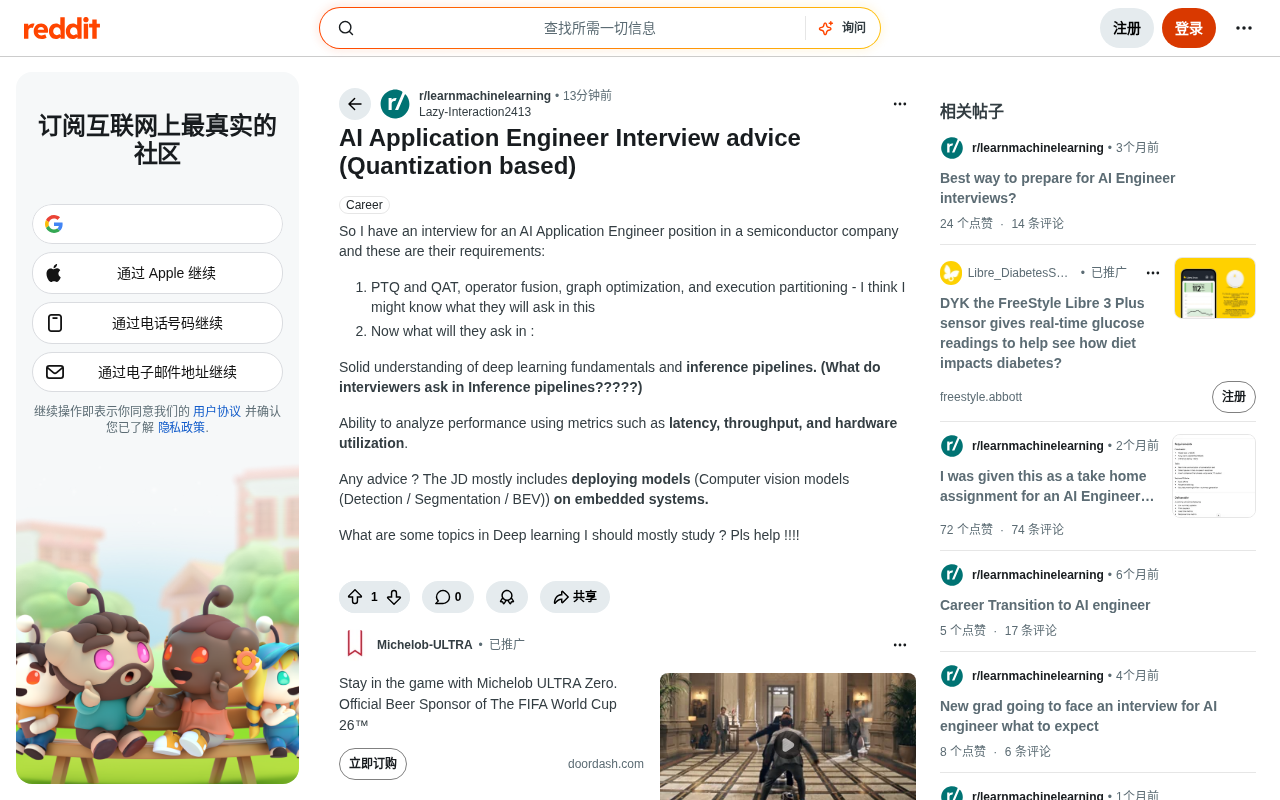
AI Application Engineer Interview Guide: Core Topics in Model Quantization and Inference Deployment
A systematic review of must-know topics for AI Application Engineer interviews: PTQ/QAT quantization, operator fusion, inference pipelines, latency/throughput analysis, and edge deployment of detection/segmentation/BEV models.
Read more →
·6 min
AI Application Engineer Interview Guide: Core Topics on Model Quantization and Inference Deployment
A systematic guide to must-know AI application engineer interview topics: PTQ/QAT quantization, operator fusion, inference pipelines, latency/throughput analysis, and edge deployment of detection/segmentation/BEV models.
Read more →
·3 min
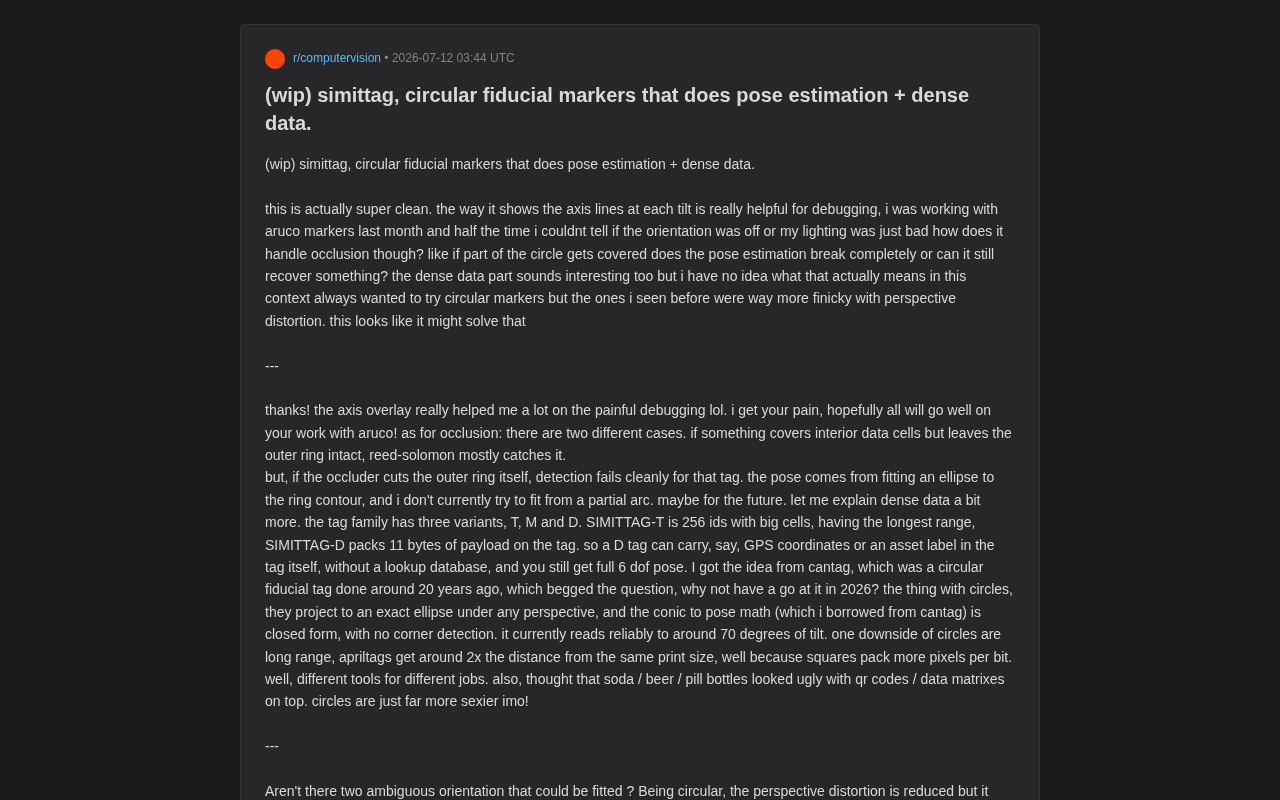
SIMITTAG Circular Fiducial Markers: Reimagining Pose Estimation with Ellipse Mathematics
SIMITTAG is a circular fiducial marker project for pose estimation that uses closed-form ellipse math instead of corner detection, supports 11-byte payloads with Reed-Solomon error correction, and compares favorably to ArUco and AprilTag in specific use cases.
Read more →

·7 min
AI Daily: T-Head Open-Sources SAIL Software Stack at WAIC, Flurry of Large Model Releases
T-Head open-sources AI software stack T-Head SAIL at WAIC to lower the barrier for domestic chip development; Kimi K3 tops the WebDev leaderboard; Qwen 3.8 Max Preview cuts prices aggressively; Moonshot prepares a Hong Kong IPO; and Oracle switches its data center to a fuel cell microgrid.
Read more →

·3 min
Running a 27B Model on iPhone: How 1-bit Quantization Achieves Extreme Compression
PrismML's Bonsai compresses a 27B model from 54GB to 3.9GB, running at ~11 tokens/sec on iPhone. A deep dive into QAT, knowledge distillation, and speculative decoding.
Read more →
NVIDIA DeepStream 9.1 Multi-Camera 3D …
·2 min
NVIDIA DeepStream 9.1 Multi-Camera 3D Tracking: Principles, Architecture, and Applications
A deep dive into NVIDIA DeepStream 9.1 multi-camera 3D tracking: cross-camera Re-ID, 3D coordinate fusion, GPU-accelerated pipelines, and real-world deployments in retail, warehousing, and security.
Read more →

·2 min
LeRobot 3D: Building 3D Spatial Perception and Manipulation for the SO101 Robot
LeRobot 3D is an open-source project adding 3D spatial perception to the SO101 robot, featuring multi-camera point cloud fusion, forward kinematics, ICP calibration, and browser-based visualization.
Read more →

·2 min
One Sentence, One Game: A Teochew Creator Used AI to Build a Beef Ball Hammering Game — and It's Both Stunning and Unsettling
A Teochew creator used one sentence to prompt Codex into generating a fully playable beef ball hammering game. Here's how it works — and what it means for professional skills in the AI era.
Read more →

·6 min
Multimodal and Embodied Intelligence: A Comprehensive Look at Progress, Pitfalls, and Opportunities
At the Microsoft Research India summit, top experts explore the real progress of multimodal AI and embodied intelligence: fusing classical robotics with large models, healthcare AI deployment challenges, perceptual bottlenecks in reasoning, and possibilities beyond scaling.
Read more →

·2 min
Mistral's First Embodied Navigation Model: Single Camera Outperforms LiDAR Solutions
Mistral launches its first embodied navigation model: 8B parameters, single RGB camera, 76.6% success rate in unseen environments — beating LiDAR-based multi-sensor systems.
Read more →

·2 min
Pheno4D: A Deep Dive into the Sub-Millimeter 4D Plant Point Cloud Dataset
Pheno4D is a 4D plant point cloud dataset built with laser scanning, covering 20 days of daily scans across 14 maize and tomato plants at 0.012mm precision with per-leaf instance tracking.
Read more →

·2 min
Road Damage Measurement Using Only a GoPro: A Low-Cost Inspection Solution with Monocular Cameras + AI
How can a single GoPro replace expensive LiDAR for road damage detection? This article analyzes core technologies like monocular depth estimation and ground plane fitting, exploring the feasibility and accuracy limits of georeferenced road surveying with consumer cameras.
Read more →

·3 min
Antigravity A1 Review: How a Flying 360 Camera Is Redefining the Drone Experience
Antigravity A1 packs Insta360 X5 optics into a 249g drone with 24-min battery and FPV goggles. Fly first, frame later — a fresh approach to aerial content creation.
Read more →

·2 min
Beyond Voice Commands: The Future Evolution of Multimodal Human-Robot Interaction
Voice isn't the only answer for human-robot interaction. Explore how gesture recognition, eye tracking, and environmental sensing are transforming robots from command-followers to intent-understanding partners.
Read more →

·2 min
Snapmaker U1 Review: An In-Depth Look at the Independent 4-Nozzle Color Multi-Material 3D Printer
Snapmaker U1 features independent 4-nozzle design, color multi-material printing, and AI monitoring. With subsidies, price drops to ¥4,572. Full review inside.
Read more →

·2 min
AI Marketing Backlash: Why Obsessing Over 'AI-First' Is Starting to Backfire
Why "AI-First" branding is backfiring: how over-marketing AI erodes brand trust, triggers consumer fatigue, and what brands should do instead to rebuild credibility.
Read more →

·6 min
White House Pressures World Cup Red Card: The Battle Over Sports Independence vs. Political Interference
The White House tried to overturn a World Cup red card, sparking global debate. This article analyzes sports governance independence, VAR technology limits, and the risks of political interference in sports officiating.
Read more →