#clean code
1351 related articles
 Tech Frontiers
·3 min
Redis Gets a New Array Data Type: 18 Commands + Server-Side Regex Matching + WASM Online Playground
Redis creator antirez introduces a new Array data type with 18 commands and ARGREP server-side regex matching. Simon Willison built a browser WASM Playground with Claude Code for instant online testing.
Read more →
 Product Reviews
·4 min
Chatbox Open-Source AI Client: A Comprehensive Review of the 40K-Star Multi-Model Desktop Tool
In-depth review of Chatbox, an open-source AI client supporting GPT-4, Claude, and Gemini. Covers core features, technical architecture, and use cases for this 40K-Star desktop AI tool.
Read more →
 Product Reviews
·3 min
Hugging Face Transformers: A Deep Dive into the AI Open-Source Framework Behind 160K Stars
Deep dive into Hugging Face Transformers: core features, Pipeline API usage, ecosystem synergy, large model support, and future challenges of this 160K-star AI framework.
Read more →
 Product Reviews
·5 min
LibreChat: An Open-Source Chat Platform That Connects All AI Models Through One Interface
Deep dive into LibreChat, an open-source platform supporting GPT-5, Claude, Gemini, DeepSeek with unified access, built-in Agents, MCP protocol, code interpreter, and Docker deployment for self-hosted ChatGPT alternative.
Read more →
 Tutorials
·3 min
Simon Willison Uses His Phone and Claude Code to Add Wildlife Sightings to His Blog
Developer Simon Willison used Claude Code for Web on his phone to build a wildlife sightings feature for his blog, syncing iNaturalist data with deep integration into search, RSS, and archives.
Read more →
 Product Reviews
·2 min
Amazon Bedrock macOS Client: Access Claude and Other AI Models Directly from Your Desktop
AWS's official open-source native macOS client for Amazon Bedrock supports Claude Sonnet 4.5, Claude Opus 4 and more. Built in Swift with global hotkey and AWS IAM integration for developers.
Read more →
 Product Reviews
·3 min
awesome-LLM-resources: A Large Language Model Learning Resource Repository with 8000+ Stars
awesome-LLM-resources is a GitHub repo with 8200+ Stars covering multimodal generation, AI Agents, model training/inference, MCP protocol, and more for LLM learners.
Read more →
 Deep Dives
·2 min
OpenAI Symphony Deep Dive: When AI Starts Pulling Tasks from Your Ticket System, Is Your Team Ready?
Deep dive into OpenAI Symphony: how AI agents autonomously pull tickets from Linear, write code, and submit PRs — plus four critical checks before your team adopts it.
Read more →
 Tech Frontiers
·2 min
OpenAI Codex Upgrades to Computer Agent: Taking Over Your Mac to Work Autonomously, From Writing Code to Doing Your Job
OpenAI Codex upgrades to a computer agent that autonomously operates Mac apps like Photoshop and Audition, integrates with Slack, Google Workspace, and Microsoft 365, evolving from a code tool to an all-purpose AI assistant.
Read more →
 Deep Dives
·2 min
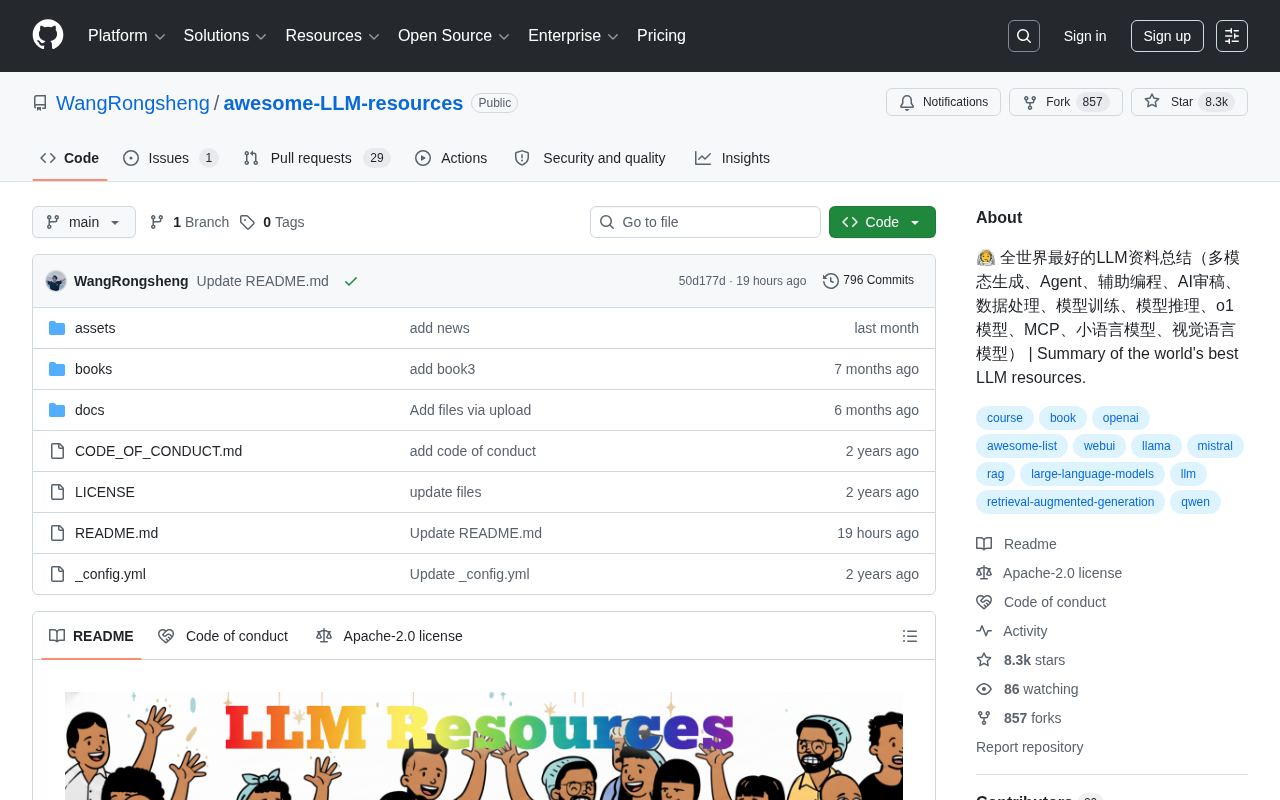
awesome-LLM-resources: A Comprehensive LLM Collection with 8000+ Stars, Covering Multimodal, Agent, MCP, and 11 Major Domains
Deep dive into awesome-LLM-resources, a GitHub repo with 8200+ Stars covering multimodal generation, AI Agents, MCP, o1 models, small language models, and more.
Read more →
 Deep Dives
·4 min
The GPT-5.5 'Goblin' Incident Deep Dive: From Hilarious Bug to the Ultimate AI Alignment Challenge
OpenAI's GPT-5.5 model collectively outputs 'goblin' vocabulary. Official technical blog reveals the root cause: reward signal generalization in reinforcement learning.
Read more →