#combinatorial explosion
47 related articles

·3 min
Why Was the Bicycle Invented So Late? The Deep Reasons Behind Technological Lag
The bicycle is structurally simple, so why wasn't it invented until the 19th century? This article explores the deep reasons behind technological lag, from materials science to cognitive biases.
Read more →

·3 min
LangChain Managed DeepAgents: Hosted Agent Infrastructure So You Can Focus on Core Logic
LangChain launches Managed DeepAgents public beta, hosting evals, memory, OAuth, Slack integration, and sandbox infrastructure so developers can focus on Agent core logic.
Read more →

·2 min
Can OpenAI's Most Powerful Agent Independently Run a Business? Real-World Testing Reveals the Answer
OpenAI's top AI Agent was stress-tested in real business scenarios to see if it could independently run a company. The experiment reveals agent capabilities and limitations in decision-making, memory, and strategic planning.
Read more →

·3 min
Getting Started with MARL (Multi-Agent Reinforcement Learning): A Complete Path from Theory to Code
A systematic guide to learning MARL from theory to code, covering CleanRL, PettingZoo, PyMARL tools, IQL/VDN/QMIX/MADDPG algorithm progression, and practical tips for bridging theory and implementation.
Read more →

·5 min
Have AI Doomers Actually Used AI? A Developer Exposes the Gap Between Hype and Reality
AI Doomers warn AI will destroy humanity, but have they actually built AI apps? A developer's sharp critique reveals the vast gap between AI demos and real engineering practice.
Read more →

·3 min
How to Test a 25-Minute AI Voice Call? A Practical Guide to Long Conversation QA
Deep dive into QA challenges for long AI voice calls: why short script testing fails, how to evaluate context tracking, state management, and task correctness with actionable testing methodologies.
Read more →

·3 min
Gemini Robotics 2 Deep Dive: Three Core Breakthroughs in Google's Universal Robot AI
Deep dive into Google's Gemini Robotics 2 and its three core capabilities: full body intelligence, advanced dexterity, and multi-robot teamwork—achieving universal robot AI with one brain for any robot.
Read more →

·4 min
Cracking TSP: A Closure Theory for Identifying Critical "Exception Edges"
Exploring a mathematically precise definition of "exception edges" in TSP, using closure problem theory to identify critical non-local edges that determine optimal solutions, providing verifiable structural priors for RL and NCO solvers.
Read more →

·2 min
AI-Driven Persistent RPG Engine: A Full-Stack Practice Guide with React + Supabase
Deep dive into an AI persistent RPG game engine built with React SPA and Supabase, exploring how LLMs combine with modern web stacks for cross-session memory, dynamic narrative, and game state management.
Read more →

·4 min
WebMCP in Practice: How MakeMyTrip Is Reshaping the Travel Booking Experience
India's largest OTA platform MakeMyTrip uses WebMCP to standardize AI Agent interactions with web apps, replacing fragile DOM scraping with natural language-driven test automation and simplified complex booking scenarios.
Read more →

·4 min
WebMCP in Practice: How MakeMyTrip Is Reshaping the Travel Booking Experience
India's largest OTA platform MakeMyTrip uses WebMCP to standardize AI Agent interaction with web apps, solving DOM scraping fragility, enabling natural language test automation, and simplifying complex international flight bookings.
Read more →
·3 min
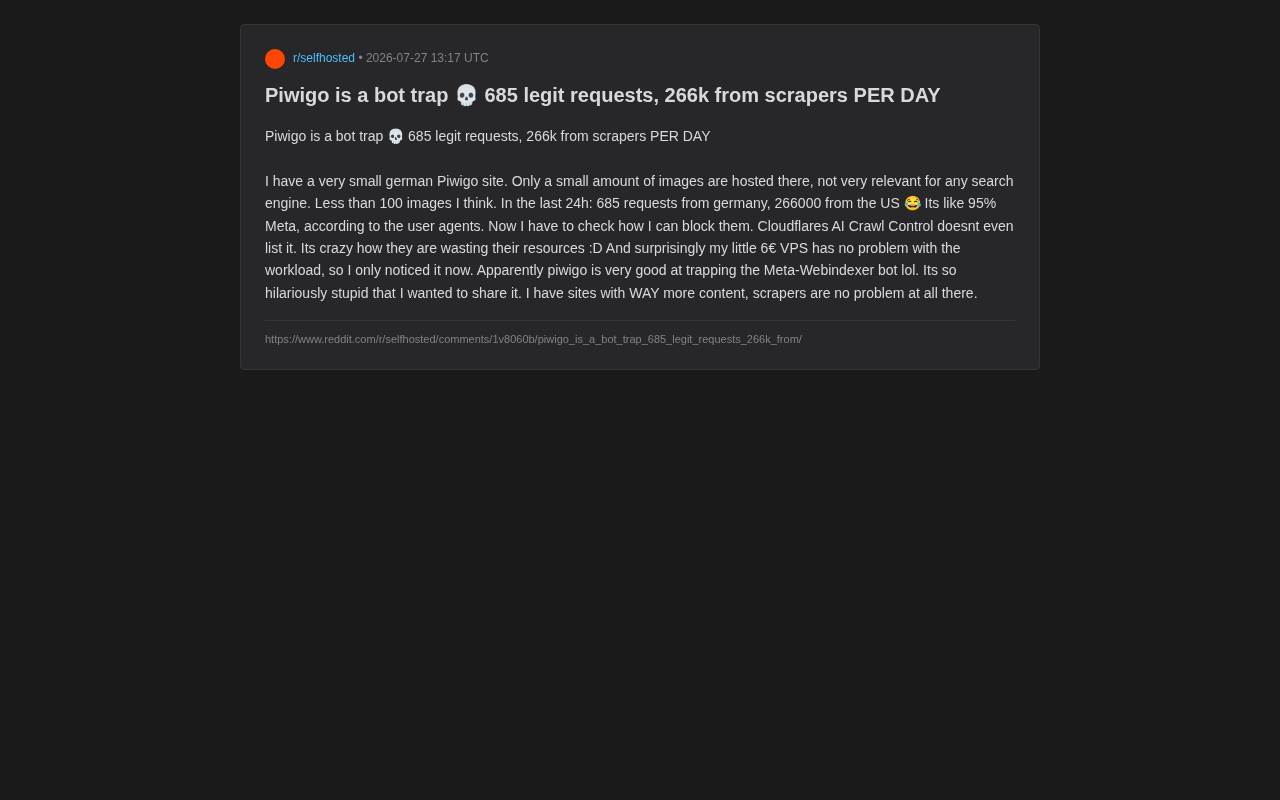
Small Site Besieged by AI Crawlers: Under 100 Images, 266K Crawl Requests
A Piwigo gallery with under 100 images received 266K AI crawler requests in 24 hours. Analysis of why gallery CMS becomes a bot trap and how to defend against it.
Read more →
Terence Tao on AI and Mathematics: For…
·4 min
Terence Tao on AI and Mathematics: Formal Proofs, Human-AI Collaboration, and the Road Ahead
Fields Medalist Terence Tao analyzes AI's impact on math research, discussing LLM-assisted proofs, Lean formal verification, large-scale collaboration, and the future of math education in the AI era.
Read more →

·5 min
From Chat to Agent: Automating Your Entire Business Workflow with AI Agents
Veteran AI practitioner Remy breaks down the leap from chat models to AI agents: how agents work, the three pillars of context, tools, and skills, MCP connections, and hands-on architecture to make you a 100x employee.
Read more →

·2 min
Wildcards in Action: A Guide to Batch Exploration and Diversity in AI Image Generation
Wildcards are one of AI image generation's most underrated features. Learn how the randomization mechanism works, how to use ChatGPT to bulk-generate vocabulary lists, and how to build reproducible, systematic creative workflows.
Read more →

·2 min
SVM Training Taking 10 Minutes? A Deep Dive into Grid Search Performance Pitfalls for Beginners
SVM training taking 10 minutes on 8,000 samples? This post dissects GridSearchCV combinatorial explosion, probability=True overhead, and redundant params — with actionable fixes.
Read more →

·3 min
Open-Source LLM Surge: K3 and V4 Drop Together as the Marginal Cost of Intelligence Approaches Zero
Kimi K3, DeepSeek V4, Liquid, and Mistral are all dropping at once. MXFP4 quantization and MoE architecture are pushing the marginal cost of intelligence toward zero. Here's what it means.
Read more →

·2 min
Symbolic AI and Neural Networks: A Systematic Learning Path and Core Mathematical Tools
A deep dive into symbolic vs. neural AI paradigms — exploring type theory, category theory, and algebraic geometry as mathematical bridges toward neuro-symbolic integration.
Read more →

·2 min
MCP vs. Skills: A Clear Breakdown of AI Agent Architecture Layers
MCP and Skills aren't alternatives — they occupy different layers of AI Agent architecture. This article breaks down Function Call, MCP, and Skills to clarify each layer's role.
Read more →

·2 min
GPT-5.6 in Practice: How AI Becomes a Deep Co-Creator in Game Design
An indie dev's deep dive with GPT-5.6 (Sol) reveals AI that goes beyond coding — spotting gameplay loop flaws, predicting unit balance, and challenging rival model solutions.
Read more →