#directed acyclic graph
269 related articles
 Research
·3 min
MEMOIR: Solving AI Agent Memory Management with Git Version Control
MEMOIR is an open-source tool bringing Git version control to AI Agent memory management, with branching, rollback, semantic paths, and visualization to solve context pollution and memory drift.
Read more →
 Tutorials
·4 min
AI-Powered Research in Practice: From LLM Selection to Building Automated Workflows with N8N
A deep dive into AI-driven research methodology: LLM selection, Python automation, Zotero reference management, Overleaf writing, local LLM deployment, and N8N workflow automation.
Read more →
 Deep Dives
·4 min
From Copilot to Agentic AI: A Complete Guide to Multi-Agent Collaboration Architectures
Deep dive into AI's four-stage evolution from Chat to Agentic AI, covering multi-Agent architectures, ReAct framework, and MCP protocol for developers.
Read more →
 Tutorials
·4 min
A Practical Guide for Java Developers Transitioning to AI Agent Development: Technology Selection, Architecture Design & Resume Positioning
A systematic guide for Java developers entering AI Agent development, covering core concepts, Workflow vs. Agent architecture comparison, Spring AI Alibaba selection, and resume positioning strategies.
Read more →
 Deep Dives
·4 min
From AIGC to AI Agent: Core Strategies and Practical Guide for Multi-Agent Development in 2025
Deep analysis of AIGC vs AI Agent differences, covering multi-agent system architecture, task orchestration, hallucination control, with developer skill roadmap and career outlook.
Read more →
 Deep Dives
·4 min
The Complete Guide to Agentic RAG: Principles and Code Implementation
Deep dive into Agentic RAG vs traditional RAG, covering tool calling, multi-step iteration, query rewriting, with LangChain and LangGraph code examples for building intelligent retrieval systems.
Read more →
 Product Reviews
·3 min
Cube Studio: A Comprehensive Analysis of Tencent's Open-Source Cloud-Native AI Platform
Deep dive into Tencent Music's open-source Cube Studio cloud-native AI platform, covering distributed training, LLM fine-tuning & inference, Pipeline orchestration, and domestic hardware adaptation.
Read more →
 Tech Frontiers
·2 min
LLM 0.32 Refactoring Deep Dive: Message Sequence Input and Streaming Multi-Type Response Design
Deep dive into LLM 0.32 alpha's two core refactorings: message sequence API aligned with OpenAI format, stream_events for typed streaming responses, serialization design, and backward compatibility.
Read more →
 Deep Dives
·3 min
LangGraph Deep Dive: An Open-Source Framework for Building Resilient AI Agents
Deep dive into LangGraph's core architecture, StateGraph design, multi-Agent collaboration, and deployment. Learn how this 31K+ Star project helps build reliable AI Agents.
Read more →
 Tutorials
·2 min
OpenClaw Orange Book: An In-Depth Guide to the Open-Source AI Agent Framework
In-depth look at the OpenClaw Orange Book open-source project covering AI Agent framework components, tech ecosystem, and practical development methodology.
Read more →
 Tutorials
·3 min
LangGraph E-commerce AI Agent in Practice: From RAG Q&A to Automated Return Workflows
Deep dive into the E-commerce-Smart-Agent open-source framework built with LangGraph and FastAPI, covering RAG knowledge base Q&A, return workflow automation, and graph-based orchestration.
Read more →
 Deep Dives
·3 min
oh-my-kimi: Deep Dive into a Multi-Agent Orchestration Framework for Kimi Code CLI
Deep analysis of the oh-my-kimi open-source project, a multi-agent orchestration framework for Kimi Code CLI featuring Worktree Runtime, DAG planning, MCP hooks, Quality Gates, and Local Graph Memory.
Read more →
 Product Reviews
·2 min
Deep Dive into LobeHub: The 75K-Star Open Source Multi-Agent Collaboration Platform
Deep dive into LobeHub, a trending GitHub open-source project with 75,900+ Stars. Explore its multi-agent collaboration mechanisms, low-code team design, and competitive advantages over AutoGen and CrewAI.
Read more →
 Product Reviews
·2 min
LobeHub Open Source Project Deep Dive: How a Multi-Agent Collaboration Platform is Reshaping AI Workflows
Deep dive into LobeHub's open-source multi-agent collaboration platform, covering core features, technical architecture, and industry trends. Learn how this 75K+ Star GitHub project redefines human-AI collaboration through Agent team design and multi-agent coordination.
Read more →
 Product Reviews
·2 min
Cursor Coding Team: Practices and Prospects of Multi-Agent Collaborative Programming
Deep dive into cursor-coding-team: an open-source project orchestrating multiple AI agents via Cursor Cloud Agents API for parallel development, code review, and automated collaborative workflows.
Read more →
 Deep Dives
·2 min
Open Multi-Agent: A TypeScript Multi-Agent Orchestration Framework with Automatic Task DAG Generation
Deep dive into Open Multi-Agent, a TypeScript-native multi-agent orchestration framework with automatic task DAG generation, MCP integration, live tracing, and only three runtime dependencies. 6000+ GitHub Stars.
Read more →
 Tech Frontiers
·3 min
Strands Agents: An Open-Source SDK for Building AI Agents in Just a Few Lines of Python
Strands Agents is a trending GitHub project using model-driven design to let developers build AI Agents in just a few lines of Python. Learn its philosophy, use cases, and advantages over LangChain.
Read more →
 Product Reviews
·3 min
Artificial: A Go-Based Framework for Orchestrating Claude Code and Multiple AI Coding Assistants
Artificial is a Go open-source multi-agent orchestration framework that unifies Claude Code, OpenAI Codex, Cursor Agent, and local models for parallel AI coding workflows.
Read more →
 Product Reviews
·4 min
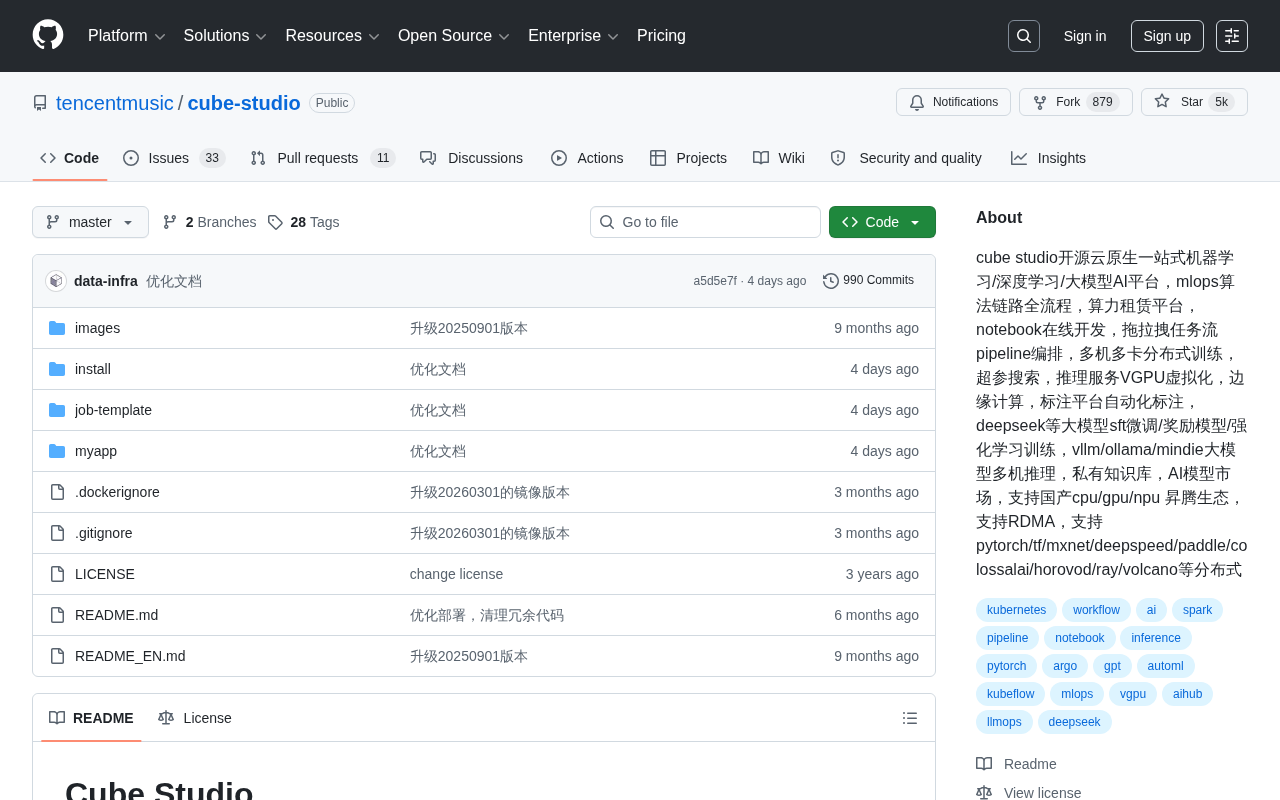
Cube Studio: Tencent's Open-Source All-in-One AI Platform Covering the Full Pipeline from Large Model Training to Inference
Deep dive into Tencent Music's open-source Cube Studio cloud-native AI platform, covering distributed training, LLM fine-tuning, vLLM inference, VGPU virtualization, and Huawei Ascend adaptation.
Read more →
 Product Reviews
·4 min
Deep Dive into Cube Studio: Tencent's Open-Source All-in-One AI Platform
Deep dive into Tencent's open-source AI platform Cube Studio, covering distributed training, large model fine-tuning and inference, Pipeline orchestration, VGPU virtualization, and Huawei Ascend support for enterprise cloud-native MLOps.
Read more →