#intelligence explosion
159 related articles

·5 min
Learn AI Agent Development from Scratch: A 3-Step Practical Path to Get Started Quickly
How to learn AI Agent development from scratch? This article outlines a clear 3-step path: Python crash course, LLM theory & practice, and LangChain framework project implementation.
Read more →

·4 min
Deep Dive into AI Short Drama "Nido de Villanas": How AIGC Mass-Produces Binge-Worthy Content
Using AI-generated Spanish short drama Nido de Villanas as a case study to analyze AIGC script generation, character consistency, multilingual dubbing, and the commercial logic of scaled AI drama production.
Read more →

·2 min
Will AI End Human History? The Deep Anxiety Behind Technological Optimism
A viral Reddit post asks: will AI end human history? This article analyzes the blind spots of tech accelerationism, the governance mismatch, and how to rationally navigate AI transformation.
Read more →

·5 min
The Five Stages of AI Agent Architecture Evolution: The Real Path from Model Calls to Production Runtime
Deep dive into the five evolution stages of AI Agent architecture: model calls, tool calls, workflows, Agent loops, and production runtime. Learn the responsibility boundaries and design principles.
Read more →

·3 min
DeepSeek Ignites Open Source vs. Closed Source Debate in Silicon Valley, Splitting Tech Giant Alliances
DeepSeek's open source model shakes Silicon Valley. OpenAI defends closed source while Microsoft, NVIDIA, and Meta back open ecosystems. Analysis of the AI open/closed source debate, Apple-Micron chip tensions, and AI-driven historical disinformation.
Read more →
Terence Tao on AI and Mathematics: For…
·4 min
Terence Tao on AI and Mathematics: Formal Proofs, Human-AI Collaboration, and the Road Ahead
Fields Medalist Terence Tao analyzes AI's impact on math research, discussing LLM-assisted proofs, Lean formal verification, large-scale collaboration, and the future of math education in the AI era.
Read more →

·8 min
A Complete Guide to Agent Testing: Five Core Dimensions and Automation in Practice
In-depth analysis of the five core dimensions of AI Agent testing: command safety, tool-calling accuracy, task planning, output consistency, and error self-repair. Master automated testing and the transition path for test engineers.
Read more →
Alibaba Open-Sources Code Review Tool …
·5 min
Alibaba Open-Sources Code Review Tool open-code-review: Deterministic Pipeline + LLM Dual-Engine Analysis
Alibaba open-sources code review tool open-code-review, using a hybrid architecture of deterministic rule pipelines and LLM Agents. Supports line-level comments, OpenAI/Anthropic APIs, battle-tested at Alibaba scale, written in Go, fully free and open-source.
Read more →

·3 min
Qwen3.8 Deep Dive: How Does a 2.4 Trillion Parameter MoE Model Claim Second Place?
Alibaba's Qwen3.8 challenges larger models with a 2.4T-parameter MoE architecture, claiming second only to Gemini. A deep dive into MoE mechanics, continuous updates, two-speed release strategy, and real local deployment requirements.
Read more →

·4 min
Qwen-Image 3.0 Released: Image Generation Moves Toward Production-Ready Design
Qwen-Image 3.0 supports 4.5K token instructions, 10px text rendering, and 12-language typography for production-ready posters and infographics. Plus: Anthropic settlement, Grok in Excel, Tencent HRAP 1.0.
Read more →

·5 min
Inside Cursor: How Recursive Model Improvement Enables AI to Self-Evolve
A Cursor ML engineer breaks down AI training methodology: outer/inner loop acceleration, preventing reward hacking, textual feedback, and recursive self-improvement (RSI) where models train the next generation.
Read more →
TradingView MCP: Auto-Analyze Trading …
·2 min
TradingView MCP: Auto-Analyze Trading Charts with Claude AI
tradingview-mcp is an open-source MCP Server connecting Claude AI with TradingView desktop to read charts, identify patterns, and interpret indicators via natural language. 4,500+ stars.
Read more →
·2 min
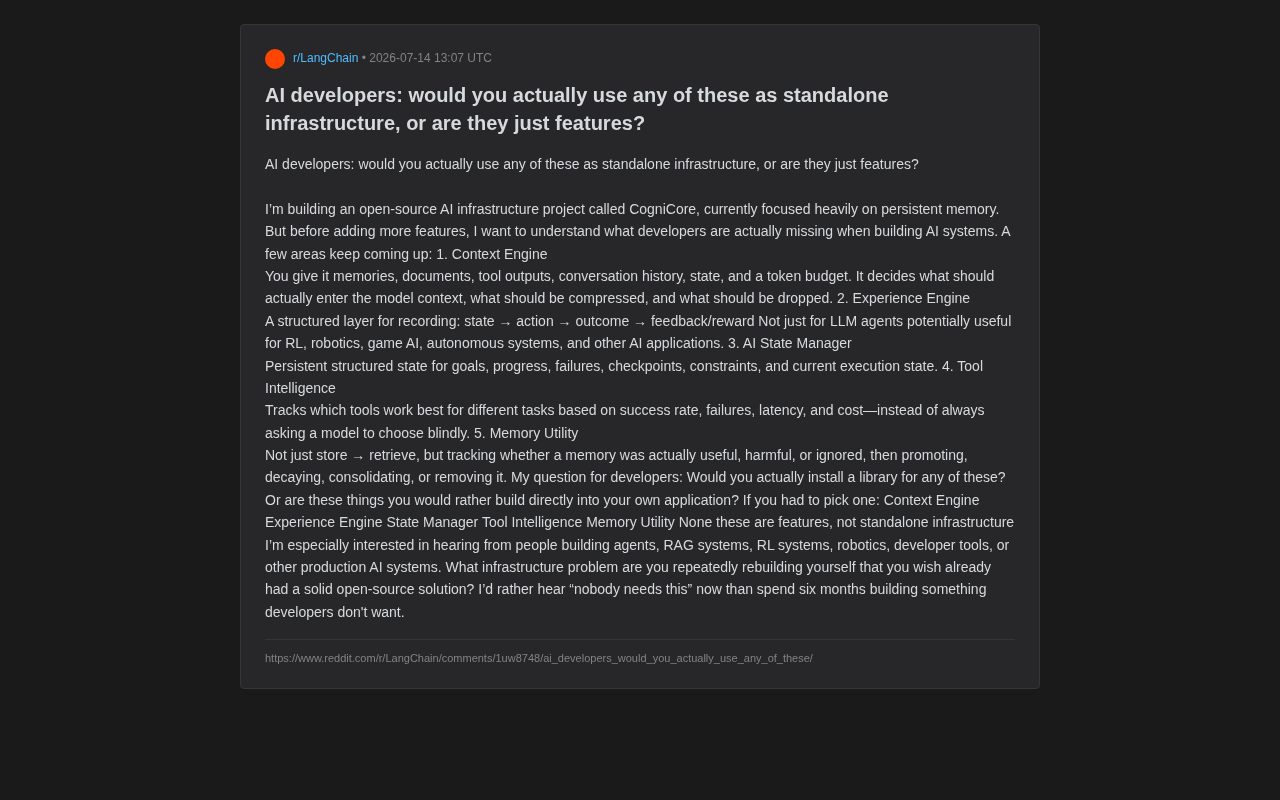
AI Infrastructure or App Feature? The Architecture Debate Sparked by CogniCore
CogniCore asks: should persistent memory, context engines, and state management be standalone AI infrastructure or in-app features? A deep dive into 5 key directions and the missing middleware of the agent era.
Read more →

·2 min
Getting Started with ROS2: What Is a Robot Operating System, and How Does It Differ from ROS1?
A beginner's guide to ROS2: what ROS really is (an SDK, not a traditional OS), how ROS1 and ROS2 differ, and how to choose the right version to start robot development.
Read more →

·3 min
Claude Opus 5 Launch Imminent, Alibaba Qwen Officially Integrated into Apple Intelligence
Claude Opus 5 launches next week; Alibaba Qwen integrates into Apple Intelligence for Chinese users; 27B on-device model compressed to 3.8GB; open-source models narrow gap to closed-source by 3.3%.
Read more →
Self-Hosted Voice AI Assistant: Bringi…
·2 min
Self-Hosted Voice AI Assistant: Bringing Conversational Intelligence to Asterisk/FreePBX
Explore a self-hosted voice AI assistant built for Asterisk and FreePBX: keep data on-premises, integrate with existing PBX, replace legacy IVR, and deploy local voice intelligence affordably.
Read more →

·4 min
Former OpenAI Researcher Warns: 70% Chance AI Spins Out of Control
Former OpenAI researcher Daniel Kokotajlo, who forfeited $2M in equity, warns of a 70% chance AI leads to catastrophic outcomes and superintelligence by 2029.
Read more →

·3 min
The Compute Gamble Gone Wrong: How OpenAI Is Striking Back Against Anthropic
Anthropic's conservative compute bet two years ago is now being exploited by OpenAI across three dimensions: subscription value, quota generosity, and developer sentiment.
Read more →
AI: Bubble or Revolution? A Deep Dive …
·3 min
AI: Bubble or Revolution? A Deep Dive into Speculative Growth
Is the AI boom a speculative bubble or a real revolution? This analysis examines speculative growth economics, compares optimist and pessimist views, and draws lessons from railway and dot-com history.
Read more →

·4 min
Cursor's Recursive Self-Improvement: A Complete Path to Models Training the Next Generation
Cursor ML engineer reveals Recursive Self-Improvement (RSI) in practice: dual-loop flywheels, agent-driven data, anti-cheating evals, SpaceX compute, and how models are training the next generation.
Read more →