#open-source Agent model
2891 related articles

·3 min
Three Words to Break Claude Opus 5? Unpacking the Security Concerns Behind LLM Jailbreaking
A reported 3-word jailbreak of Claude Opus 5 sparks debate. We analyze LLM jailbreak mechanics, alignment fragility, and defense-in-depth strategies for AI security.
Read more →

·3 min
Can Talking Like a Caveman Save 65% on Tokens? An In-Depth Analysis
Can caveman-style minimal prompts save 65% on Tokens? We analyze task quality, hidden cost transfers, and model robustness to reveal the right Token optimization strategies.
Read more →

·3 min
Can Talking Like a Caveman Save 65% on Tokens? An In-Depth Analysis
Can caveman-style minimal prompts save 65% on Tokens? We analyze task quality, hidden cost transfers, and model robustness to reveal the right Token optimization strategies.
Read more →

·3 min
GPT-5.6 Slashes Prices by 80%: The Industry Logic Behind the AI Price War and Opportunities for Developers
OpenAI's GPT-5.6 series sees massive price cuts—Luna drops 80% to $0.20/M input tokens. Deep analysis of the AI price war's tech drivers, competitive landscape, and impact on developer costs and model selection.
Read more →

·3 min
GPT-5.6 Price Cut of 80%: The Industry Logic Behind the AI Price War and Opportunities for Developers
OpenAI's GPT-5.6 series sees major price cuts with Luna dropping 80% to $0.20/M input tokens. Analysis of the AI price war's technical drivers, competitive landscape, and impact on developer costs.
Read more →

·3 min
DANE/TLSA Record Mismatch Causing Silent Email Loss: From Packet Capture Troubleshooting to Root Cause Resolution
A real-world case study of silent email loss caused by DANE/TLSA record mismatch. From empty logs to tcpdump packet capture revealing TLS handshake failures, with TLSA update procedures and automation strategies.
Read more →

·2 min
GPT-5.6 Price Cut of 80%: How OpenAI Reclaims the AI Price-Performance Throne
OpenAI launches GPT-5.6 with 80% price cuts on its Luna model series, surpassing DeepSeek on the price-performance curve. Analysis of the tech logic, developer impact, and AI price war trends.
Read more →

·2 min
GPT-5.6 Price Cut of 80%: How OpenAI Reclaims the AI Price-Performance Throne
OpenAI releases GPT-5.6 with 80% price cuts on Luna models, overtaking DeepSeek on price-performance. Analysis of the tech logic, developer impact, and AI pricing trends.
Read more →

·2 min
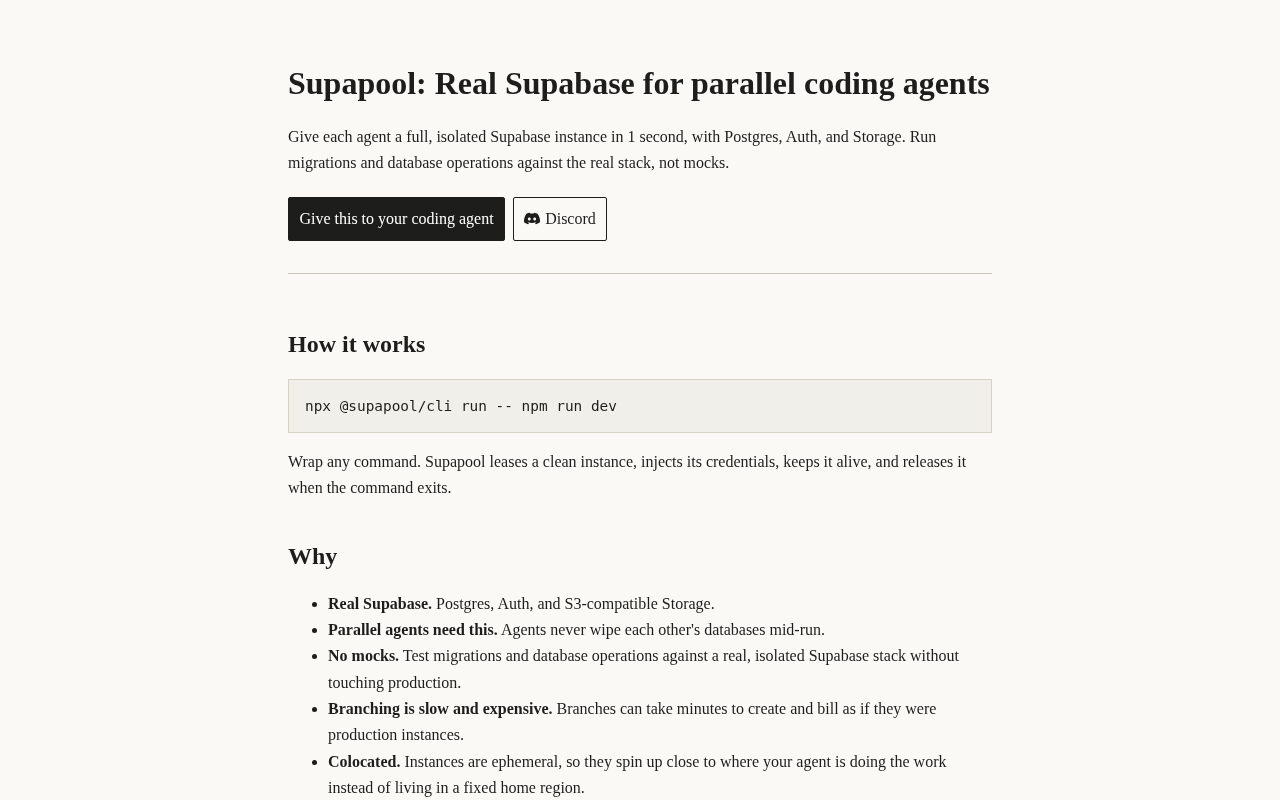
Supapool: Creating Isolated Databases for AI Coding Assistants in 400 Milliseconds
Supapool uses pool prewarming to create isolated Supabase database instances in 400ms for AI coding assistants like Claude, Cursor, and Devin—a prime example of AI-native infrastructure.
Read more →
·2 min
Supapool: Creating Isolated Databases for AI Coding Agents in 400 Milliseconds
Supapool uses pool prewarming to create isolated Supabase database instances in 400ms for AI coding agents like Claude, Cursor, and Devin, solving the database isolation challenge.
Read more →

·2 min
GPT-5.6 Released: Redefining the Price-Performance Boundary of AI Models
OpenAI releases GPT-5.6, targeting the price-performance frontier. Analysis of how architectural optimization and inference efficiency reduce costs, and how LLM competition shifts from capability to cost efficiency.
Read more →

·6 min
Securely Exposing Self-Hosted Services via VPS: Architecture & Practical Guide
Learn how to securely expose self-hosted services via VPS using WireGuard tunnels, Pangolin, and reverse proxies — enabling client-free access to Plex, Immich, and more while hiding your home IP.
Read more →

·2 min
SKI: A Free Voice Coding Tool That Gives Claude Code a Voice
SKI is a free locally-run voice coding tool that adds bidirectional voice conversation to Claude Code and Codex. Supports Mac and Windows with hotkey activation for hands-free AI-driven programming.
Read more →

·2 min
Memmy Agent: A Cross-Platform AI Memory Sharing Tool and Local-First Personal Memory Hub
Memmy Agent is a local-first, open-source AI memory hub enabling cross-platform memory sharing across Claude Code, Codex, and more. Free 2M token tier included.
Read more →

·2 min
Memmy Agent: Cross-Platform AI Memory Sharing Tool, A Local-First Personal Memory Hub
Memmy Agent is a local-first open-source AI memory hub enabling cross-platform memory sharing across Claude Code, Codex, and more. Free 2M tokens included.
Read more →

·3 min
Jina v3 Matryoshka Embeddings in Practice: Cut Vector Storage Costs by 75%
Use Jina v3 Matryoshka embeddings to truncate 1024-dim vectors to 256-dim, cutting Pinecone storage costs by 75% while maintaining retrieval quality with task-specific LoRA adapters and circuit breakers.
Read more →

·3 min
Building a Streaming LLM Backend in Go: Deep Dive into the SDK and React Frontend Library
Deep dive into an open-source Go SDK for building streaming LLM backends, covering streaming responses, tool-calling architecture, and companion React library for end-to-end integration.
Read more →

·3 min
Jina v3 Matryoshka Embeddings in Practice: Cut Vector Storage Costs by 75%
Use Jina v3's Matryoshka embeddings to truncate 1024-dim vectors to 256-dim, cutting Pinecone storage costs by 75%. Covers dimension truncation, task-specific LoRA adapters, and circuit breakers for reliable RAG systems.
Read more →

·3 min
Greplica: A Self-Updating Code Knowledge Base Built for AI Coding Agents
Greplica is an open-source self-updating Wiki for coding agents that automatically extracts decisions, constraints, and gotchas from sessions, enabling shared codebase memory across agents and developers.
Read more →

·3 min
Greplica: A Self-Updating Code Knowledge Base Built for AI Coding Agents
Greplica is an open-source self-updating wiki for coding agents that auto-extracts decisions, constraints, and gotchas from sessions, enabling shared codebase memory across agents and developers.
Read more →