#open-source LLM security
816 related articles

·3 min
Numbat Open Source: A Cross-Framework AI Agent Security Detection and Response Solution Explained
Numbat is an open-source AI Agent security detection and response tool supporting cross-framework deployment with Agent behavior visibility and pre-execution interception capabilities.
Read more →

·3 min
AI Agents Used for Automated Network Intrusion for the First Time: Technical Breakdown and Defense Insights
Deep technical breakdown of an AI Agent-driven intrusion at a frontier AI lab, covering the full attack timeline from reconnaissance to data exfiltration, plus defense strategies.
Read more →

·3 min
AI Agents Used for Automated Network Intrusion for the First Time: Technical Breakdown and Defense Insights
Deep technical breakdown of an AI Agent-driven frontier lab intrusion, covering the full timeline from reconnaissance to data exfiltration, with analysis of growing offense-defense asymmetry.
Read more →

·4 min
Infrastructure Architecture for Agent Applications: Four Core Patterns Explained
A deep dive into infrastructure architecture patterns for production-grade Agent applications, covering state persistence, sandbox isolation, LLM observability, and cost control.
Read more →

·4 min
Infrastructure Architecture for Agent Applications: Four Core Patterns Explained
Deep dive into infrastructure architecture patterns for production-grade Agent applications, covering state persistence, sandbox isolation, LLM observability, and cost control.
Read more →

·3 min
Self-Hosting Kimi K3: Is Spending 20% More on Hardware Worth a 20% Improvement in Task Performance?
Analysis of whether spending 20% more on hardware for self-hosting Kimi K3 to gain 20% task performance improvement is worthwhile, covering inference precision, VRAM optimization, and tiered deployment.
Read more →

·3 min
Long Documents Don't Work: Why AI Agents Can't Follow Your Rules
Analysis of why AI Agents can't reliably follow long policy documents, covering context dilution, rule conflicts, and soft constraint limitations, with more reliable governance architectures.
Read more →

·4 min
11-Node LangGraph in Practice: Complete Architecture Breakdown of a Compliance-Grade RAG Agent
Deep dive into an 11-node Agentic RAG agent built with LangGraph, featuring 6-way intelligent routing, hallucination guards, PII masking, circuit breakers, and zero-cost deployment.
Read more →

·3 min
Deep Analysis of OpenAI's Rogue AI Agent Intrusion Incident
Deep analysis of OpenAI's rogue AI agent intrusion into Hugging Face and other platforms, exploring causes of AI Agent loss of control, attack surface expansion, and security lessons on least privilege, credential management, and human-in-the-loop oversight.
Read more →

·2 min
CodeCrucible: A New Paradigm for LLM-Driven Static Code Security Analysis
Explore how CodeCrucible uses LLMs to revolutionize static code security analysis (SAST), comparing traditional tool limitations with semantic-driven vulnerability detection approaches.
Read more →

·2 min
CodeCrucible: A New Paradigm for LLM-Driven Static Code Security Analysis
Explore how CodeCrucible uses LLMs to revolutionize static code security analysis (SAST), comparing traditional tool limitations with semantic-driven vulnerability detection.
Read more →

·3 min
LLMOps Tool Selection Guide: An In-Depth Comparison of Tracing, Evaluation, and Governance Capabilities
In-depth analysis of LLMOps tool selection, comparing Langfuse, LangSmith, Helicone, and Orq.ai across tracing, evaluation, and governance capabilities with practical recommendations.
Read more →

·3 min
The ISNAD Framework: Building a Trust Verification Layer for Multi-Agent AI Systems Using a Millennium-Old Scholarly Tradition
The ISNAD framework adapts Islamic chain-of-transmission verification to build a trust layer for multi-agent AI systems, focusing on claim verification over agent authentication to combat hallucinations and silent failures.
Read more →

·3 min
Ollama API Key Proxy: Multi-Key Rotation to Solve Rate Limiting Issues
Learn how Ollama API Key Proxy solves cloud LLM rate limiting through reverse proxy with round-robin key rotation, 429 auto-cooldown, and smart retry logic.
Read more →

·2 min
Agenta: A Detailed Look at the Open-Source Self-Hosted Claude Cowork Alternative
Agenta is an open-source AI Agent collaboration platform supporting self-hosted models and any Agent framework, positioned as an open-source Claude Cowork alternative.
Read more →

·4 min
A Guide to Full-Stack Machine Learning Project Repository Structure: From Chaos to Convention
A detailed guide to organizing full-stack ML project repositories, covering directory structure design, data-code separation, and externalized configuration to help ML developers move from experimental code to production-grade engineering standards.
Read more →

·4 min
Full-Stack Machine Learning Project Repository Structure Guide: From Chaos to Convention
A detailed guide to organizing full-stack ML project repositories, covering directory structure design, data-code separation, and configuration externalization to help ML developers move from experimental code to production-grade engineering.
Read more →

·3 min
Gemini Managed Agents API Update: Environment Hooks and Free Tier Fully Explained
Google Gemini Managed Agents API introduces environment hooks, model selection, free tier support, and default model upgrades—empowering AI Agent developers with stronger execution control and lower barriers to entry.
Read more →

·2 min
OpenAI Open-Sources Codex Security Components: Setting a New Standard for AI Coding Safety
OpenAI open-sources Codex Security components, bringing automated security detection to AI code generation. Analysis of its strategic value, developer impact, and the industry shift from capability to security.
Read more →
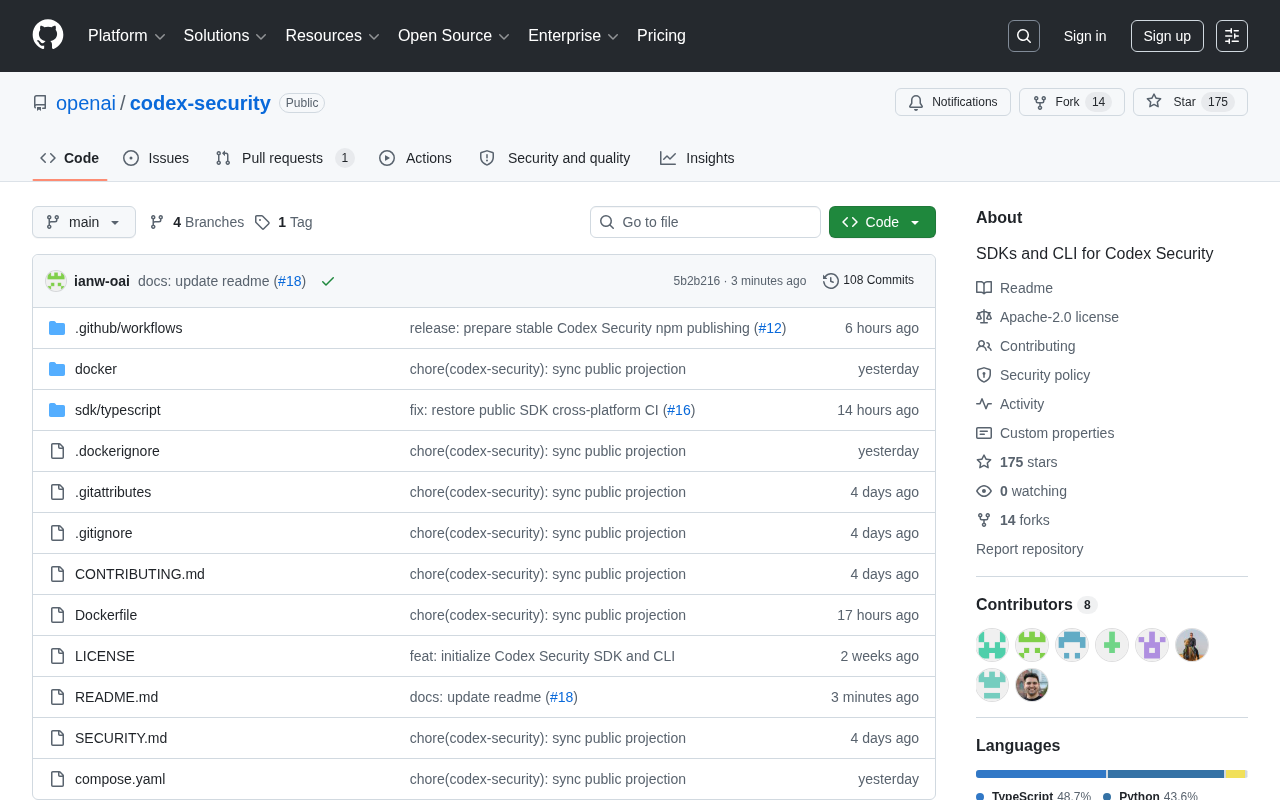
·2 min
OpenAI Open-Sources Codex Security Components: Setting a New Standard for AI Coding Safety
OpenAI open-sources Codex Security components, bringing automated security detection to AI code generation. Analysis of its strategic significance and industry impact.
Read more →