#open-source observability platform
237 related articles

·2 min
Acrux Core: Open-Source LLM Observability Platform, a Self-Hosted Alternative to LangSmith
Acrux Core is an open-source LLM observability platform supporting self-hosted deployment with prompt management, dynamic tool binding, user feedback loops, and full-chain tracing—a free alternative to LangSmith and Langfuse.
Read more →

·3 min
TraceLLM: An Open-Source LLM Observability Platform Built on OpenTelemetry
TraceLLM is an open-source observability platform for production AI apps, built on OpenTelemetry, offering Prompt tracing, Token monitoring, latency analysis, and full distributed tracing.
Read more →
PostHog Deep Dive: The Open-Source All…
·2 min
PostHog Deep Dive: The Open-Source All-in-One Platform for Product Analytics and AI Observability
PostHog is an open-source all-in-one platform combining product analytics, session replay, feature flags, A/B testing, and AI Observability. Supports self-hosting and MCP protocol.
Read more →
 Product Reviews
·1 min
Tracea: Open-Source Observability Platform for AI Agents with One-Click Self-Hosted Deployment
Tracea is an open-source AI Agent observability platform offering end-to-end tracing, cost monitoring, automated RCA, and a team memory system. Self-hosted via Docker with data staying on-premise.
Read more →
 Product Reviews
·2 min
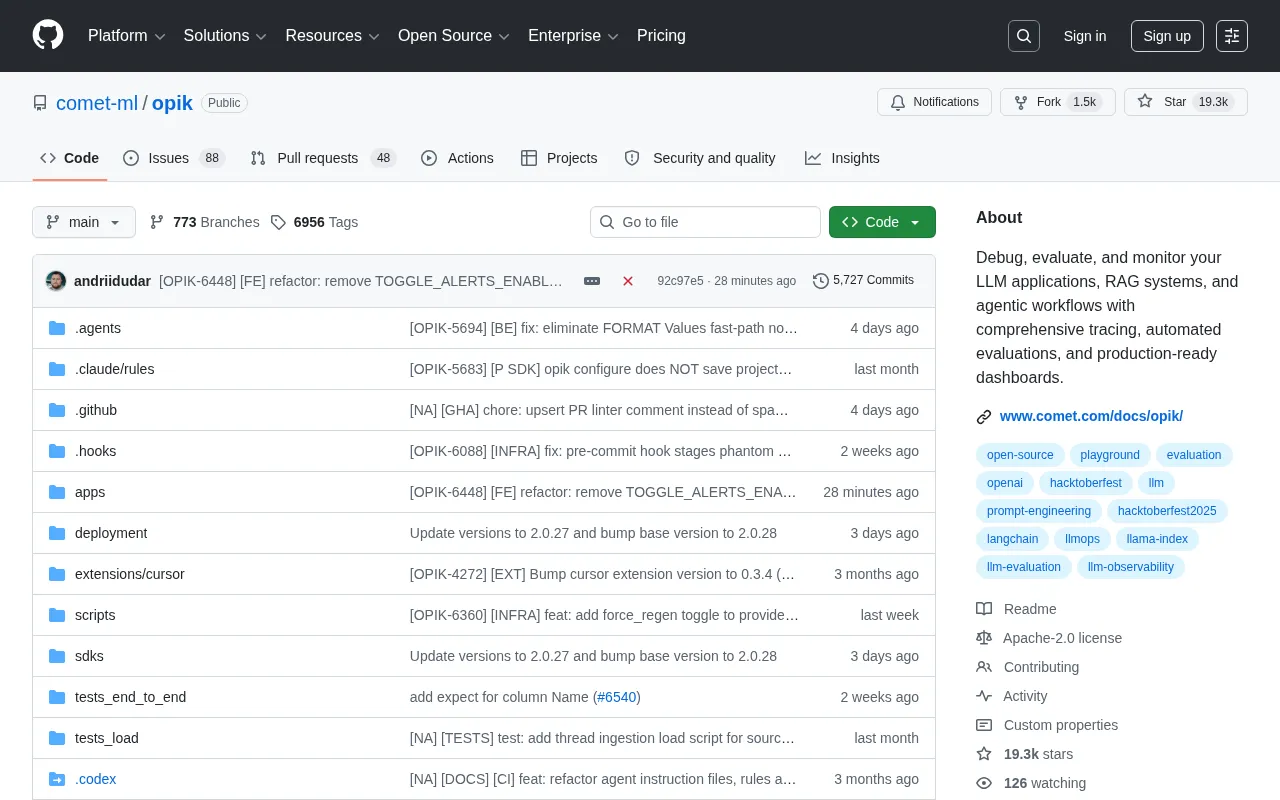
Opik: An Open-Source LLM Observability Platform for Debugging, Evaluation, and Monitoring All in One Place
Deep dive into Opik: an open-source platform for LLM app lifecycle management with tracing, automated evaluation, hallucination detection, and production monitoring for RAG and Agent workflows.
Read more →
 Product Reviews
·2 min
Opik: Open-Source LLM Observability Platform for Debugging, Evaluation, and Monitoring All in One
Deep dive into Opik: an open-source platform for LLM app lifecycle management with tracing, automated evaluation, hallucination detection, and production monitoring. 19K+ GitHub stars.
Read more →

·3 min
AI Agent Observability: A New Paradigm for Production Debugging and Hallucination Governance
Deep dive into AI Agent observability tools for production debugging and hallucination governance, covering full-chain tracing, semantic evaluation, and continuous improvement strategies.
Read more →

·4 min
How Databricks Cut AI Coding Costs by 70%: Strategies and Insights
Databricks cut AI coding tool costs by 70% through intelligent model routing, prompt caching, context optimization, and self-hosted open-source models. Learn actionable strategies for controlling LLM inference costs.
Read more →

·3 min
A Complete Guide to AI Agent Observability and Evaluation Tech Stacks
Deep dive into three technical approaches for AI Agent observability and evaluation: LangSmith native integration, open-source self-hosted solutions like LangFuse, and unified platforms like Lyzr.
Read more →

·3 min
OpenAI Prepaid Credits Vanish Without Records: An Analysis of API Billing Transparency Issues
A developer found OpenAI prepaid credits marked consumed with no usage records available. We analyze API billing transparency issues and offer practical self-protection tips.
Read more →

·3 min
ngrok AI Gateway: One Private Gateway to Rule All AI Models
Deep dive into how ngrok AI Gateway manages OpenAI, Anthropic, and self-hosted models through unified keys and entry points, delivering observability, access control, and fallbacks for production AI.
Read more →

·3 min
persistent-inference: Solving TF/Keras Cold Start Problems with Just Two Files
Deep dive into the persistent-inference open-source project: solve TF/Keras cold start problems with just two files by keeping models resident in memory, eliminating reload overhead.
Read more →

·3 min
Laguna S 2.1 Performance Upgrade: 10x Rate Limit Increase, 250B Tokens Processed Daily
Poolside announces major Laguna S 2.1 upgrade with 10x rate limits, 250B daily tokens on OpenRouter, 1M context dedicated deployment, and integration with cline, opencode, and other AI coding agents.
Read more →

·3 min
Hoplite: A Deep Dive into the Cloud-Based Coding Agent Deployment Platform
Deep analysis of YC S26 project Hoplite, a platform for cloud coding agent deployment and orchestration. Learn how it addresses execution isolation, scalable orchestration, and the AI programming infrastructure market.
Read more →

·3 min
From DevOps to MLOps: Market Demand, Transition Path, and Practical Advice
In-depth analysis of transitioning from DevOps to MLOps: core differences, market demand, required skills, and a practical three-step path for operations engineers making rational career decisions.
Read more →

·2 min
Finyuus: A Deep Dive into the Code-First AI Workflow Governance Language
Deep dive into Finyuus, an open-source code-first AI workflow governance language built on Temporal with agent orchestration, Guards, human approvals, and Langfuse observability.
Read more →

·3 min
Mu: A Standardized Toolset Platform Designed for AI Agents
An in-depth analysis of Mu, a toolset platform built for AI Agents, exploring the importance of Agent tooling, Mu's design philosophy, competitive landscape, and its value in AI deployment.
Read more →

·3 min
GitHub Daily · August 4th: Uber Open-Sources AI Agent Security Framework, Enterprise-Grade Agent Protection Takes Center Stage
Uber open-sources ADR, an enterprise AI Agent security framework gaining 140 stars in one day. Plus webpack, Deno, Angular, Tailwind CSS hold steady.
Read more →

·2 min
AI Agent Debugging Tool: Inspect Execution Chains Like Browser DevTools
Agent DevTools is an open-source AI Agent debugging tool inspired by Browser DevTools, offering execution visualization, tool call tracing, and breakpoint analysis to help developers diagnose Agent failures.
Read more →

·3 min
Control Theory Meets Machine Learning: A Learning Roadmap from Fundamentals to the Cutting Edge
A tailored ML guide for control theory learners covering reinforcement learning, data-driven control, Learning-based MPC, and a three-stage roadmap with practical advice.
Read more →