#parallel drafting
42 related articles

·4 min
Two Paths to Better AI Reasoning: Test-Time Scaling and Formal Verification
This article synthesizes two MSR India Summit talks, exploring two key paths to better AI reasoning: test-time scaling with variable granularity search, and a formal verification framework for trustworthy agent execution.
Read more →

·2 min
The AI Startup Boom: The Era of One-Person Companies Has Arrived
AI tools are lowering startup barriers, making one-person companies a real possibility. Explore how AI reshapes entrepreneurship, compresses costs, and what challenges remain.
Read more →

·5 min
GPT-5.6 Triple Launch: Understanding the Positioning and Key Differences of Sol, Terra, and Luna
OpenAI released three GPT-5.6 models—Sol, Terra, and Luna—covering everything from flagship reasoning to lightweight speed. A deep dive into their positioning, performance differences, pricing, and industry signals.
Read more →

·6 min
Zuckerberg Admits AI Progress Falls Short of Expectations: The Industry Truth Behind the Layoffs
Meta laid off 8,000 to bet on AI, yet Zuckerberg admits AI agents fell short of expectations. A look at the collective 'AI reflection' among OpenAI, Microsoft, and Google, plus research on AI's selective impact on jobs.
Read more →

·2 min
OpenAI GPT-5.6 Released: Three Versions Compared — Full Breakdown of the All-in-One Super App
OpenAI releases GPT-5.6 in three tiers (SOUL/TERA/LUNA) and a unified ChatGPT desktop app with Chat, Work, and Codex modes. Learn how to choose the right version.
Read more →

·5 min
DeepSeek Boosts Inference Speed by 85%: How Speculative Decoding Is Reshaping the AI Speed Race
DeepSeek and Peking University's DS Spark paper boosts AI inference speed by up to 85% via confidence scheduling and semi-autoregressive speculative decoding — no model or GPU changes.
Read more →

·6 min
OpenAI's Head of Evals: We've Been Consistently Underestimating What AI Models Can Really Do
OpenAI Frontier Evals lead Tejal Patwardhan reveals AI models are systematically underestimated — reasoning breakthroughs, wet lab records, the internal AGI Index, and a progress curve far steeper than most realize.
Read more →
·5 min
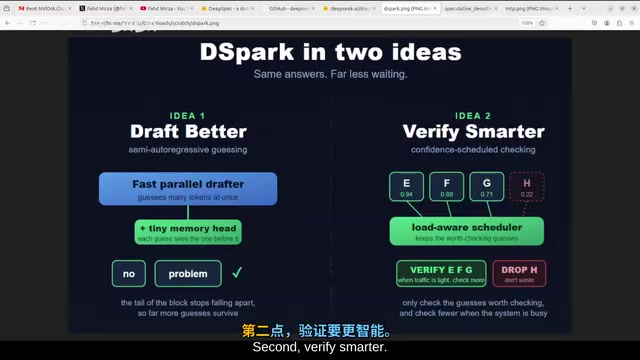
DeepSeek DSpec Hands-On: How Speculative Decoding Accelerates LLM Inference by 6x
Hands-on report on DeepSeek's open-source inference acceleration toolkit DSpec: draft model + smart scheduling delivers lossless speedup, hitting acceptance length 6 on GSM8K and reproducing official data.
Read more →

·7 min
Gemini Meets Google Business Profile: How AI Becomes a Dedicated Business Partner for Small Businesses
Google lets businesses connect their Google Business Profile to Gemini, so the AI can read operating info, reviews, and business data to offer targeted marketing advice—lowering AI barriers for SMBs.
Read more →

·6 min
AI Agent Practical Guide: From Chatting to Directing — Building Fully Automated Workflows
AI use has three levels: Chat, Automation, and Agent. Learn how to use tools like Manus AI with a "director mindset" to build fully automated workflows — no technical background required.
Read more →

·7 min
LangSmith Engine: An Intelligent Operations Tool That Automatically Diagnoses and Fixes Agent Failures
LangChain's LangSmith Engine is an intelligent agent tool for tracking Agent failures, prioritizing issues, and auto-drafting fixes. Deep dive into its core capabilities, sandbox isolation, sub-Agent architecture, and continuous evaluation challenges.
Read more →

·7 min
The Revenge of the Philosophy Majors in the AI Era: Why Critical Thinking Has Become the New Scarce Resource
As generative AI sweeps the workplace, once-marginalized philosophy and humanities are being revalued. This article explores why critical thinking, ethical judgment, and questioning are the new scarce competencies in the AI era.
Read more →

·6 min
Getting Started with Vibe Coding: Building Software with Natural Language from Scratch
Vibe Coding lets you build software with no coding background—just talk to AI in natural language. Learn its core ideas, learning path, and practical tools.
Read more →

·6 min
Does AI Adoption Actually Lead to More Hiring? Explaining This Counterintuitive Phenomenon
Growing data shows companies aggressively adopting AI are actually hiring more. This article explores the overlooked complex relationship between AI and employment through the Jevons Paradox, new job creation, and competitive divergence.
Read more →

·3 min
Complete Guide to Codex /goal Command: Making AI Execute Long Tasks Without Cutting Corners
Deep dive into OpenAI Codex's /goal slash command: four core mechanisms that prevent AI "fake completion," enforce stop conditions, and support task resumption. Includes full prompt structure and permission configuration for complex automation tasks.
Read more →

·2 min
Claude Code's Seven-Layer Architecture: A Complete Guide to Building an AI Operating System from a Chat Tool
A detailed guide to Claude Code's seven-layer architecture including memory, agent, and feedback loop layers, plus five pitfalls to avoid and four expert tips for building your AI operating system.
Read more →

·1 min
How Can Ordinary People Use Codex to Boost Productivity? Practical Tips and Case Studies
Codex isn't just for programmers—knowledge workers grow 3x faster than developers. Learn how to use Codex for data analysis, document processing, and content creation with real cases and workflows.
Read more →
 Tutorials
·4 min
Four Core Rules Anthropic Engineers Use to Prompt Claude Code
Anthropic engineers share how to properly use Claude Code at AI Code Summit: build composable Skills systems instead of one-off prompts. Master four core rules for skills that get smarter over time.
Read more →
 Tutorials
·3 min
DeepSeek V4 Flash MTP Speculative Decoding Real-World Test: A Guide to 20% Faster Local Inference
Real-world testing of DeepSeek V4 Flash with MTP speculative decoding: ~20% speedup for code generation, minimal gains for text. Covers memory overhead, accuracy differences, Q4 vs Q3 quantization, and full deployment tutorial.
Read more →
 Product Reviews
·3 min
OpenAI Codex Deep Dive: How Does the Async AI Coding Agent Actually Perform?
Deep dive testing OpenAI Codex cloud coding agent on a 50K-user production codebase, covering bug fixes, prompt optimization, and frontend UI tasks, with insights on the 30% completion rate value.
Read more →