All articles
38472 articles

tok: A Textual BPMN/DMN Syntax for Humans and AI
The paper proposes tok: a plain-text concrete syntax for BPMN 2.0.2 and DMN 1.5. It uses 2.2x fewer tokens than minimal BPMN XML and 7.7x fewer than raw exports; fault detection is 98.2% vs 85.8%, and it is applied via an MCP service for language models.

AttnSR: Using Attention Mechanisms to Solve the Reward Assignment Challenge in Long-Horizon Agent Reinforcement Learning
AttnSR proposes a policy-attention-based step-level reward enhancement method that requires no extra reward model or rollouts, improving ALFWorld success rate from 91.2% to 97.1% while reducing environment interactions by 29.9%.

CLEAR-WSI: A Diagnosis-Driven Retrieval Framework for Whole-Slide Pathology Images
CLEAR-WSI is a diagnosis-driven whole-slide image retrieval framework using fixed-length embeddings and a scalable memory bank, improving Precision@5 on CAMELYON16, BRACS, and X-HER2 for scalable digital pathology archive retrieval.
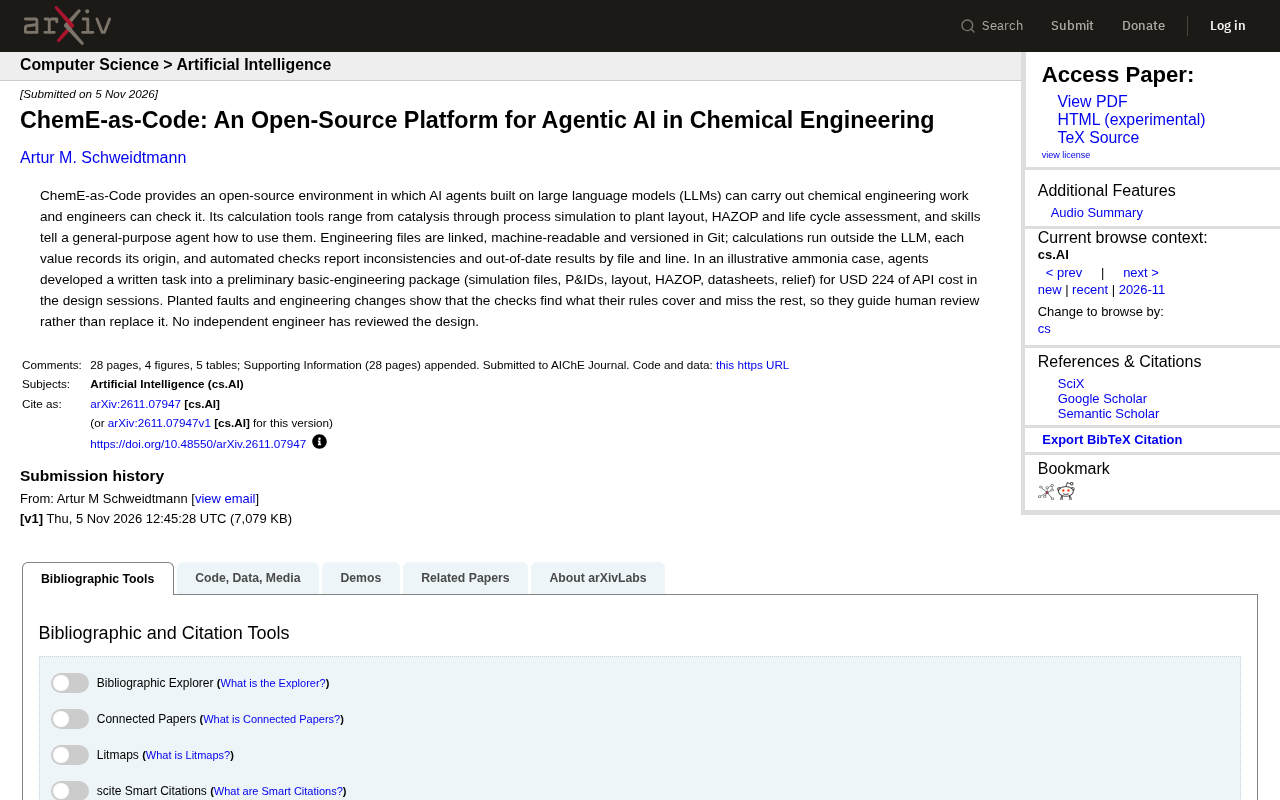
ChemE-as-Code: Open-Source Platform Lets AI Agents Take Over Chemical Engineering Design
ChemE-as-Code is an open-source agent platform for chemical engineering, packaging catalysis, process simulation, HAZOP, and LCA tools; computations run outside the LLM with traceable sources, Git-versioned engineering files, and automated checks that locate inconsistencies and outdated results. The ammonia plant example cost $224 in API fees.

Circe: A Training-Free LLM Self-Evaluation Method Using Component Interaction Consistency
Circe is a training-free LLM self-evaluation method that fuses component interaction consistency (CIC), representation geometry (RG), and likelihood confidence (LC) to distinguish correct from incorrect answers without reference answers, generalizing across multilingual, multimodal, and open-world settings.

Technohybridism: How AI Recursively Reshapes Social Semantic Norms
How does AI-generated content flowing back into society change language norms? A social theory study proposes "recursive semantic normalization" and "technohybridism," breaking down four stages—generation, selection, adoption, persistence—and identifying three consequences: provenance laundering, erosion of cognitive diversity, and narrowing of hermeneutic resources.

LLMs Meet Knowledge Graphs: A Benchmark for Multi-hop Reasoning and Hallucination Suppression
A new benchmark evaluates GPT-5.1, Gemini 2.0 Pro, Llama 3, Qwen, and BioGPT on multi-hop reasoning across five heterogeneous knowledge graphs, finding general models lead on higher-order reasoning and graph grounding broadly reduces hallucination.

SpecCTMC: Exact Speculative Sampling for Diffusion Language Models
SpecCTMC is a training-free speculative sampler that uses the model's own predictions to propose parallel token updates, reducing sequential evaluations for diffusion language models by 1.73–4.38x while preserving the exact joint distribution of the continuous-time Markov chain.

New Breakthrough in Multi-Task Learning: Implicit Syntactic Augmentation Boosts Sentiment Classification Efficiency
This article explores syntactic augmentation strategies for sentiment polarity classification under multi-task learning, comparing Standard-MTL and Contrastive-MTL across 11 datasets in performance and efficiency, showing implicit syntactic supervision can match explicit parsing while being faster.

A New Paradigm for LLM Cultural Adaptation: From Q&A to Repeated Social Interactions
LLM cultural competence evaluation is shifting from static Q&A to dynamic social interaction. A new study in a sandbox environment finds that memory mechanisms are key to norm assimilation, cross-scenario transfer, and multilingual adaptation in repeated interactions, offering a new paradigm for cultural alignment of interactive agents.

StepBack: Step-Level Error-Localized Resampling Cuts Reasoning Tokens by 41%
StepBack introduces step-level error-localized resampling: locate the first erroneous step in draft trajectories, resample that step and its suffix, matching self-consistency accuracy on seven math reasoning and multi-hop QA benchmarks while cutting token usage by up to 41.26%. It can also be combined with adaptive reasoning methods such as Adaptive Consistency.

Label-Wording Augmentation: Effective for Unfamiliar Words, Ineffective for Abbreviations and Code
A study compares two versions of the multilingual cross-encoder Ru-Jev and finds that label-wording augmentation improves accuracy by up to 0.24 on ordinary words and loanwords, but yields no gains—and even performs worse—on abbreviations and opaque codes.

How Mechanistic Interpretability Backstops AI Safety: A Deep Dive into One Survey
A deep dive into a mechanistic interpretability survey for AI safety: contrasting mechanistic evidence with behavioral evaluation, covering features, polysemanticity, circuits, and methods like feature extraction, circuit discovery, and causal verification, plus safety applications including knowledge editing, steering, and monitoring, and their limitations.

MedGraph: Using Graph Memory to Track Patient State and Improve Accuracy in Long-Term Medical Conversations
MedGraph uses graph memory to track patient state, solving outdated information, person confusion, and safety omissions in long-term medical conversations, leading baselines by over 10 percentage points on MedMemoryBench.

Hidden Markov Preference Models: Online Prediction of an Attacker's Next Move
The paper proposes a hidden Markov preference model that jointly models attacker mode switching and time-varying action parameters, worth 0.8 nats per step on CAGE 2.
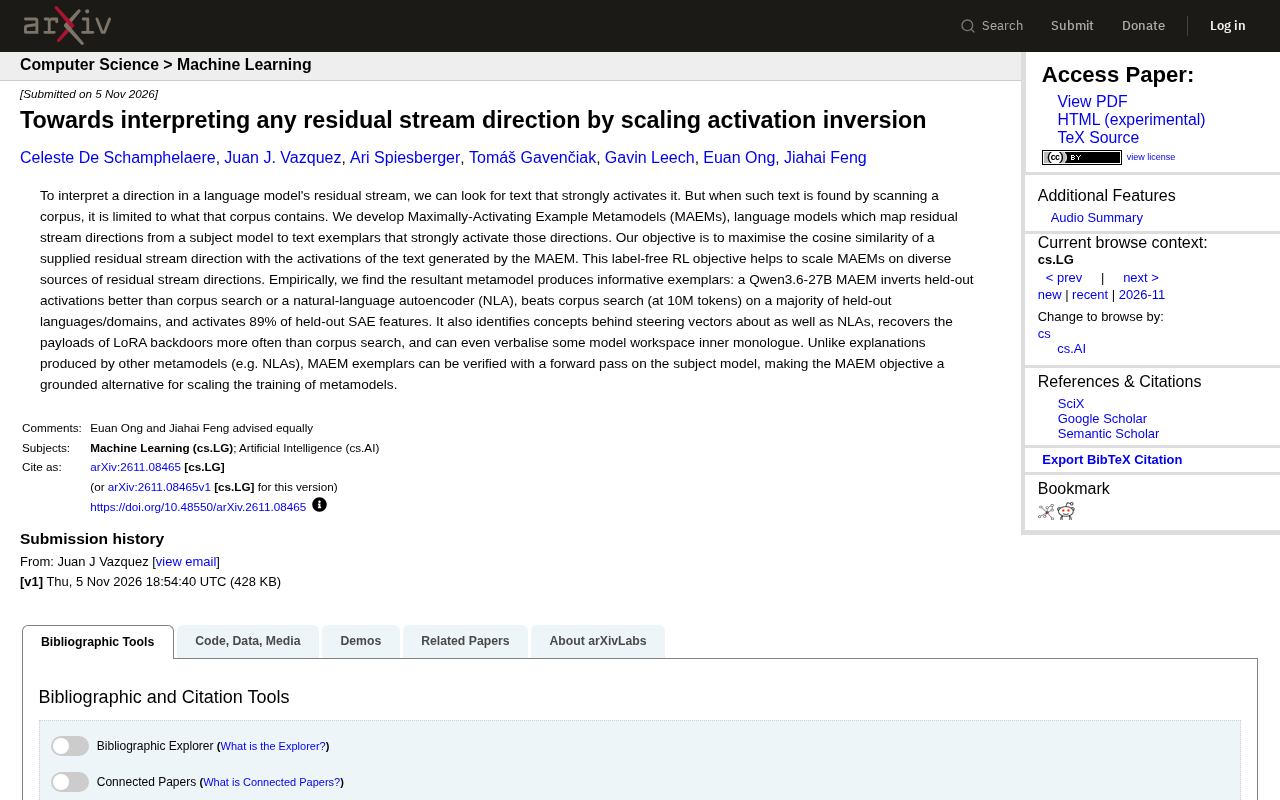
MAEM: Scaling the Interpretation of Residual Stream Directions with Reinforcement Learning
The MAEM metamodel uses label-free reinforcement learning to map residual stream directions into strongly activating text examples, outperforming corpus search and NLA on Qwen3.6-27B and activating 89% of held-out SAE features and recovering LoRA backdoor payloads.

Strong-to-Weak Distillation More Compute-Efficient Than GRPO? New Study Reveals Key Conditions
New study compares strong-to-weak OPD vs GRPO compute efficiency: external teachers lose to GRPO with response-length inflation; self-GRPO-checkpoint teachers distill math tasks at 1/50 the FLOPs; multi-teacher OPD costs just 5.2%–8.0%.

Large-Step Adversarial Training: New Findings on Implicit Bias, Optimization, and Sharpness
This paper studies gradient descent dynamics in adversarial training with large step sizes, finding three key differences from standard training: a persistent implicit bias gap, no unified convergence rate, and two-phase sharpness dynamics rather than edge-of-stability.

Can Finite Experiments Validate Integrated Information? New Study Reveals Identifiability Boundaries of Mechanism-Level Measures
New study precisely analyzes identifiability of integrated information φ in finite experiments: same behavior but different mechanisms, precision floors from partial access, drastic measure shifts at edges, yet one-sided lower bounds remain certifiable. Measurability becomes a computable design problem.

Scientist World: Building a Runnable Research World for AI Scientists
Scientist World turns every paper into an executable research environment, with 1,000 validated environments. AI scientists outperform humans in 74% of cases, and 6,400 hours of research trajectories boost small-model research ideation by 158%.