#AI Agent developer roadmap
276 related articles

·3 min
Learning AI Large Language Models: A Complete Roadmap from Beginner to Practitioner
A systematic breakdown of the AI LLM learning roadmap covering prompt engineering, AI Agent development, RAG knowledge bases, model fine-tuning, and hands-on projects for beginners.
Read more →

·3 min
Backend Developer Transition to AI/LLM: 4 Core Skills and a Practical Learning Roadmap
Complete guide for backend developers transitioning to AI/LLM engineering. Covers the 4 core skills—Python, RAG, Fine-tuning, and Agents—with a phased learning roadmap and practical project advice.
Read more →

·3 min
How to Choose an AI Agent Platform for Your Team: 5 Evaluation Dimensions and a Decision Framework
Choose the right AI Agent platform by evaluating model flexibility, observability, tool integration, security compliance, and total cost. A complete decision framework to help technical leaders avoid vendor lock-in.
Read more →

·3 min
How to Choose an AI Agent Platform for Your Team: 5 Evaluation Dimensions & Decision Framework
Choose an AI Agent platform by evaluating model flexibility, observability, tool integration, security compliance, and total cost. A complete decision framework to avoid vendor lock-in.
Read more →

·3 min
A Beginner's Guide to AI Agents: Two Learning Paths for Developers and Practitioners
How to learn AI Agents from scratch? This guide covers two clear paths: developers go from Python to LLMs to open-source framework source code; practitioners use Claude Code or similar tools to get results fast.
Read more →
·2 min
Claude as Music Partner: The AGI Moment of AI Paired Creation
A developer added a DAW to their agentic dev environment with Claude, then paired with AI to finish music — experiencing a true AGI moment in creative collaboration.
Read more →
·3 min
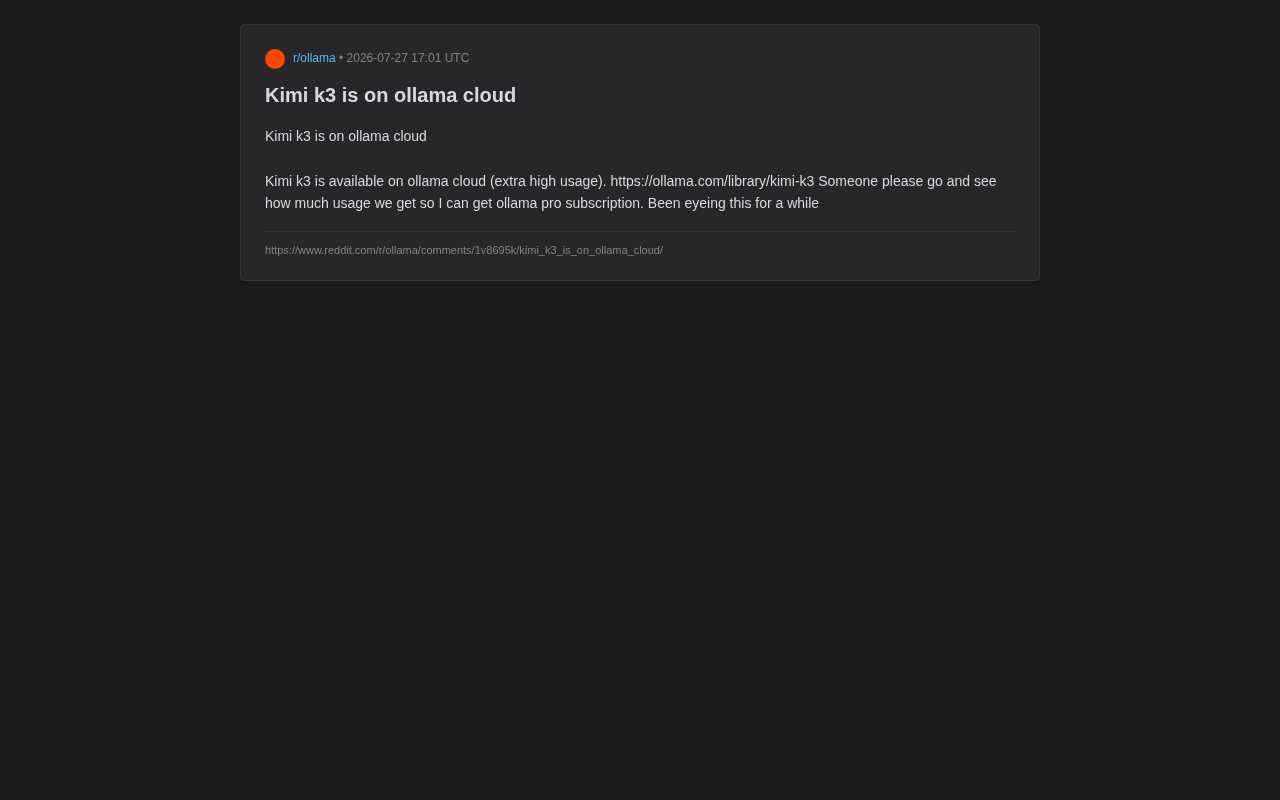
Kimi K3 Launches on Ollama Cloud: Free Tier, User Experience, and Developer Guide
Kimi K3 officially launches on Ollama Cloud as an "extra high usage" model. This guide covers free tier quotas, cloud inference experience, technical advantages, and how developers can seamlessly call this high-performance LLM.
Read more →

·5 min
The Complete Guide to AI Agent Development: A Four-Stage Progressive Roadmap
A systematic guide to AI Agent development across four stages: LLM fundamentals, ReAct paradigm, memory & tools, and multi-agent collaboration for developers.
Read more →

·3 min
Ollama Prepares for Trillion-Parameter Open-Source Models as the Open-Source Ecosystem Heats Up
Ollama scales up for trillion-parameter open-source models like Kimi K3 and Qwen 3.8. Hugging Face demands $100M from OpenAI, Alibaba Coder goes mobile, and DeepSeek pauses fundraising.
Read more →

·4 min
Frontend Engineer Driven to Homelab by AI: From React Specialist to Full-Stack Self-Rescue
A 7-year frontend engineer, fearing AI-driven job loss, builds a homelab to learn Docker, databases, and networking. A pragmatic roadmap for developers building breadth in the AI era.
Read more →

·2 min
GPT-5.6 Goes Live with Dual Quota Reset as AI Models Update Rapidly
GPT-5.6 fully launches with enhanced coding, computer operation, and long-horizon agent tasks, plus a dual quota reset. Meanwhile, ByteDance opens its C-Dance 2.5 API and Mistral debuts a single-RGB-camera natural language navigation model.
Read more →

·2 min
Multi-Agent Collaborative Paper Writing System: End-to-End Automation with FastAPI + Vue 3
An in-depth look at an intelligent paper writing platform built on FastAPI + Vue 3, combining LLM, RAG, and multi-Agent collaboration for full-process automation—an excellent case study for AI developers.
Read more →

·5 min
DeepSeek's Five-Step Ladder to AGI: A Restrained Roadmap Built on 20,000 GPUs
DeepSeek founder Liang Wenfeng reveals a five-step AGI roadmap—from chain-of-thought to embodied intelligence—under a 20,000-GPU constraint, using the TileLang compiler to break domestic substitution challenges while API cash flow backs AGI exploration.
Read more →

·5 min
DeepSeek's Five-Step Ladder to AGI: A Restrained Roadmap Built on Twenty Thousand GPUs
DeepSeek founder Liang Wenfeng reveals a five-step AGI roadmap from chain-of-thought to embodied intelligence. How does TileLang crack domestic GPU substitution under a 20,000-card constraint?
Read more →

·5 min
Inside Liang Wenfeng's Closed-Door Meeting: DeepSeek's Philosophy of Restraint and Its AGI Strategy
A full breakdown of DeepSeek founder Liang Wenfeng's 4-hour closed-door meeting: no KPIs, only reasonable profits, open-sourcing top models, and tackling AGI via continual learning—a rare AI strategy confession showing how restraint becomes a core edge.
Read more →

·5 min
The DeepSeek Investor Q&A with Liang Wenfeng: Decoding Restrained Pricing and the AGI Roadmap
Decoding DeepSeek's Liang Wenfeng 4-hour investor Q&A: 10-month-payback restrained pricing, why open source doesn't hurt revenue, the Agent-continual learning-self-iteration AGI roadmap, plus domestic chips, talent, and your moat.
Read more →

·5 min
DeepSeek's Liang Wenfeng Investor Meeting: Restrained Pricing and the AGI Roadmap Explained
An analysis of DeepSeek's Liang Wenfeng 4-hour investor meeting: restrained pricing with 10-month payback, why open source doesn't hurt revenue, the Agent–continual learning–self-iteration AGI roadmap, plus domestic chips, talent, and your moat.
Read more →

·5 min
Liang Wenfeng's In-Depth Confession: DeepSeek's Philosophy of Restraint, Open-Source Strategy, and AGI Roadmap
DeepSeek founder Liang Wenfeng systematically explains: a KPI-free culture, 10-month break-even pricing, long-term open-source strategy, continual learning to break the AGI bottleneck, and his prediction of a mature domestic chip ecosystem within a year.
Read more →

·5 min
Liang Wenfeng's 4-Hour Internal Talk: DeepSeek's Philosophy of Restraint and Its Path to AGI
DeepSeek founder Liang Wenfeng shares his views on open source, pricing, computing power, and the five-stage roadmap to AGI in a 4-hour internal investor talk.
Read more →

·6 min
The Three-Layer GTM Agent Architecture: Enabling AI to Truly Recognize Buyer Intent and Identity
An in-depth analysis of the three-layer GTM Agent architecture—the Signal, Buyer Intelligence, and Action layers—revealing how context graphs identify anonymous visitors and capture purchase intent.
Read more →