#ComfyUI workflow
93 related articles

·2 min
Open-Source 3D Generation Models Tested: Can Trellis 2 Challenge Paid Products?
A deep comparison of open-source Trellis 2, Hunyuan 2.1, UltraShape vs. paid Tripo 3.1 and Hi3D — covering geometry, texture, and complex details to help you decide.
Read more →

·3 min
UniFlex 11: A Complete Guide to the Free, Open-Source Krea 2 Workflow Suite
UniFlex 11 is a free, open-source ComfyUI workflow suite built for Krea 2. It offers Core and Full editions with prompt enhancement, inpainting, upscaling, and annotated modular design for all skill levels.
Read more →

·2 min
LingBot-Video 1.3B Selective FP8 Quantization Benchmark: 22% Faster Sampling
Reddit developer ALX-CODE shares a selective FP8 quantization scheme for LingBot-Video 1.3B, achieving ~22% faster sampling (4.65s→3.65s) on an RTX 5080. This article breaks down the mixed-precision strategy, open-source resources, and ComfyUI adaptation.
Read more →

·2 min
LTX 2.3 Hands-On: How Efficient Is Local AI Video Generation on the RTX 5080?
Hands-on with LTX 2.3 and ComfyUI for local AI video generation on the RTX 5080: 8-second clips in just 2-3 minutes while running DaVinci Resolve simultaneously. Covers hardware, workflow setup, and multi-tool creation.
Read more →

·4 min
Eight Text-to-Image Models Compared: Which Excels at Realism, Ghibli, and Anime Styles
A comprehensive comparison of eight mainstream text-to-image models including Krea2, Flux2, and Qwen Image, covering realistic portraits, Ghibli, 3D anime, and Japanese anime styles.
Read more →

·3 min
Depth Map and OpenPose Extraction Workflow: A Practical Guide to Controllable AI Video Generation
A deep dive into the principles and applications of the Depth Map and OpenPose pose extraction workflow, combined with Seedance 2's reference video feature, helping creators precisely control camera movement and character poses in AI video.
Read more →

·5 min
In-Depth Comparison of AI Image Generation Tools: How to Choose Between Flux, Midjourney, and Gemini?
A comprehensive comparison of mainstream AI image generation tools: Flux, Midjourney, Grok, Gemini, and Stable Diffusion. Dissecting their pros and cons across quality, freedom, and usability to help you find the right AI drawing solution.
Read more →

·4 min
INT4 ConvRot W4A4 Quantization: Running Large Image Models on Low-VRAM GPUs in ComfyUI
An in-depth look at INT4 ConvRot W4A4 quantization, covering conversions of Krea2, Qwen-Image, and other diffusion models to help ComfyUI users run large image models on 8GB GPUs.
Read more →

·3 min
Flow Review: 3D AI Studio's ComfyUI-Style Node System for 3D Creation
3D AI Studio launches Flow, a node-based workflow tool supporting image-to-3D, part splitting, batch export, and a built-in AI Agent for auto-building pipelines from Blender to UE5.
Read more →

·2 min
Krea 2 Emotion Expression Test: Turbo vs Raw+LoRA Head-to-Head Review
An in-depth review of how Krea 2 Turbo and Raw+LoRA differ in emotional scenarios. Using a variable-controlled workflow and the same random seed, comparing 11 emotional scenarios, with auxiliary LoRA and prompt tips.
Read more →

·2 min
ComfyUI Trellis Turntable Rendering Node: Finally Solving the Texture Seam Problem
A practical breakdown of the ComfyUI-TrellisNativeTurntable node: render Trellis mesh turntables inside ComfyUI without Blender, plus deep dives on UV seam fixes, camera control, SSAA, and camera data export.
Read more →
·2 min
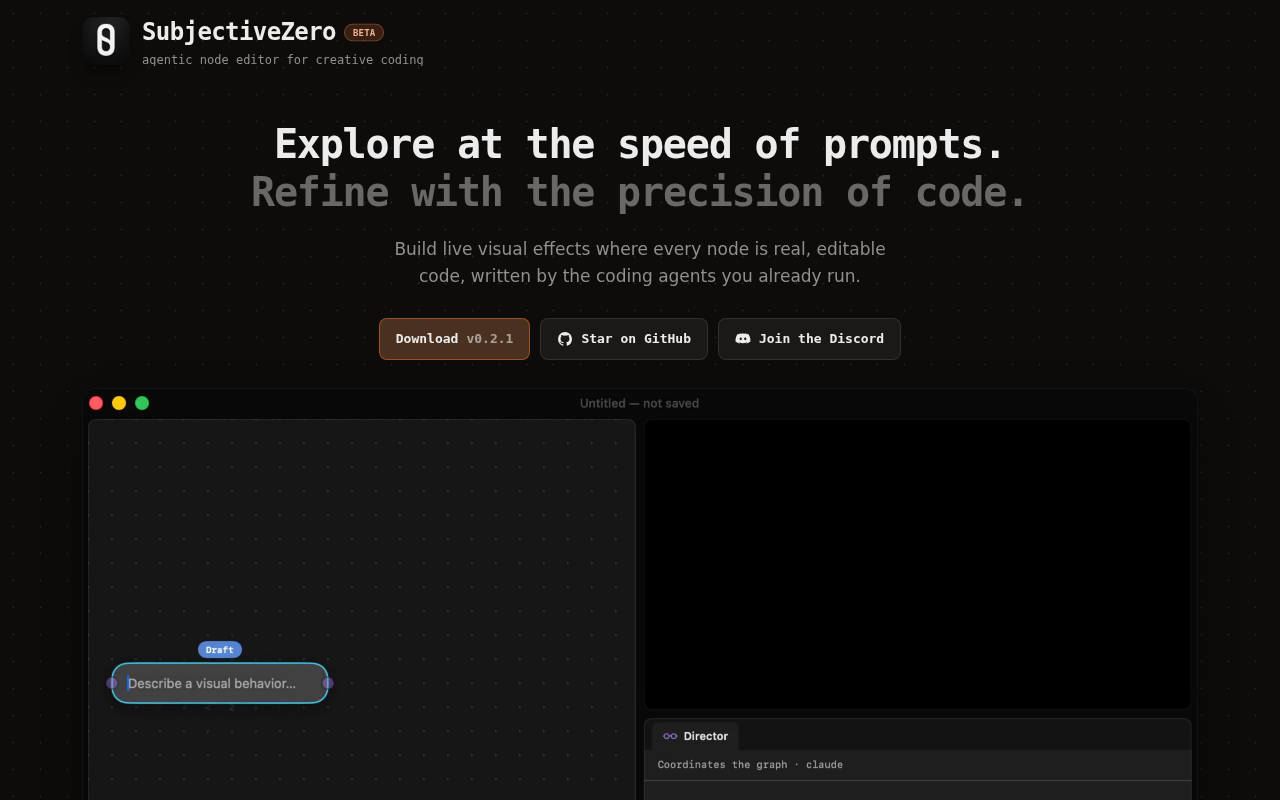
SubjectiveZero: A New Creative Coding Paradigm with AI Agents and Node Editors
SubjectiveZero is an open-source agentic node editor for creative coding, merging AI agents with visual node programming. Explore its technical vision and value for digital artists.
Read more →

·3 min
Velorn: Open-Source NLE Editor Where AI Agents Handle Editing and Mixing
Velorn is an open-source NLE with ComfyUI generation and a local MCP server of 100+ tools, letting Claude and Cursor agents edit timelines and mix audio — no cloud credits required.
Read more →

·5 min
Runs on Low VRAM! A Hands-On Look at the ID LoRA Face-to-Video Workflow
A face-to-video workflow built on GGUF quantized models and ID LoRA runs on just an RTX 3060 with 6GB VRAM. This article breaks down its core principles, four-step process, and how it tackles facial consistency in AI video.
Read more →

·7 min
Krea2 Tested: Does the FP8 vs BF16 Quality Gap Still Exist?
A Reddit user compared FP8 and BF16 precision on the Krea2 model and found almost no difference in image quality. This article analyzes the technical reasons behind the shrinking quantization gap and its real-world impact on VRAM usage and inference speed.
Read more →

·6 min
7 Anima Model Combinations Tested: The Optimal Config Guide for Anime Image Generation
A Reddit user's rigorous controlled experiment testing all 7 Anima combos—base, aesthetic, turbo LoRA, and turbo baked. Key takeaway: choose aesthetic first, add Turbo LoRA for anime-girl style. Includes prompt structures and ComfyUI configs.
Read more →

·4 min
ByteDance Open-Sources Bernini Video Editing: Local Deployment Guide for Character Replacement
ByteDance open-sources Bernini, a video editing model supporting character replacement, outfit swapping, and video blending via ComfyUI. Full local deployment guide.
Read more →

·4 min
Ideogram 4 Local Deployment Test: Cinematic Quality on 8GB VRAM
Ideogram 4 open-source image model tested: runs locally on 8GB VRAM + 32GB RAM, Midjourney-level aesthetics, stable text rendering. Learn the 3-part prompt structure and automated ComfyUI workflow with Qwen3 VL.
Read more →

·4 min
LangGraph.js Practical Guide: A Frontend Engineer's Path to AI Agent Development
A practical LangGraph.js guide for frontend engineers covering LangGraph vs LangChain comparison, workflow vs general-purpose agent types, and layered Agent architecture design.
Read more →

·3 min
Ideogram 4 Fully Automated Workflow: Run Locally with Just 8GB VRAM, No Complex Prompts Needed
Ideogram 4 automated ComfyUI workflow using Qwen2.5 VL-8B: run locally with 8GB VRAM, auto-generate structured JSON prompts from simple descriptions, with image reverse-engineering support.
Read more →