#Cursor Agent mode
1688 related articles

·3 min
Practical Guide to Setting Up a Local AI Coding Environment on MacBook Pro M4
Complete guide to setting up a local AI coding environment on MacBook Pro M4, covering Ollama, MLX, Continue, Qwen3-Coder 30B configuration, and performance optimization strategies for 32GB RAM.
Read more →

·3 min
Graph Engineering: The Core Paradigm and Design Patterns for AI Agent Orchestration
Deep dive into how graph engineering uses state machines and directed graphs to constrain AI agent behavior, covering reflection, routing, human-in-the-loop, and parallel execution patterns.
Read more →

·3 min
Graph Engineering: The Core Paradigm and Design Patterns for AI Agent Orchestration
Explore how graph engineering uses state machines and directed graph structures to constrain AI agent behavior, covering reflection, routing, human-in-the-loop, and parallel execution patterns.
Read more →

·3 min
13 Models, 4 Agents: Who Is the Best Coding AI?
A systematic evaluation of 13 LLMs, 4 agent frameworks, and 5 programming languages reveals the real differences in AI coding capabilities and optimal model-framework pairing strategies.
Read more →

·4 min
Tiling Window Management: A New Interaction Paradigm for Multi-Agent Conversations
Exploring tiling window management for multi-agent AI conversations: how it solves parallel monitoring and observability challenges, real-world limitations, and the evolution from chat boxes to control consoles.
Read more →

·3 min
VulX Watch: A Standalone Security Audit Tool Built Specifically for AI-Generated Code
VulX Watch is a security audit tool for AI-generated code that connects read-only to GitHub repos, independently reviews vulnerabilities, and provides line-level evidence for every finding.
Read more →

·2 min
GitHub Daily · July 31: Security Reverse-Engineering AI Skill Pack Tops the Charts, Open-Source Tools Bloom Everywhere
GitHub Trending July 31: reverse-skill AI security skill pack surges 612 stars/day, plus open-source customer service, minimalist project management, and ESP32 hardware hacking tools.
Read more →

·3 min
What Kind of GUI Do AI Agents Need? The Evolution from Chat Boxes to Task Consoles
Exploring GUI design for AI Agents: why chat boxes fall short, and how ideal agent interfaces need task visualization, human-in-the-loop intervention, state presentation, and multi-agent orchestration.
Read more →

·3 min
How PhD Students Can Use AI for Programming Without Losing Their Coding Skills: A Layered Delegation Strategy
How can PhD students avoid coding skill atrophy when using AI programming assistants? This article proposes a layered delegation strategy with actionable advice for researchers.
Read more →

·2 min
Supapool: Creating Isolated Databases for AI Coding Assistants in 400 Milliseconds
Supapool uses pool prewarming to create isolated Supabase database instances in 400ms for AI coding assistants like Claude, Cursor, and Devin—a prime example of AI-native infrastructure.
Read more →
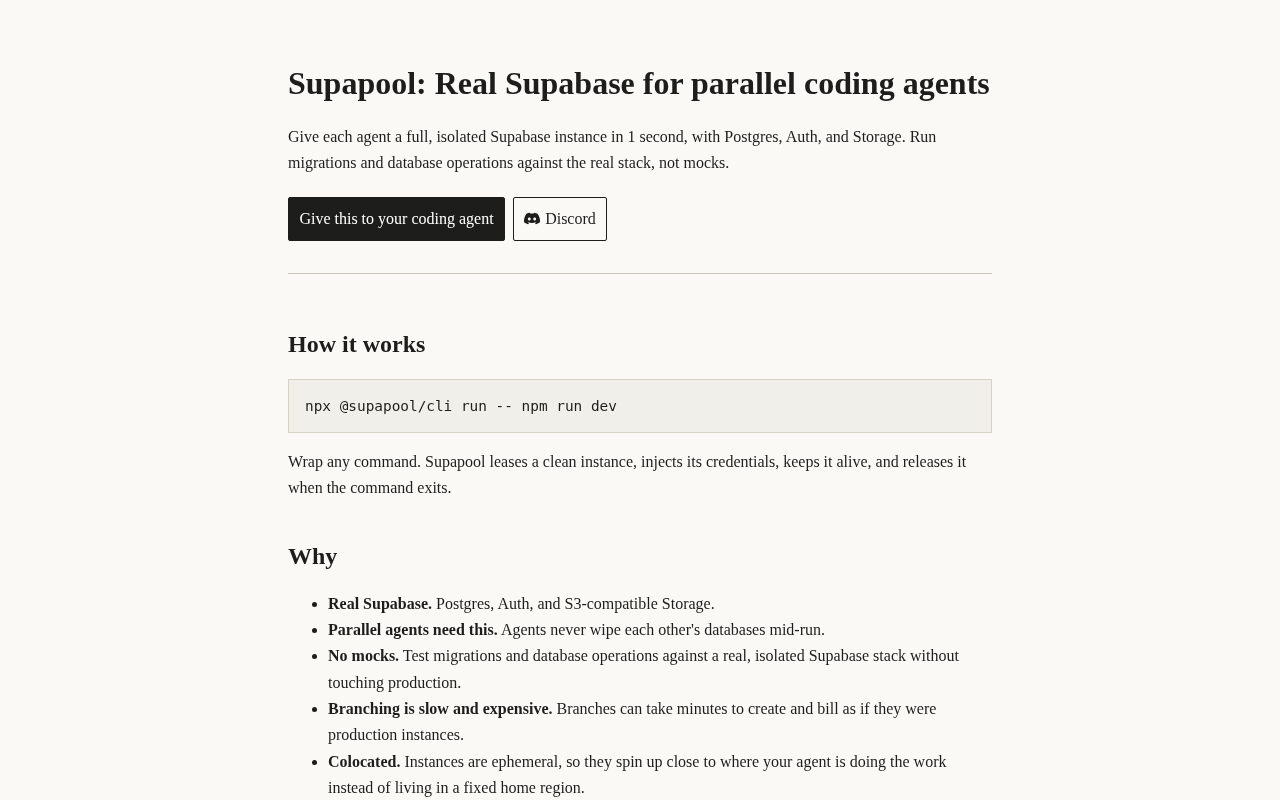
·2 min
Supapool: Creating Isolated Databases for AI Coding Agents in 400 Milliseconds
Supapool uses pool prewarming to create isolated Supabase database instances in 400ms for AI coding agents like Claude, Cursor, and Devin, solving the database isolation challenge.
Read more →

·3 min
Git Worktree Is Not an Isolation Boundary for AI Coding Agents: Real Sandboxing Solutions Explained
Analysis of why Git worktree fails as a security boundary for AI coding agents like Claude Code and Cursor, and why containers and VMs are the real solution.
Read more →

·2 min
SKI: A Free Voice Coding Tool That Gives Claude Code a Voice
SKI is a free locally-run voice coding tool that adds bidirectional voice conversation to Claude Code and Codex. Supports Mac and Windows with hotkey activation for hands-free AI-driven programming.
Read more →

·3 min
Greplica: A Self-Updating Code Knowledge Base Built for AI Coding Agents
Greplica is an open-source self-updating wiki for coding agents that auto-extracts decisions, constraints, and gotchas from sessions, enabling shared codebase memory across agents and developers.
Read more →

·3 min
Greplica: A Self-Updating Code Knowledge Base Built for AI Coding Agents
Greplica is an open-source self-updating Wiki for coding agents that automatically extracts decisions, constraints, and gotchas from sessions, enabling shared codebase memory across agents and developers.
Read more →

·2 min
Denovo Review: A Growth Tool for Taking AI Apps from Code to Paying Users
Deep dive into Product Hunt hit Denovo: how it helps indie devs turn vibe-coded AI apps into paying customers with pre-built Stripe, email automation, and Meta ads.
Read more →

·2 min
Task Monki: An Open-Source Multi-Agent Collaborative Programming Workflow Platform
Task Monki is an open-source desktop app that lets coding agents handle the full dev workflow from task planning to Pull Request, with multi-agent parallel execution, code review, and collaborative discussion.
Read more →

·3 min
Medley: A Deep Dive into the Multi-Agent Orchestration Plugin for Claude Code
Medley is a free Claude Code plugin that decomposes complex dev tasks into live task graphs via /mission, orchestrating multiple AI agents with BYOK model support and built-in review cycles.
Read more →

·2 min
MemoryCustodian: A Repo-Native Persistent Memory Store for Coding AIs
MemoryCustodian is an open-source tool that stores AI memory as Markdown files in your code repo, solving cross-session amnesia for Claude Code, Codex, and other coding assistants.
Read more →

·2 min
AgentQuartz: Real-Time Claude and Cursor Usage Monitoring from Your macOS Menu Bar
AgentQuartz is a macOS menu bar app for real-time monitoring of Claude and Cursor AI coding usage quotas. Local-first architecture protects privacy, core features are free forever, Pro is a one-time $3 purchase.
Read more →