#FLOPs
159 related articles

·1 min
FLOPs Are Intelligence, Parameters Are Knowledge: Understanding the Essence of AI Large Models in One Sentence
Exploring the insight that FLOPs represent intelligence (computational reasoning) while parameters represent knowledge (memory storage) in AI large language models.
Read more →

·3 min
GLM-5.2 Released: MIT Open Source + Million-Token Context Long-Horizon Task Benchmark
Zhipu releases flagship model GLM-5.2 with stable 1M token context, near Opus 4.8 performance on FrontierSWE, MIT open-source license with no geographic restrictions, and IndexShare architecture for reduced compute costs.
Read more →

·5 min
Topic Selection Guide for LLM Inference Optimization: How to Find Valuable Research Questions
A systematic guide to topic selection in LLM inference optimization, covering the distinction between research questions and engineering improvements, with high-value directions in KV Cache, speculative decoding, and serving systems.
Read more →

·3 min
Mythos Preview Parameter Scale Analysis: 10 Trillion Parameters and the Validation of Scaling Law
Cross-validating through pricing analysis, benchmarks, and compute estimation to analyze whether Anthropic's Mythos Preview reaches 10 trillion parameters and what this means for Scaling Law.
Read more →

·3 min
Full Record of Training a Minecraft Skin Generation Model from Scratch on a Single RTX 3060
A developer trained a Minecraft skin generation model from scratch on a single consumer RTX 3060 GPU over 18 months. This article covers UV texture constraints, low-resolution high-semantic-density challenges, and constrained generative modeling strategies.
Read more →
 Expert Opinions
·3 min
Rethinking Scaling Laws: Parameters Are Not the Only Answer
Deep analysis of Scaling Law evolution from Kaplan to Chinchilla to the MoE era, exploring why blindly stacking parameters is a mistake, and how GLM-5.3 proves scaling has multiple knobs.
Read more →

·3 min
Fine-Tuning Qwen3-4B in Practice: Fixing Role Confusion with Just 100 Data Samples
A hands-on guide to fine-tuning Qwen3-4B: solving role confusion with just 100-200 identity stability samples. Covers data strategy, evaluation methods, and MoE architecture plans.
Read more →
·2 min
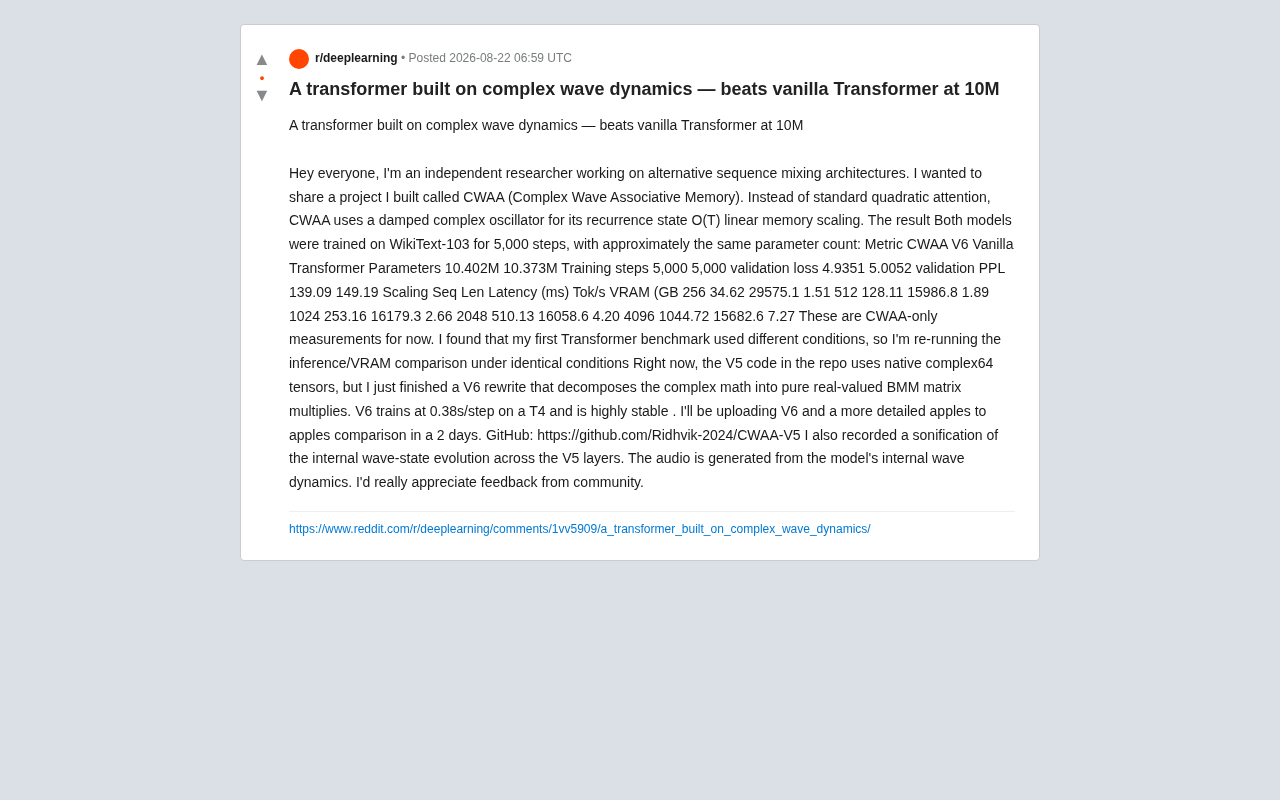
CWAA Architecture Explained: Replacing Transformer Attention with Complex Wave Dynamics
Deep dive into CWAA (Complex Wave Associative Memory), an architecture replacing Transformer self-attention with damped complex oscillators. At 10M parameters, it shows ~7% better perplexity with O(T) linear memory scaling.
Read more →

·3 min
GPU Memory Read Principles: A Deep Dive into Latency Hiding and Bandwidth Optimization
Deep dive into GPU memory read pipelines, from warp scheduling and memory coalescing to cache hierarchies, revealing how GPUs hide latency through massive parallelism with practical optimization guidance.
Read more →

·4 min
Running Qwen3 27B on a 4090: Q4 Quantization + 128K Context VRAM Calculation & Tuning Guide
Complete guide to deploying Qwen3 27B Q4 quantized model on a single RTX 4090, covering VRAM calculation, K8V4 asymmetric KV Cache quantization, 128K context configuration, and speed analysis.
Read more →

·2 min
CPU Simulation vs GPU Simulation: The Compute Architecture Debate Sparked by UniLabSim
Is GPU parallel simulation the only choice for robot reinforcement learning? UniLabSim argues CPU simulation remains competitive. We analyze the hidden costs of GPU simulation, CPU flexibility advantages, and the tech and business logic behind this compute debate.
Read more →

·5 min
How Undergraduates Without Research Advisors Can Start Independent Research
How can undergraduates without advisors or labs conduct independent research? This guide covers paper reproduction, open resources, finding remote mentors, and publishing — a complete path for resource-limited students.
Read more →

·3 min
DFlash 2: How Parallel Draft Decoding Accelerates Large Model Inference
Deep dive into DFlash 2's parallel draft decoding technology, explaining how its Keep Drafting Parallel mechanism breaks autoregressive bottlenecks for lossless LLM inference acceleration.
Read more →

·1 min
Compute-Optimal ≠ Cluster-Optimal: The Real-World Dilemmas of Distributed LLM Training and How to Overcome Them
Read more →

·3 min
Not Allocating AI Assets Is Itself a Risk
From real estate to trillion-scale computing, national wealth logic is shifting. With Tencent spending 50B+ yuan on AI in one quarter, learn why lacking AI exposure may be your portfolio's biggest hidden risk.
Read more →

·4 min
vLLM Deployment & Unsloth Fine-Tuning in Practice: A Complete Guide to LLM Inference Services
Complete guide to vLLM inference deployment and Unsloth fine-tuning, covering CLI deployment, Python integration, AutoDL cloud setup, and ModelScope acceleration with DeepSeek-OCR as a practical example.
Read more →

·3 min
Galileo's Square-Cube Law: Why Giants Are Physically Impossible
Galileo's 1638 Square-Cube Law reveals why giants can't exist: volume grows as the cube while area grows as the square, creating fundamental limits on scaling in engineering, biology, and AI.
Read more →

·3 min
NVIDIA Nemotron Open-Source MoE Model: A Large Language Model That Runs Locally on Your Laptop
NVIDIA launches the Nemotron open-source MoE model series with sparse activation, enabling efficient local deployment on laptops or DGX Spark. Learn about the MoE architecture and NVIDIA's tiered strategy.
Read more →

·4 min
Running a 26B LLM on AMD Integrated Graphics: Full GPU Inference and mmap Optimization Guide for Unified Memory Architecture
Benchmarking AMD Radeon 840M iGPU running Gemma 26B-A4B LLM with 32GB unified memory at 17 tok/s. Deep dive into Ollama's GPU/CPU misreporting, mmap bottlenecks, and optimization strategies for APU users.
Read more →

·4 min
Deep Dive into Kimi K3 Architecture: KDA, Stable Latent MoE, and Attention Residuals — Three Core Technologies Explained
Deep dive into Kimi K3's three core architecture technologies: KDA memory management, Stable Latent MoE with 896 experts activating only 16, and Attention Residuals — from math to implementation.
Read more →