#Feishu docs
21 related articles

·4 min
Feishu-Style Docs + AI Knowledge Base in Practice: A Complete Guide to RAG and TipTap Editor Development
Learn how to build a Feishu-style document system with TipTap editor, integrating AI auto-completion, document continuation, and RAG knowledge base Q&A with vector databases and Embedding.
Read more →

·2 min
Claude Code Chinese Tutorial: A 100-Page Systematic Learning Guide on Feishu Docs
A detailed look at the Claude Code Chinese learning resource on Feishu Docs, covering AI agent learning, memory systems, and task decomposition with a systematic path from beginner to advanced.
Read more →

·3 min
Vibe Coding at Big Tech: Frontend Practices and an AI Programming Interview Guide
An in-depth look at Vibe Coding (AI-assisted programming) at major tech companies. With three real AI coding interview questions from firms like ByteDance, we analyze how frontend developers can master AI programming and rebuild core competitiveness.
Read more →

·4 min
AI Testing in Practice: A Complete Guide to Three Types of AI Tools and the New Paradigm of Test Development
A complete guide to the three core categories of AI tools in the testing era (personal assistants, CLI geek tools, AI IDEs), revealing the real challenges of AI test case generation and the new AI test development paradigm.
Read more →

·3 min
Coze Deep Dive: Multi-Agent Collaboration Platform Architecture and Usage Guide
Deep dive into Coze's three core capabilities: multi-person multi-AI collaboration, customizable agents, and cross-platform project management. Covers credits, Dify comparison, and a practical learning path.
Read more →

·3 min
ByteDance Interviewer Deep Dive: How Vibe Coding Is Reshaping Frontend Engineers' Core Competitiveness
A ByteDance interviewer breaks down the 3-layer Vibe Coding interview framework: AI tool awareness, complex product engineering, and a 1-hour full-stack challenge. Architectural thinking wins.
Read more →

·4 min
The Complete Claude Code Guide: From Chat and CoWork to Automated Workflows
From Claude Chat to CoWork to Claude Code: a complete guide covering the three usage levels, Projects/Skills setup, MCP/CLI tool integration, and real automation workflows like fully automated knowledge video pipelines.
Read more →

·5 min
A Deep Dive into Cloud Coding Agents: How Users in China Can Choose Wisely
What exactly is the Cloud Coding Agent Silicon Valley is hyping? This article breaks down the core concept across three axes—where it runs, who watches, where tasks start—and gives users in China practical advice on local alternatives.
Read more →
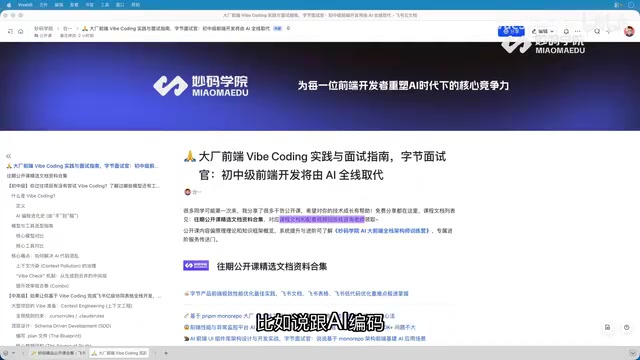
·6 min
Vibe Coding in Practice at Big Tech: How Frontend Engineers Can Avoid Being Replaced in the AI Era
A big-tech interviewer reveals: junior/mid frontend dev is being replaced by AI. This article breaks down 3 core Vibe Coding interview questions to help you master key skills for the AI-assisted coding era.
Read more →

·4 min
Why General-Purpose Agents Don't Work: How a Job Interview Reshaped One Developer's Thinking
An Agent developer's three-round interview reveals why general-purpose Agents are a dead end for startups. The path forward: vertical Agents, domain context, and iteration speed as a moat.
Read more →

·6 min
Skill vs MCP: The Essential Difference Between Two Types of AI Agent Capabilities and How They Work Together
Skill and MCP are two core concepts for building AI Agents. Skill encapsulates task execution methodology, while MCP provides a standardized protocol for connecting external tools. This article breaks down their core differences, abstraction levels, and collaboration.
Read more →

·4 min
Getting Started with Software Testing: A Complete Guide to Core Concepts and Classification Systems
A comprehensive guide to software testing fundamentals covering definitions, purposes, classification by phase, technique, and method, plus core concepts like smoke testing and regression testing.
Read more →

·2 min
Deep Dive into n8n Workflow Platform: Core Capabilities and Suitability Assessment for China
Deep dive into n8n's core capabilities including 500+ nodes, AI Agent building, and RAG integration, with an objective analysis of its limitations and suitability for use in China.
Read more →

·4 min
Agent Tool Selection Guide: A Comprehensive Comparison of API, CLI, MCP, Browser Use, and Computer Use
Compare 5 Agent tool types: CLI, API, MCP, Browser Use & Computer Use on speed, accuracy, and token cost. Includes a selection priority table to cut costs and boost Agent efficiency.
Read more →

·3 min
n8n from Beginner to Expert: A Complete Guide to Workflow Automation and AI Agent Development
A deep dive into n8n's workflow automation capabilities, covering its 500+ node ecosystem, AI Agent development, RAG system building, and practical tips for use in different regions.
Read more →

·1 min
Deep Dive into n8n Workflow Platform: Capability Boundaries and Suitability Assessment for the Chinese Market
Deep dive into n8n's core capabilities, 500+ node ecosystem, AI Agent integration, and the localization challenges it faces in China, with workarounds and suitability assessment.
Read more →
 Tutorials
·2 min
OpenClaw Step-by-Step Deployment Guide: From Local Installation to Multi-Platform Integration
Step-by-step OpenClaw open-source AI agent deployment guide covering local setup, cloud deployment, WeChat and Feishu integration, and custom Skills development.
Read more →
 Tutorials
·3 min
Claude Code in Practice: VibeCoding a Gomoku Game & Tips to Prevent Intelligence Degradation
Build a Gomoku game with Claude Code: learn three working modes, the development workflow, and core anti-degradation tips using Compact/Clear commands and context monitoring plugins.
Read more →
 Tutorials
·3 min
Cursor Interface Fully Explained: Master the Four Core Workspaces from Scratch
A detailed guide to Cursor's four core workspaces: File Explorer, Code Editor, Terminal, and AI Chat Panel. Learn Agent mode, Ask mode, Git version control, and key settings for beginners.
Read more →
 Tutorials
·2 min
Vibe Coding from Zero to $1 Million: A Complete Playbook for Indie Developers Going Global
Indie developer Owen shares a complete Vibe Coding playbook — from product portfolios to global monetization, covering AI coding tools, SEO traffic, and SaaS templates.
Read more →