#GraphRAG
55 related articles

·3 min
GBrain Local Deployment: 12-Step Deep Retrieval Pipeline Outperforms Traditional RAG by 31%
GBrain's 12-step deep retrieval pipeline and knowledge graph construction outperforms traditional RAG by 31% — with full local offline deployment for data security and lower API costs.
Read more →

·7 min
Previewing the AI Engineer Summit: Industry Signals of AI Engineering Reaching Maturity
An exclusive look at the AI Engineer Summit dress rehearsals, decoding the paradigm shift from research to production. A deep dive into AI Engineer challenges, RAG, agent systems, and AI engineering as a distinct discipline.
Read more →

·4 min
Career Switch to LLM Development: A Four-Level Skill Progression Roadmap
Want to switch careers into LLM development but don't know where to start? This guide breaks down a four-level skill roadmap — from basics and API calls to RAG, fine-tuning, Agent development, and multimodal — to help you build real AI career value.
Read more →

·5 min
Context Graphs: The Key Technology for AI Agents to Remember and Reuse Past Decisions
Context Graphs use graph structures to store decisions, causal relationships, and outcomes, enabling AI agents to accumulate experience and reuse historical decisions without modifying model weights.
Read more →

·7 min
Context Warp Drive: A Deep Dive into Deterministic Context Folding for AI Agents
An in-depth look at 'Deterministic Context Folding' from Context Warp Drive: solving AI agent context window management with reproducible, cacheable, debuggable context compression for production-grade agents.
Read more →

·6 min
Coze from Scratch: A Complete Guide to Building Multi-Agent Collaboration
A detailed guide to Coze's core features: cross-platform interoperability, the Skills system, multi-agent collaboration, and workflow building. Compare Coze and Dify to build practical AI apps with zero coding.
Read more →

·6 min
Getting Started with Vibe Coding: Building Software with Natural Language from Scratch
Vibe Coding lets you build software with no coding background—just talk to AI in natural language. Learn its core ideas, learning path, and practical tools.
Read more →
·7 min
Spring AI 2.0 in Practice: A Beginner's Guide for Java Developers Building AI Agents
A complete Spring AI 2.0 guide for Java developers covering unified API abstraction, RAG, tool calling, MCP protocol, and enterprise projects to build AI Agents.
Read more →

·6 min
LangChain 1.0 Comprehensive Guide: Three Core Frameworks and Hands-On AI Application Development
Deep dive into LangChain 1.0's architecture: LangChain framework, LangGraph multi-Agent orchestration, and LangSmith observability platform, with hands-on RAG and intelligent customer service projects.
Read more →

·7 min
The Complete Guide to AI-Powered Customer Service: How AI Is Reshaping Enterprise Service Systems
AI customer service is a core tool for digital transformation. This guide covers its value, use cases, and implementation logic, including efficiency gains, cost reduction, and data-driven optimization.
Read more →

·3 min
Building a RAG Q&A Workflow with Dify: A 4-Step Guide to Enterprise Knowledge Base Chatbots
Learn RAG fundamentals and build an enterprise knowledge base chatbot with Dify in 4 steps: data prep, model config, knowledge base import, and workflow orchestration.
Read more →

·7 min
AI Agent Practical Guide: From Content Generation to Enterprise Applications
A deep dive into AI Agent's two core directions: 2C content generation (text/images/video) and 2B enterprise applications (RAG/AutoGen/LLM integration). With real startup cases and practical methods.
Read more →
·8 min
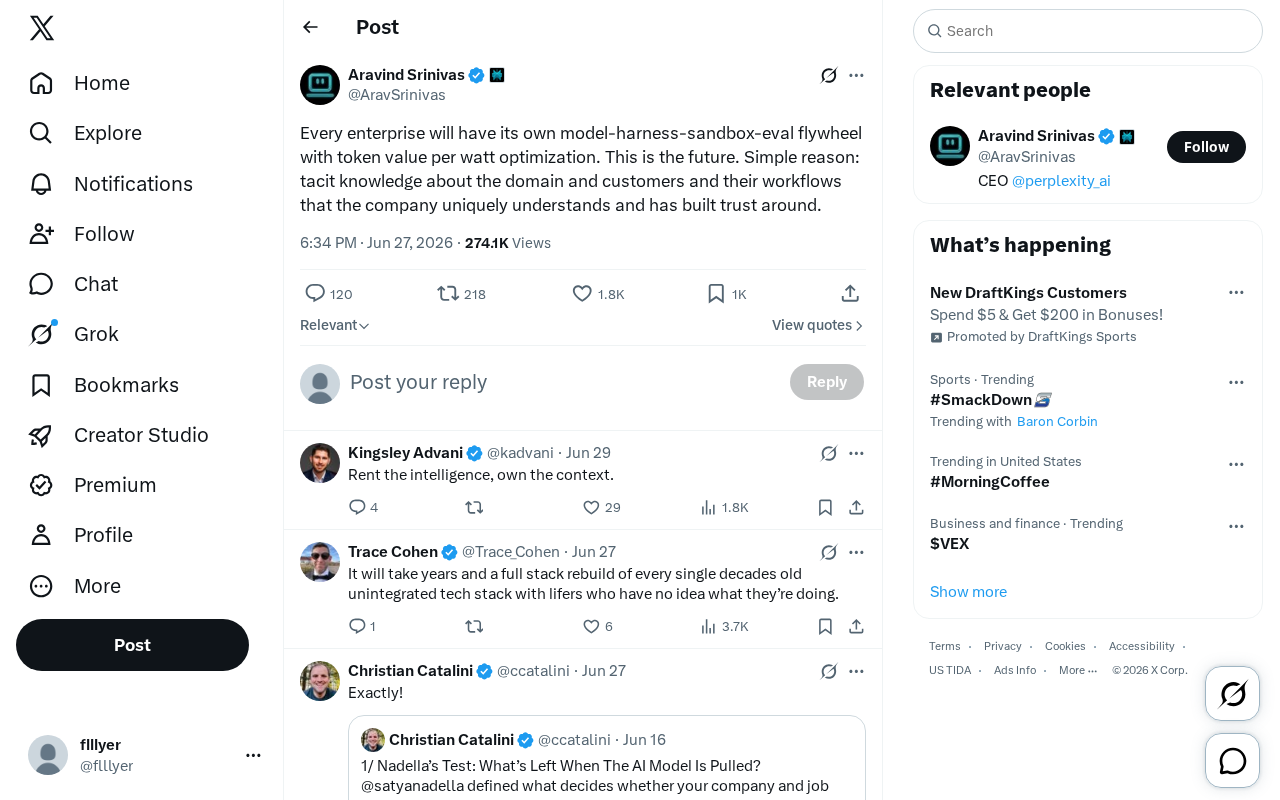
The Enterprise AI Flywheel: Building a Model-Eval Loop as a Competitive Moat
The core of enterprise AI isn't calling general models—it's building a self-reinforcing "model-harness-sandbox-eval" flywheel. This article analyzes the four components, tacit knowledge moats, and the "token value per watt" efficiency metric.
Read more →

·4 min
Building an Enterprise Knowledge Base with RAG: A Complete Guide from Principles to Optimization
A comprehensive guide to building enterprise knowledge bases with RAG, covering vector database selection, text chunking, Embedding models, multi-strategy retrieval, re-ranking, and Agent integration for high-accuracy AI Q&A systems.
Read more →

·3 min
AI Large Language Model Learning Roadmap from Scratch: From Beginner to Enterprise-Level Practice
A systematic AI LLM learning roadmap from scratch, covering Python basics, Prompt Engineering, RAG, Agent development, and enterprise-level projects.
Read more →

·4 min
Deconstructing the Core Principles of AI Agents: A Deep Dive into the Control, Perception, and Action Modules
A systematic breakdown of the three core AI Agent modules (Control, Perception, Action), with deep analysis of AutoGPT, BabyAGI, HuggingGPT, LlamaIndex architectures and Chain-of-Thought reasoning.
Read more →

·4 min
Is the 748-Episode AI Large Language Model Tutorial on Bilibili Worth Watching? A Full Breakdown of Content Structure and Study Tips
In-depth analysis of Bilibili's 748-episode AI LLM tutorial covering RAG, Agent, and fine-tuning. Includes content structure breakdown and practical study tips for beginners.
Read more →

·3 min
The Complete Evolution of RAG: A Six-Generation Journey from Naive Retrieval to Multimodal
A complete guide to RAG evolution from Naive RAG through Advanced, Agentic, Graph, and Multimodal RAG — covering core techniques, pain points solved, and real-world use cases.
Read more →

·3 min
LFM2.5 Local Deployment Hands-On: An 8B Parameter Model That Outperforms GPT-o3s in Tool Calling
Hands-on test of Liquid AI's LFM2.5 local deployment: architecture breakdown, 16GB VRAM troubleshooting, and GraphRAG tool-calling benchmarks vs GPT-o3s.
Read more →

·4 min
Complete AI Large Language Model Learning Roadmap: From Beginner to Production-Ready
A systematic guide to learning AI large language models, covering Transformer architecture, prompt engineering, RAG, AI Agents, fine-tuning, and enterprise projects from beginner to production-ready.
Read more →