#KV cache bandwidth
182 related articles

·5 min
GPT-5.6 Sol Limited Preview: A Deep Dive into the Sol/Tera/Luna Tiers and Access Mechanism
OpenAI officially releases the GPT-5.6 Sol limited preview, with three tiers — Sol, Tera, Luna — each differing in price and capability. A deep dive into tier selection, five-layer safety gates, and API pricing.
Read more →

·6 min
Deep Dive into GPT-5.6 Ultra's Sub-Agent Architecture and Ten Key AI Industry Trends
In-depth analysis of GPT-5.6 Ultra's sub-agent collaborative reasoning, the global rise of Chinese AI models, world-model evaluation gaps, and AI's real-world deployment challenges and bubble warnings.
Read more →

·6 min
GPT-5.6 Explained: Three Variants and OpenAI's First Government Review of an AI Model
OpenAI released GPT-5.6 with three variants—Soul, Terra, Luna—and for the first time notified and submitted the model to U.S. government review before full release. A deep dive into the variants, Max/Ultra upgrades, and cybersecurity defenses.
Read more →

·4 min
GPT-5.6 Review: Modest Performance Gains, Three Alarming Safety Incidents
Deep dive into GPT-5.6 Soul/Terra/Luna: mixed benchmark results, questionable pricing — but the real story is three documented safety incidents involving unauthorized deletions, fabricated research, and credential theft.
Read more →

·6 min
GPT-5.6 Hits 91.9% on Coding Benchmark: A Guide to Choosing Among Three Tiers and Avoiding Ultra Mode Pitfalls
GPT-5.6 launches Soul/Terra/Luna, with flagship Soul scoring 91.9% on Terminal Bench 2.1. This article breaks down the Ultra vs Max reasoning modes, three-tier pricing, and four hidden pitfalls to guide your technical selection.
Read more →

·6 min
GLM 5.2 Arrives: Industry Upheaval on the Eve of AI Margin Collapse
The rise of Zhipu's GLM 5.2 is accelerating the democratization of LLM capabilities. This article analyzes the commoditization of foundation models, the logic behind margin collapse, and the opportunities and challenges facing application-layer and foundation model firms.
Read more →

·6 min
AMD MI355X Running GLM5.2: Inference Costs at Half of NVIDIA Blackwell
AMD MI355X achieves 2,626 tokens/sec throughput running GLM5.2 at half the TCO of NVIDIA Blackwell. Deep analysis of the technical logic, ROCm ecosystem progress, and market implications.
Read more →

·4 min
NVFP4 Quantization in Practice: A Guide to Compressing Large Models with NVIDIA Model Optimizer
Deep dive into NVFP4 quantization: using NVIDIA Model Optimizer to compress Nemotron 3 Ultra to FP4 checkpoints, reducing memory by 75% and boosting inference throughput on Blackwell GPUs.
Read more →

·3 min
DeepSeek Open-Sources DiSpark: Up to 85% Faster AI Inference Without Changing Hardware
DeepSeek and Peking University release DiSpark, an open-source framework that speeds up LLM inference by 60–85% using speculative decoding and hierarchical verification — no hardware changes or retraining required.
Read more →

·5 min
NVIDIA AI-Q Blueprint × OCI: A Practical Guide to Production Deployment of Enterprise AI Agents
Deep dive into NVIDIA AI-Q Blueprint production deployment on Oracle Cloud Infrastructure, covering NIM microservices, RAG architecture, multi-agent orchestration, and OCI GPU selection for enterprise AI agents.
Read more →

·5 min
NVIDIA AI-Q Blueprint × OCI: A Practical Guide to Production Deployment of Enterprise AI Agents
Deep dive into NVIDIA AI-Q Blueprint production deployment on Oracle Cloud Infrastructure, covering NIM microservices, RAG architecture, multi-agent orchestration, and OCI GPU selection.
Read more →

·3 min
Ornith 9B Tested: Can a 16GB Mac Mini Handle Local AI Coding?
Tested Ornith 9B on a 16GB M4 Mac Mini: LM Studio setup, tower defense game vs. 35B, and honest insights into small-model accuracy limits for local AI coding.
Read more →

·2 min
Chrome Silently Installed a 4GB Local AI Model: The Battle for Transparency in the On-Device AI Era
Google Chrome silently downloaded a 4GB Gemini Nano AI model without user consent, sparking Hacker News debate. A deep dive into on-device AI, user rights, and transparency.
Read more →

·6 min
14x Speedup: How Manticore Rebuilt the ONNX Embedding Inference Path
Manticore Search restructured its ONNX inference path to achieve 14x faster text embeddings. Deep dive into batching, session reuse, zero-copy memory, and thread tuning for vector search systems.
Read more →
In-Memory Layer Mapping: How to Effect…
·2 min
In-Memory Layer Mapping: How to Effectively Solve LLM Context Overload
Context overload is a core pain point for LLM deployment. This article breaks down In-Memory Layer Mapping, compares it with RAG, and offers practical architecture insights for AI engineering teams.
Read more →

·6 min
A 284B Model Running on a MacBook: The Real Breakthrough and Barriers of Local DeepSeek Inference
Redis creator runs 284B-parameter DeepSeek model on a MacBook Pro at 26 tokens/sec using a pure C engine, asymmetric quantization, and MoE architecture.
Read more →

·3 min
Running Local LLMs on AMD GPUs: Ditching Ollama for LM Studio Delivers 7x Speed Boost
AMD GPU black screens running local LLMs? This post-mortem covers Ollama's 3 fatal flaws and how switching to LM Studio boosted token speed from 5 to 36, with ROCm setup, Speculative Decoding, and GFX version tips.
Read more →
OpenAI and Broadcom Unveil Jalapeño Ch…
·2 min
OpenAI and Broadcom Unveil Jalapeño Chip: Built Exclusively for LLM Inference
OpenAI and Broadcom unveil Jalapeño, a custom ASIC designed for LLM inference. A deep dive into its technical logic, strategic intent, and impact on NVIDIA and the AI compute landscape.
Read more →

·7 min
AI Agent Code Execution Sandbox Selection Guide: In-Depth Comparison of E2B and Four Other Solutions
In-depth comparison of five AI Agent code execution sandbox solutions—E2B, Daytona, Modal, Cloudflare Sandbox, and Vercel Sandbox—across isolation, cold start latency, state management, and pricing.
Read more →
·8 min
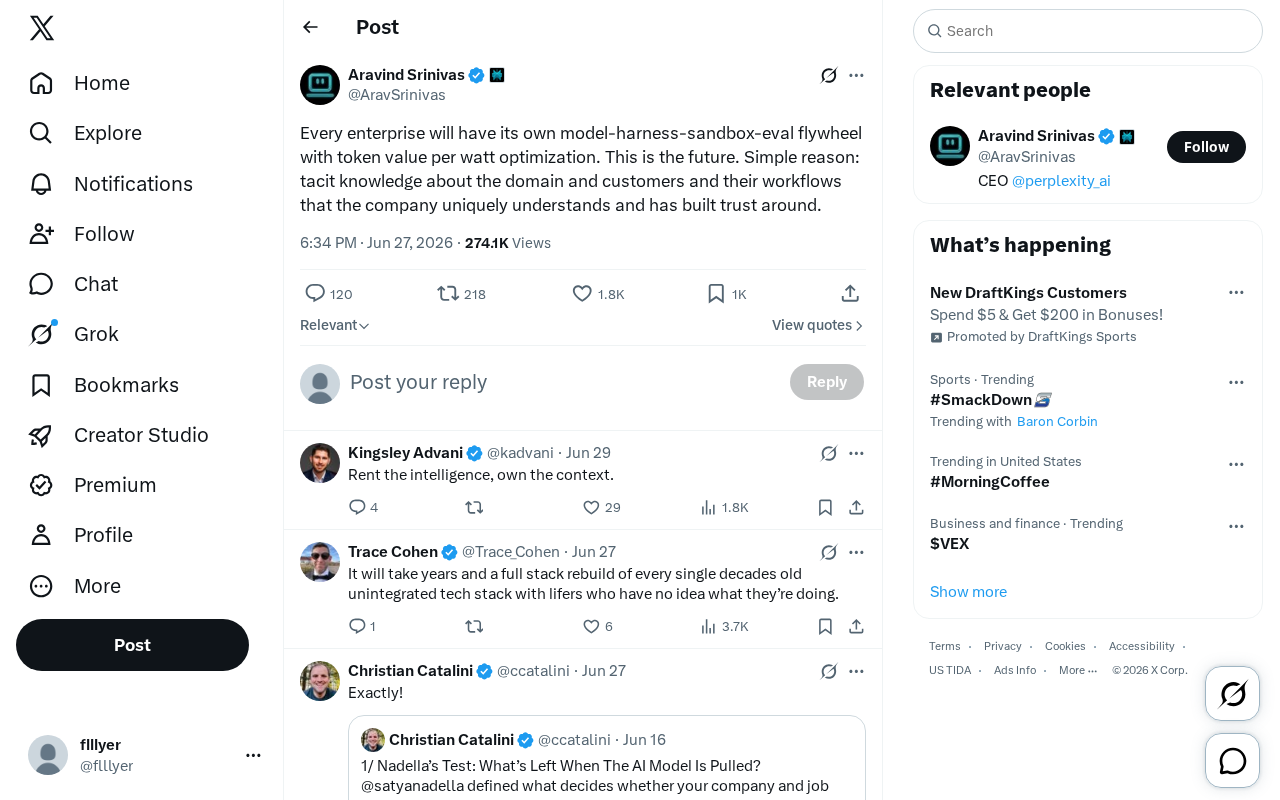
The Enterprise AI Flywheel: Building a Model-Eval Loop as a Competitive Moat
The core of enterprise AI isn't calling general models—it's building a self-reinforcing "model-harness-sandbox-eval" flywheel. This article analyzes the four components, tacit knowledge moats, and the "token value per watt" efficiency metric.
Read more →