#LLM interaction
2260 related articles
 Product Reviews
·2 min
One Prompt File to Make AI Write Truly Elegant Code
GitHub project yegor256/prompt uses a CLAUDE.md system instruction file to teach AI coding assistants to follow coding standards and generate high-quality, elegant code.
Read more →
 Product Reviews
·2 min
Claude Code Auto-Memory Plugin: Say Goodbye to AI Amnesia with Automated CLAUDE.md Maintenance
claude-code-auto-memory is an open-source plugin that automatically maintains CLAUDE.md memory files, enabling Claude Code to retain project context across sessions and eliminating AI amnesia.
Read more →
 Deep Dives
·3 min
Deep Dive into Claude Code's System Prompts: A 10K-Star GitHub Project Reveals How AI Coding Assistants Work Under the Hood
Deep analysis of the 10K-star GitHub project claude-code-system-prompts, fully deconstructing Claude Code's system prompts, 24 built-in tools, and sub-agent architecture for prompt engineering and AI Agent development.
Read more →
 Product Reviews
·3 min
NekroAgent Open-Source Framework: AI Agent Solution Supporting QQ, Discord, and Multiple Platforms
Deep analysis of NekroAgent open-source AI Agent framework supporting QQ, Discord, Telegram and more, with sandbox execution, long-term memory, MCP management, and visual console for multi-user scenarios.
Read more →
 Product Reviews
·2 min
Deep Dive Review of the Claude AI Assistant Open-Source Project: Enterprise-Grade Solution or Proof of Concept?
In-depth review of the claude-ai-assistant open-source project: analyzing its RAG architecture, knowledge base management, and maturity vs. competitors like Dify and FastGPT.
Read more →
 Product Reviews
·3 min
Bailing: Open-Source Voice Assistant with 800ms Low Latency, Rivaling GPT-4o Conversation Experience
Bailing is an open-source voice assistant using ASR+LLM+TTS architecture with DeepSeek R1 integration, achieving 800ms end-to-end latency with barge-in support, running smoothly on Mac and low-spec devices.
Read more →
 Product Reviews
·2 min
DeepSeek-Reasonix: A Terminal AI Coding Agent Optimized with Prefix Cache Stability
DeepSeek-Reasonix is an open-source terminal AI coding agent natively designed for DeepSeek models, achieving lower latency and API costs through prefix cache stability optimization.
Read more →
 Deep Dives
·3 min
Why WebRTC Is a Poor Fit for AI Voice: The Fatal Flaw of Latency-First Design
Analysis of WebRTC's design flaws for AI voice: its packet-dropping strategy corrupts user prompts and degrades LLM responses. Exploring how MoQ better balances data integrity with low latency.
Read more →
 Deep Dives
·3 min
Open-Source Replication of OpenAI Operator: Building a Computer-Controlling AI Agent in 48 Hours
A developer open-source replicated OpenAI's $200/month Operator in 48 hours using Anthropic Computer Use, building a full-stack Dockerized computer-controlling AI Agent with deep analysis of architecture and industry trends.
Read more →
 Deep Dives
·2 min
Claude-Claw Open Source Project Analysis: The Brain + Hands AI Agent Orchestration Architecture
Deep analysis of the Claude-Claw open-source project: how it combines Claude Code reasoning with OpenClaw GUI automation to build a brain + hands AI Agent orchestration architecture for autonomous computer control.
Read more →
 Deep Dives
·3 min
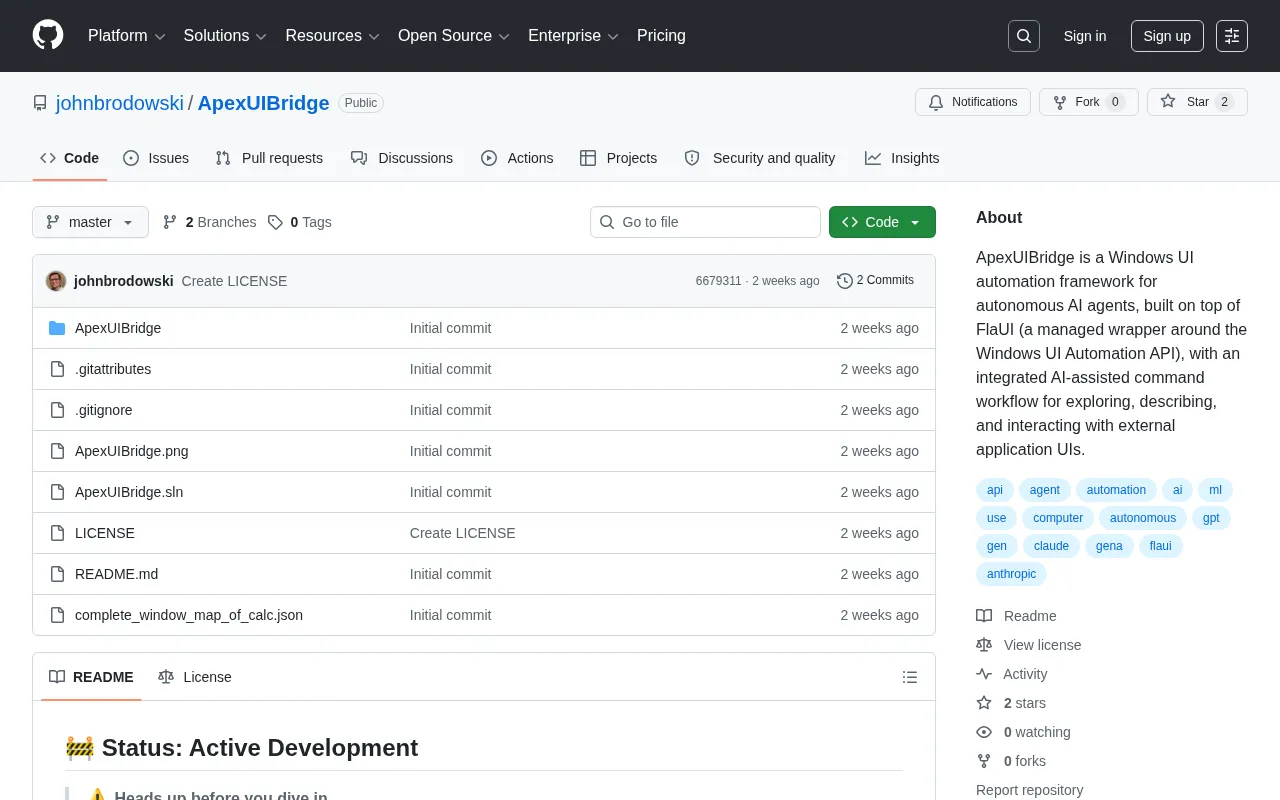
ApexUIBridge: A UI Automation Framework That Lets AI Agents Control Windows Desktop Applications
Deep dive into ApexUIBridge, an open-source AI agent automation framework built on FlaUI and Windows UI Automation API, enabling UI exploration, semantic description, and interaction with desktop apps.
Read more →
 Deep Dives
·3 min
Open Computer Use: An Open-Source Framework for AI Agents to Autonomously Control Computers
Open Computer Use is an open-source TypeScript AI agent framework enabling automated computer control via browser, terminal, and desktop. Learn about its features, architecture, and comparison with Claude Computer Use.
Read more →
 Deep Dives
·2 min
best-agent: A Self-Evolving Multi-Agent Framework Built on Claude Code
Deep analysis of best-agent, a self-evolving AI Agent framework built on Claude Code with 94+ skills, 14 specialized agents, and Computer Use capabilities.
Read more →
 Deep Dives
·3 min
Auto-Use Open Source Project Explained: One AI Agent to Handle Your OS, Browser, and Code
Deep dive into the Auto-Use open source project—an end-to-end AI Computer Use Agent that unifies OS control, browser automation, and coding. Analysis of architecture, competitors, and industry trends.
Read more →
 Deep Dives
·2 min
computer-use-windows: An Open-Source Framework for Building AI Desktop Agents on Windows
An open-source project based on Anthropic's Computer Use API, computer-use-windows enables AI agents to directly control the Windows desktop for automation tasks including office workflows and software testing.
Read more →
 Deep Dives
·3 min
Factifai: A Deep Dive into the Visual AI-Powered Open-Source Tool for CI/CD Automated Testing
Deep dive into how Factifai Agent Suite uses vision LLMs like Claude and GPT-4o to replace DOM selectors for natural language-driven automated testing with seamless CI/CD integration.
Read more →
 Deep Dives
·2 min
Deep Dive into open-computer-use: An Open-Source Computer Control Agent with 82% Accuracy
Deep dive into the open-source project open-computer-use, a computer control agent achieving 82% accuracy on OSWorld benchmark. Covers its TypeScript stack, remote/local deployment, and RPA applications.
Read more →
 Deep Dives
·2 min
Computer Agent: An Open-Source Rust AI Desktop Agent That Automatically Controls Mouse, Keyboard, and Browser
Computer Agent is an open-source AI desktop agent built in Rust that controls terminals, browsers, mice, and keyboards via natural language. Explore its features, architecture, and security.
Read more →
 Deep Dives
·2 min
OS AI Computer Use: A Cross-Platform Open-Source AI Desktop Automation Tool Explained
OS AI Computer Use is an open-source AI desktop automation tool supporting Windows, macOS, and Linux with OpenAI and Anthropic API compatibility. Learn about its features, architecture, and safety tips.
Read more →
 Tutorials
·3 min
Using HTML Instead of Markdown: An Overlooked AI Output Format Optimization Technique in Prompt Engineering
An Anthropic Claude team member reveals: asking AI to output in HTML enables SVG diagrams, interactive components, and color coding that Markdown can't achieve. Learn the principles and practice.
Read more →