#LLM stateless
247 related articles
jcode Deep Dive: Why Rust Is the Ideal…
·3 min
jcode Deep Dive: Why Rust Is the Ideal Foundation for a Coding Agent Framework
jcode is an open-source Coding Agent framework built in Rust, gaining nearly 200 GitHub Stars in a day. Explore its architecture, Rust advantages, and application potential.
Read more →
·2 min
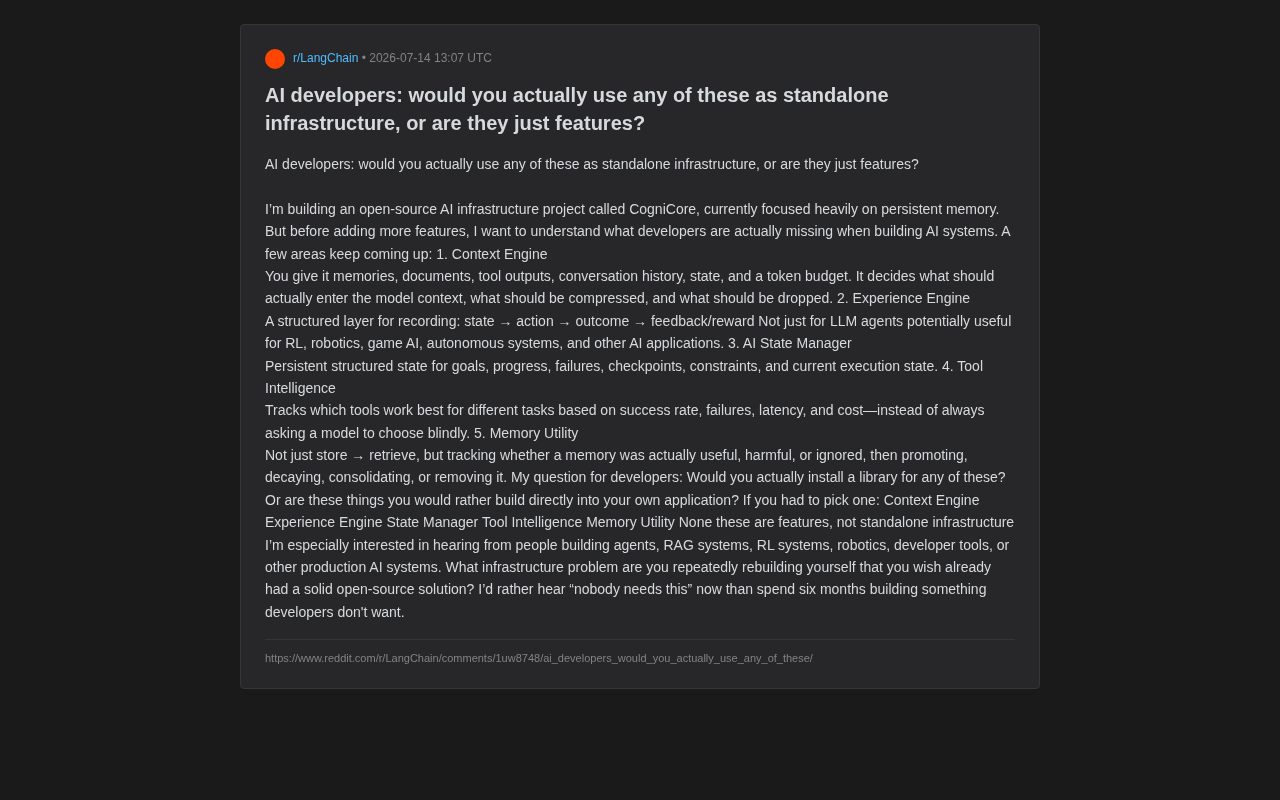
AI Infrastructure or App Feature? The Architecture Debate Sparked by CogniCore
CogniCore asks: should persistent memory, context engines, and state management be standalone AI infrastructure or in-app features? A deep dive into 5 key directions and the missing middleware of the agent era.
Read more →

·2 min
LangChain Agent Email Integration: Gmail API vs AgentMail — A Practical Comparison
Integrating email into LangChain agents: Gmail API's OAuth flow is too complex, while AgentMail offers a lightweight agent-native email API. A practical engineering comparison.
Read more →
Cognee: The Open-Source Knowledge Grap…
·2 min
Cognee: The Open-Source Knowledge Graph Engine for Persistent AI Agent Memory
Cognee is an open-source AI memory platform using knowledge graphs to give AI agents persistent cross-session memory. Self-hosted, graph + vector hybrid retrieval. 28K+ GitHub stars.
Read more →

·3 min
Multica: An Open-Source Tool for Managing Multiple AI Coding Agents from a Single Dashboard
Multica is an open-source AI Agent management tool that unifies Claude Code, Codex, Cursor and more into one visual dashboard with kanban, task queues, and cloud deployment support.
Read more →
Claude Is Mr. Meeseeks: The Disposable…
·2 min
Claude Is Mr. Meeseeks: The Disposable Nature of AI Agents and Its Engineering Implications
Using Rick and Morty's Mr. Meeseeks to explain Claude and AI agents: stateless execution, task atomicity, and multi-agent recursive failure risks. A deep dive for developers building better AI workflows.
Read more →

·5 min
AI Coding Getting Worse With Every Edit? Skills v1.1 Reveals the Real Cause and Solution
AI code getting messier with edits? The root cause isn't weak model capability but a lack of context and process. A deep dive into Matt Pocock's Skills v1.1: grilling, vertical-slice tickets, TDD, and WebFinder.
Read more →

·3 min
DeepAgents in Practice: A Complete Guide to Building a HarmonyOS Automated Testing Agent
A deep dive into DeepAgents' core mechanisms, with a hands-on guide to building a HarmonyOS automated testing Agent — covering create_deep_agent, LangChain comparison, and long-chain task planning.
Read more →

·4 min
Loop Engineering in Practice: Designing and Deploying a Multi-Agent Collaborative Development System
A deep dive into Loop Engineering: how multi-agent collaborative dev systems achieve automated coding loops through workflow scheduling, step isolation, and validation.
Read more →

·4 min
Viktor: The AI Employee Living Inside Slack — How to Build a True Company-Wide AI Colleague
Viktor is a Slack-native AI employee with 3,000+ integrations and team-shared context. Learn how it evolved from browser agents to company-level AI, tackling memory, permissions, and proactivity.
Read more →

·3 min
ASE Control Panel: How STATE_SYNC Tokens Enable AI State Persistence
A deep dive into ASE's core mechanism — the STATE_SYNC checkpoint token — and how it transforms stateless LLMs into stateful AI systems for complex multi-turn workflows.
Read more →

·4 min
LangChain + LangGraph Full-Stack in Practice: A Production-Ready Guide to Six Core Modules and Agent Deployment
A systematic breakdown of LangChain's six core modules (Models/Prompts/Chains/Memory/RAG/Agent) and LangGraph's state graph, persistence, and HITL — with production deployment tips.
Read more →
ContextVault: Building a Shared Memory…
·2 min
ContextVault: Building a Shared Memory Layer for Team AI Collaboration
ContextVault builds a shared memory layer for team AI collaboration, tackling fragmented AI context and knowledge silos. Explore its technical positioning, use cases, and challenges in context engineering.
Read more →

·3 min
AI Teams in Action: How MiniMax M3 Uses Multi-Agent Collaboration to Reinvent Content Creation
MiniMax M3-powered AR assistant M-Code automates the full content creation pipeline through four specialized agents: planning, recording, drafting, and review.
Read more →
Capn-hook: Breaking the Cycle of Repet…
·2 min
Capn-hook: Breaking the Cycle of Repetitive Exploration for Coding Agents
Capn-hook is an open-source hook-based tool that helps coding agents retain knowledge across sessions—eliminating redundant exploration and turning one-time discoveries into reusable engineering assets.
Read more →

·2 min
Spring AI in Action: A Complete Guide to LLM Integration for Java Developers
Spring AI is Java's answer to LangChain — offering unified multi-model APIs, structured output, RAG, Tool Calling, and MCP protocol support for enterprise LLM development.
Read more →

·6 min
A Deep Dive into OpenAI Codex: How AI Engineers Are Reimagining Software Development with Agents
OpenAI Codex is redefining how AI engineers work: from code completion to autonomous Agents, from single-threaded to parallel Value Maxing. A deep dive into the Codex App architecture, open ecosystem, and Manager of Agents practice.
Read more →

·4 min
From Tokens to Agents: A Complete Guide to Core AI Concepts
Master 8 core AI concepts — LLM, Token, Context Window, Prompt, Tool, Agent, MCP, and Agent Skill — and understand the complete logic chain behind AI's evolution.
Read more →

·2 min
LangChain Chain & Memory: Building AI Applications with Persistent Memory
Learn how LangChain's Chain and Memory components overcome LLM limitations. Build intelligent AI apps with multi-step workflows and persistent memory.
Read more →

·4 min
Agent Loop in Practice: A Guide to Building Self-Improving Automation with Guardrails
A deep dive into building verifiable, self-evolving Agent automation loops with Claude Code and Codex — covering Loop Contracts, four trigger types, three-phase execution architecture, and Evolve Loops.
Read more →