#LangGraph Cloud
205 related articles

·3 min
AI Second Brain Tech Stack: Building a Proactive Intelligent Assistant for ADHD Users
How to build a true AI second brain for ADHD users: LangGraph, n8n, RAG, vector databases, and layered architecture for a proactive personal assistant.
Read more →

·3 min
Cosmonapse: A Decentralized Multi-Agent Framework Built on an Event Bus
Cosmonapse is an open-source multi-agent framework that replaces central orchestrators with peer nodes, using typed signals and an event bus to fully decouple tool calls, memory, and HITL. Supports Python and TypeScript under Apache 2.0.
Read more →

·3 min
Coze Deep Dive: Multi-Agent Collaboration Platform Architecture and Usage Guide
Deep dive into Coze's three core capabilities: multi-person multi-AI collaboration, customizable agents, and cross-platform project management. Covers credits, Dify comparison, and a practical learning path.
Read more →

·2 min
GPT-5.6 Soul In-Depth Review: Can Multi-Agent Programming Mode Reshape the AI Development Tools Landscape?
GPT-5.6 Soul review: Super Mode hits 91.9% on TerminalBench. We break down multi-agent scheduling, benchmark controversies, and real-world dev tool comparisons.
Read more →

·2 min
Spring AI Alibaba Graph in Action: Build an HR Recruitment Workflow Agent from Scratch
Build a full HR recruitment Workflow Agent with Spring AI Alibaba Graph: résumé scoring, interview generation, Human-in-the-Loop, and state rollback across 20 technical concepts.
Read more →

·2 min
From Doodle to Charcoal Sketch: An AI Drawing Agent for reMarkable Tablets
A developer built a multi-agent system to convert reMarkable tablet doodles into editable charcoal sketches using Qwen, image generation, and multi-layer vectorization — for just $0.04 per run.
Read more →

·4 min
LangChain + LangGraph Full-Stack in Practice: A Production-Ready Guide to Six Core Modules and Agent Deployment
A systematic breakdown of LangChain's six core modules (Models/Prompts/Chains/Memory/RAG/Agent) and LangGraph's state graph, persistence, and HITL — with production deployment tips.
Read more →

·2 min
GPT-5.6 Deep Dive: Tiered Models + Multi-Agent Architecture, LLMs Evolve into Workflow Engines
GPT-5.6 isn't just a capability upgrade — it's an architectural shift: tiered models, programmatic tool calling, and multi-agent collaboration turn LLMs into workflow engines for production systems.
Read more →

·3 min
Waku Agent Deep Dive: The Four Core Pillars of a Local-First AI Assistant
A deep dive into Waku Agent's four pillars: Loop Engineering, three-tier Memory system, Eval assessment, and the Harness scaffold. Full walkthrough of a local-first AI assistant from task execution to memory consolidation.
Read more →
Production-Grade LangGraph Template: A…
·2 min
Production-Grade LangGraph Template: A Practical Guide to Engineering AI Agents for Production
A deep dive into production-grade LangGraph templates covering state management, observability, error handling, and containerized deployment to bridge the gap from demo to production.
Read more →
·2 min
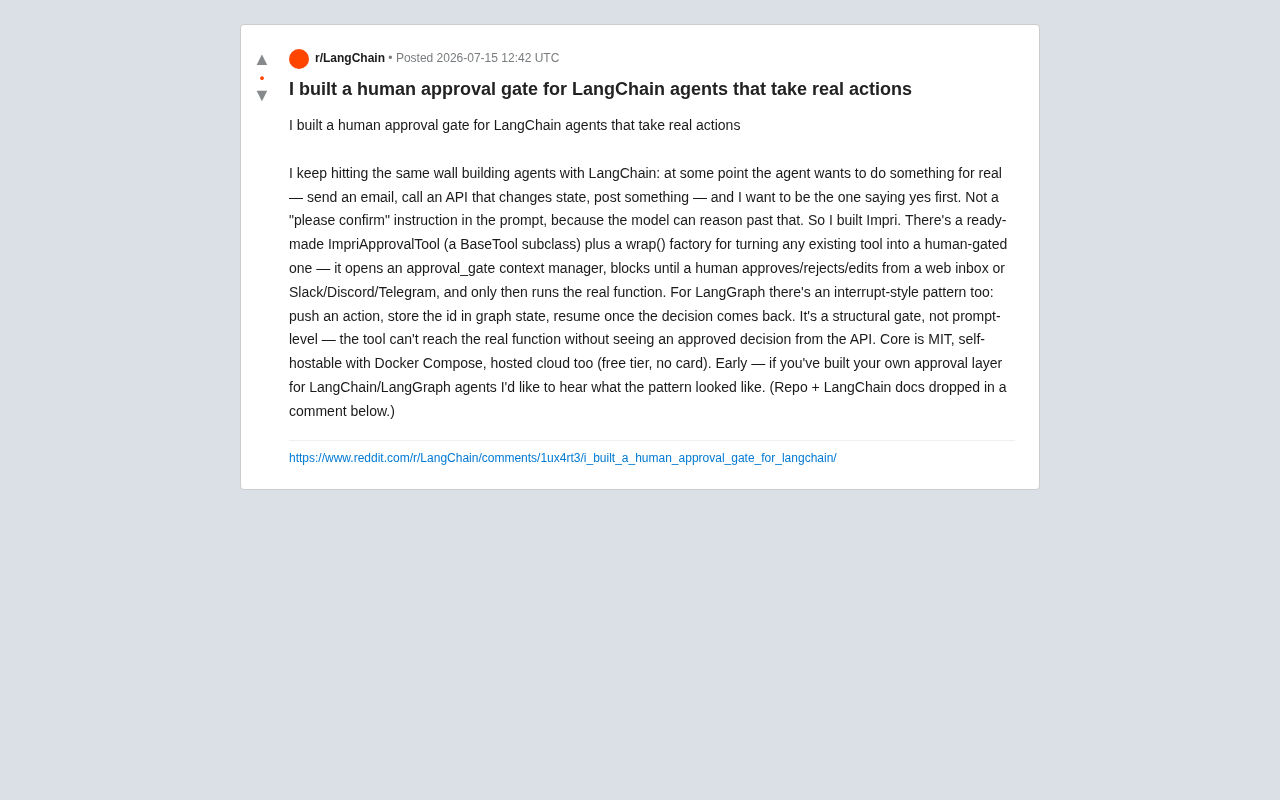
Impri: A Structural Human Approval Gateway for AI Agents
A deep dive into Impri — a structural human approval gateway for LangChain/LangGraph agents, exploring why prompt-level constraints fail and how code-layer gates enable reliable human-in-the-loop AI.
Read more →
PlanWright: A Control Plane and Multi-…
·2 min
PlanWright: A Control Plane and Multi-Agent Orchestration Layer for AI Coding Agents
PlanWright is a control plane for AI coding agents, drawing on Kubernetes orchestration principles to tackle multi-agent task assignment, state tracking, and collaboration conflicts.
Read more →

·4 min
LangChain in Practice: Mastering the Four Core Modules of the Agent Ecosystem
A deep dive into LangChain's four core modules: LangChain components, LangGraph orchestration, Deep Agents, and LangSmith. Build your first Agent from scratch.
Read more →
There's No Best Agent Framework — Only…
·2 min
There's No Best Agent Framework — Only the Right One for Your Needs: A Deep Comparison of Leading Options
LangGraph, PydanticAI, OpenAI Agents SDK, CrewAI — a senior developer's practical guide to choosing the right AI Agent framework for your project.
Read more →
·3 min
LangChain Practical Guide: From RAG Applications to Intelligent Agent Development
A comprehensive guide to LangChain: core concepts, RAG applications, Agent development, version selection (0.3/1.0), and career opportunities for Java/Python developers entering LLM development.
Read more →

·4 min
Claude Code vs. Codex vs. Cursor: A Deep Comparison of Three AI Coding Tools
Claude Code, Codex, or Cursor? This in-depth comparison covers each tool's positioning, ideal users, and how to combine them for maximum productivity in your AI coding workflow.
Read more →

·5 min
How Can Working IT Professionals Learn AI Efficiently? A Practical Learning Path from Zero to Real-World Projects
Limited time but want to learn AI systematically? This guide maps out a practical learning path for working IT pros—from AI application engineering and prompt engineering to RAG and Agents.
Read more →

·5 min
Can a Mixture of Experts Beat a Single Large Model? A Deep Dive into the Hermes 2.0 Architecture
A hands-on analysis of the Hermes 2.0 hybrid multi-agent system: can multi-model collaboration beat a single top-tier LLM? We break down how the Mixture of Experts (MoE) architecture works, AgentOS features, and model-agnostic design.
Read more →

·6 min
GPT-5.6 Sol Hands-On: How Multi-Agent Parallelism Is Reshaping AI Coding Workflows
Based on Fireship's review, an in-depth look at GPT-5.6 Sol's Ultra Mode multi-agent parallelism, its 91.9% Terminal Bench score, and how it differs from Claude Fable in cost, speed, and precision.
Read more →

·3 min
Getting Started with AI Agent Development: A Three-Step Practical Path with Python + LangChain
Learning AI Agent development is no longer daunting! This article outlines the simplest practical path: master just enough Python, grasp core LLM concepts, then build your first Agent with LangChain.
Read more →