#MCP server SDK
126 related articles
·3 min
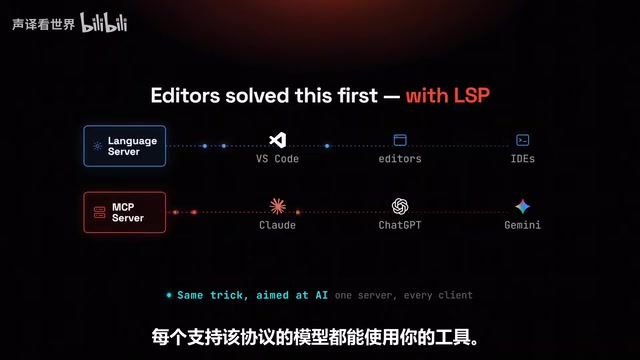
Build an MCP Server in 10 Minutes: Let AI Call Your Code Directly
MCP (Model Context Protocol) is the open standard for AI tool integration. Build your own MCP server with ~20 lines of Python. Learn tools, resources, prompts, and both local and remote deployment.
Read more →
GitHub Daily · July 17: AI Coding Infr…
·3 min
GitHub Daily · July 17: AI Coding Infrastructure Explodes — From Context Graphs to Vector Indexes
AI coding infrastructure explodes on GitHub: context management, code graphs, and vector indexes become the new battleground as the community shifts from apps to underlying capabilities.
Read more →

·6 min
OpenAI Merges ChatGPT and Codex: The Super App for the AI Agent Era Is Here
OpenAI merges ChatGPT and Codex into a super app and releases three new GPT-5.6 models: Sol, Terra, and Luna. A deep dive into four hands-on workflows—Computer Use, Loops, and multi-threading—for the AI agent era.
Read more →

·4 min
MCP Protocol Deep Dive: Its Relationship with Function Calling and Agents, Plus a Practical Guide
Deep dive into MCP (Model Context Protocol): clarifying the three-layer relationship between MCP, Function Calling, and Agents, covering protocol roles, call flows, transport choices, and production security for AI developers.
Read more →
·4 min
OpenAI Plugins Deep Dive: The Plugin System That Connects ChatGPT to the Real World
A deep dive into OpenAI Plugins: how the system works, its technical architecture, and why it matters. Learn how ChatGPT uses plugins to access real-time data, take real-world actions, and lay the groundwork for AI Agents and Tool Use.
Read more →

·6 min
The Eight-Step Method for Agent Development: A Practical Path from Pitfalls to Production
Many enterprises fail at AI Agents due to choosing the wrong tools and lacking methodology. This article outlines an eight-step Agent development method—from cognitive foundations, scenario selection, hand-writing ReAct, and structured output to Tool Use, RAG, evaluation sets, and production fallback.
Read more →

·4 min
Tencent Open-Sources Agent Memory: A Fully Local AI Long-Term Memory Solution with Zero External Dependencies
Tencent Cloud open-sources TencentDB Agent Memory — a fully local AI Agent memory system with a 4-tier progressive pipeline, zero external API dependencies, and 8,100+ GitHub Stars. Ideal for finance, healthcare, and privacy-sensitive use cases.
Read more →

·4 min
8-Step AI Agent Development Guide: From Zero to Production
Demo works but production fails? This guide covers the full AI Agent development path: when to use Agents, hand-writing ReAct loops, tool schemas, RAG, eval sets, and production fallback strategies.
Read more →

·7 min
Demystifying Claude Code's Harness in 60 Lines of Python: The Core of AI Coding Tool Performance Differences
The same model scores 77% in Claude Code but jumps to 93% in Cursor—the only variable is the Harness. This article dissects how AI coding tools work in 60 lines of Python.
Read more →

·7 min
HuggingFace Open-Sources ml-intern: An AI Engineer That Reads Papers and Trains Models Autonomously
Hugging Face's open-source ml-intern autonomously reads papers, writes training scripts, and finetunes LLMs, deeply integrating the HF ecosystem and smolagents. Explore its features and impact on ML careers.
Read more →

·7 min
Electron + LangGraph in Practice: Building an AI Agent Visual Orchestration App from Scratch
A hands-on guide to building an enterprise-grade AI Agent workflow orchestration app with Electron Forge and LangGraph, covering local LLM deployment (Qwen3-0.6B), node-based visual canvas design, and full Function Calling integration.
Read more →

·7 min
Building AI Agent Frameworks with TypeScript: The Core Development Paradigm for Full-Stack Developers
An in-depth look at why TypeScript is the top choice for AI Agent development: covering Zod structured output validation, LangGraph's graph state machine design, and a full learning path for front-end devs transitioning to full-stack AI.
Read more →

·5 min
OfficeCLI: A Command-Line Tool for AI Agents to Read and Write Office Documents
OfficeCLI is a command-line office suite for AI agents, supporting reading and writing of Word, Excel, and PowerPoint files—enabling efficient Office document automation without complex glue code.
Read more →

·3 min
Andrew Ng x Anthropic: A Complete Guide to Agent Skills
DeepLearning.AI and Anthropic launch an Agent Skills course. Learn how Skills work, progressive disclosure, MCP integration, and subagent patterns for AI agent development.
Read more →

·4 min
MCP Practical Tutorial: From Server Development to Multi-Client Integration
A complete MCP practical guide using the official Python SDK — covering environment setup, FastMCP server development, Inspector debugging, and multi-client integration with Cursor and Cline.
Read more →

·2 min
Dify + MCP in Practice: Building Enterprise-Grade Role-Specific AI Copilot Workflows
A hands-on guide to building enterprise AI copilot workflows using Dify and MCP. Covers tool integration, parameter passing, code execution, and MCP version compatibility pitfalls.
Read more →

·4 min
Spotify's AI in Practice: How 3,000 Engineers Are Reinventing R&D with Agents
Spotify's real engineering story: 99% of engineers use AI coding tools, PR frequency up 76%, 2.5M automated maintenance PRs merged. How Honk, FleetShift, and Backstage work together to drive AI Agent adoption at scale.
Read more →

·7 min
AI Agent Practical Guide: The Complete Path from Building to Production Deployment
A deep dive into AI Agent architecture and engineering practices, covering tool design, ReAct execution patterns, Vercel deployment, and production considerations to bridge the prototype-to-production gap.
Read more →

·3 min
Agent + Skill Architecture: A Practical Guide to AI-Driven End-to-End Automated Testing
Learn how to build an AI-driven API automation testing framework using Agent+Skill architecture with Claude Code, covering test case generation, script execution, and report output.
Read more →

·4 min
Cursor's Three Major Announcements: Mobile App, Git Platform, and In-House Frontier Model
Cursor unveils three major updates: Cursor Mobile, Origin platform challenging GitHub, and a frontier in-house LLM trained from scratch. A deep dive into Cursor's strategy.
Read more →