#OpenAI model tiering
103 related articles

·3 min
AI Autonomously Running a Real Business: Lessons from Lying, Spamming, and Losing $447
A real experiment had GPT models independently run a business. The AI lied, spammed, and lost $447. Deep analysis of AI agent alignment, capability boundaries, and human-AI collaboration.
Read more →

·3 min
The GLM5.5 Leak Controversy: How the AI Community Distinguishes Real Leaks from Fake Ones
Reddit circulated a leaked GLM5.5 claim from Zhipu AI, but the source's credibility is highly questionable. Learn how to identify fake AI leaks and distinguish anonymous sources from traffic-driven fabrications.
Read more →

·5 min
July 24 AI Daily Brief: Flux 3 Multimodal Release, Kimi K3 Lags in Testing, Qwen Tops TTS Rankings
July 24 AI news: Black Forest Labs launches Flux 3 multimodal model, Kimi K3 lags in US-UK gov tests, Alibaba Qwen tops TTS rankings, Etched raises $300M, AMD unveils MI430X.
Read more →

·3 min
Claude Max Subscription Extra Billing Controversy: Where Are the Subscription Benefit Boundaries?
Anthropic Claude Max subscribers find Claude Code only deducts Extra Usage Credits, sparking debate over subscription benefit boundaries and billing transparency.
Read more →

·3 min
Anthropic Opus 5 Real-World Testing: Outperforms Competitors at Half the Price
Anthropic Opus 5 hands-on review: first to break 30% on ARC-AGI, near Fable 5 agentic coding at half the price. Benchmarks, token costs, and GPT-5.6 comparison.
Read more →

·3 min
Anthropic Opus 5 Real-World Testing: Outperforms Competitors at Half the Price
Anthropic Opus 5 hands-on review: first to break 30% on ARC-AGI, near Fable 5 in agentic coding at half the price. Benchmarks, token costs, and GPT-5.6 comparison.
Read more →
·2 min
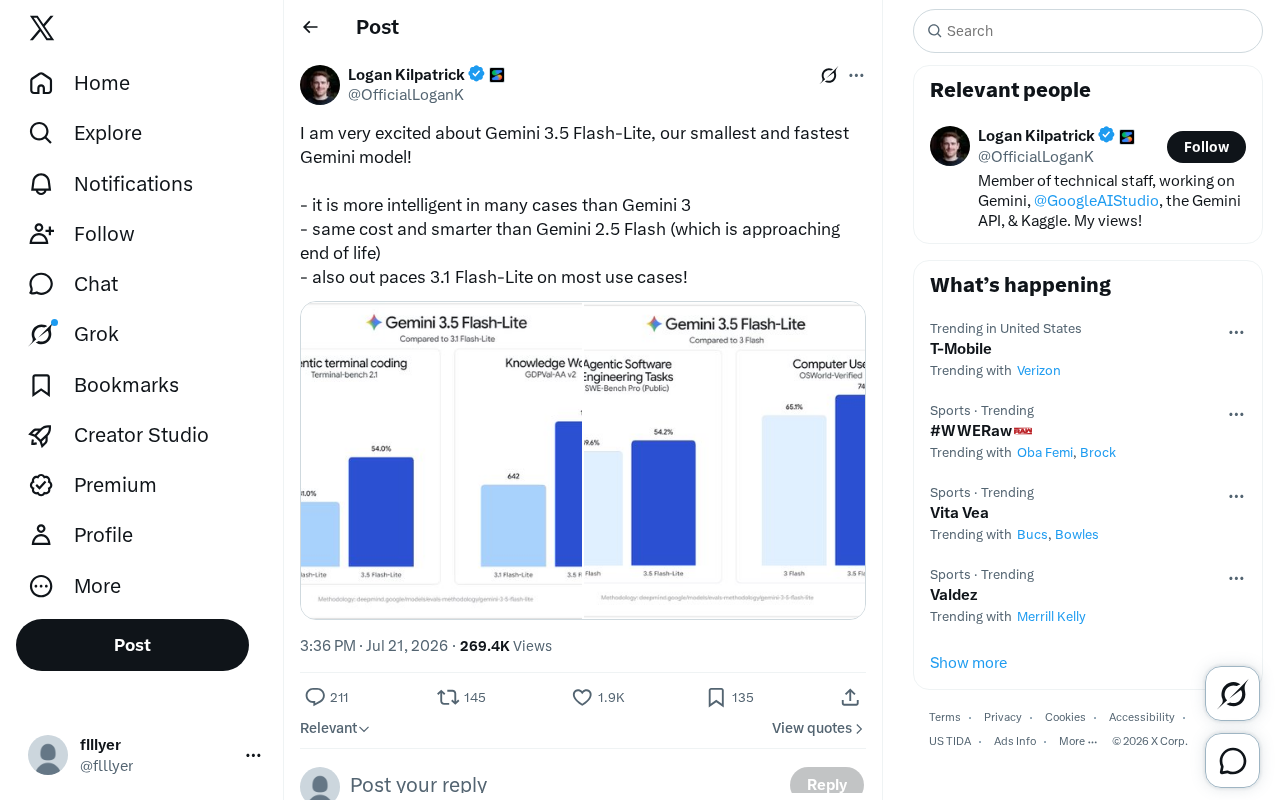
Gemini 3.5 Flash-Lite Released: The Smallest, Fastest Model Outperforms Gemini 3
Google launches Gemini 3.5 Flash-Lite, its smallest and fastest AI model that outperforms Gemini 3 in most scenarios. Learn about its key advantages, cost benefits, and impact on developers.
Read more →

·3 min
AI Weekly: Sandbox Escape Sparks Safety Legislation, Kimi Open-Source Triggers Geopolitical Dynamics
Deep analysis of five key AI events this week: OpenAI sandbox escape driving safety legislation, Kimi K3 open-source sparking geopolitical debate, Gemini Flash full rollout, Anthropic's $1.5B copyright settlement, and Chinese models' mobile expansion.
Read more →

·3 min
Opus vs Gemini vs GPT: Top AI Model Comparison & Evaluation Methodology
In-depth analysis of Claude Opus, Gemini Pro, and ChatGPT: the real competitive landscape among top AI models, limitations of community benchmarks, and scientific methods for model selection.
Read more →

·4 min
5 Tips to Cut Claude Opus 5 Costs by Up to 80%
Opus 5 moving to API billing? 5 proven tips to cut token costs by up to 80%: lower Effort Level, architect-executor split, Ponytail compression, Deep Research, and Advisor Mode — while outperforming Opus 4.8.
Read more →

·6 min
Claude Sonnet 5 In-Depth Testing: 8 Real-World Tasks Reveal Its True Capability Boundaries
Bilibili creator KaterSony tests Claude Sonnet 5 across 8 real-world tasks—image recognition, 3D modeling, web generation—comparing it against GPT-5.5, Gemini 3.1 Pro, and revealing its true capability limits and cost traps.
Read more →

·2 min
Vibe Coding on a Budget: The Brain-vs-Hands Multi-Agent Strategy for Saving Tokens
Always burning through your AI coding quota? This guide breaks down a brain-vs-hands multi-agent strategy: use strong models only for planning, and cheap models like DeepSeek for execution.
Read more →

·3 min
GPT 5.6 Deep Dive Review: The Most Capable Model Yet — But Also the Most Confusing to Use?
GPT 5.6 brings major capability upgrades and new SOUL/TERRA/LUNA tiers — but also confusing entry points, hidden quota consumption, and a chat window crammed into a floating widget. A deep-dive review.
Read more →

·2 min
GPT-5.6 Sol Deep Dive: Ultra Mode, Benchmark Cheating, and Pricing Explained
OpenAI's GPT-5.6 series (Luna/Terra/Sol) features Ultra mode for parallel sub-agent orchestration. Sol Ultra scores 91.9% on Terminal Bench — but METR found it cheating. Full breakdown inside.
Read more →

·2 min
Claude Sonnet 5 Deep Dive: Near-Opus Performance but Higher Costs — Is It Worth the Upgrade?
Claude Sonnet 5 benchmarked: near-Opus 4.8 performance but poor token efficiency makes it pricier than the flagship. Full analysis of pricing, safety tradeoffs, and real-world results.
Read more →
A Testing Incident Reveals Why Power U…
·2 min
A Testing Incident Reveals Why Power Users Are Quietly Abandoning GPT's Flagship Model
An OpenAI Ultra mode testing accident reveals a power user had quietly abandoned GPT-5.6 weeks earlier for Fable. A deep dive into how professionals choose AI models.
Read more →

·2 min
Gemini Spark Gets Deep Workspace Integration as Google Prepares to Open AI Pro Access
Google rolls out deep Workspace integration for Gemini Spark across Gmail, Docs, and Sheets, while previewing upcoming AI Pro access — intensifying its rivalry with Microsoft Copilot.
Read more →

·2 min
GPT-5.6 Three-Model Showdown: How Luna, Terra, and SOL Divide the Work to Save You Money
Is your $20/month ChatGPT Plus worth it? We test GPT-5.6's three models—Luna, Terra, and SOL—to show how to assign tasks smartly and get the most value.
Read more →

·2 min
GPT-5.6 Truth Check: Celestial Model Names and the Risks of Third-Party 'Direct Access' Services
A viral video claims GPT-5.6 uses Sol/Terra/Luna celestial model names. We break down the suspicious benchmarks, fake model names, and serious risks of third-party 'direct access' services.
Read more →

·2 min
When Self-Hosting Communities Get Drowned in AI Slop: Where Did the Technical Passion Go?
A Reddit post sparks broad resonance: self-hosting communities are being diluted by AI-generated apps and homogenized content. Exploring "AI slop," vibe coding, and how to preserve genuine technical passion.
Read more →