#Optimize Anything
121 related articles
 Research
·2 min
Optimize Anything: One API to Unify Optimization of Code, Prompts, and Agent Architectures
UC Berkeley and Stanford propose Optimize Anything, a universal text optimization framework that unifies optimization of CUDA kernels, agent architectures, and prompts through one declarative API.
Read more →

·4 min
Dell OptiPlex 3080 Self-Hosting Server: System Options Compared & Selection Guide
Compare three system options for a Dell OptiPlex 3080 self-hosting server: Lubuntu, Debian, and headless virtualization. Learn why Proxmox is ideal for 64GB RAM Homelab setups.
Read more →

·3 min
Building Your Own Email Archiving Tool: Breaking Free from Single-Provider Dependency and Reclaiming Data Sovereignty
Learn how to build your own email archiving tool using Maildir format and metadata separation to break free from Gmail/Outlook dependency and reclaim data sovereignty.
Read more →

·2 min
Microsoft's VibeVoice Goes Open Source: A Deep Dive into the Frontier Voice AI Behind 50K Stars
Microsoft's open-source voice AI project VibeVoice rapidly gained 50K+ GitHub Stars, focusing on emotional expression and natural prosody. A deep dive into its technology, strategy, and applications.
Read more →

·3 min
What Happens After You Click a Link? A Complete Technical Breakdown
From DNS resolution, TCP handshake, and TLS encryption to the Blink rendering engine — a detailed breakdown of what happens after you click a link.
Read more →

·2 min
Chrome Web Store Review Approval Guide: Dead Code Cleanup and Packaging Best Practices
Chrome Web Store submission rejected? Learn how to pass review by cleaning dead code, removing node_modules from builds, and ensuring compliance with store policies.
Read more →

·3 min
Monocular RGB Human Mesh Reconstruction: Real-Time Motion Capture at 18 FPS with Rust + CUDA
Deep dive into a real-time 3D human mesh reconstruction project using a single RGB camera, built with Rust, Candle, and CUDA, achieving 55ms/frame on RTX 5080. Exploring its architecture, Metal porting plans, and applications in VTuber, AR/VR, and sports analysis.
Read more →

·3 min
Monocular RGB Human Mesh Reconstruction: Real-Time Motion Capture at 18 FPS with Rust + CUDA
A deep dive into a real-time 3D human mesh reconstruction project using a single RGB camera, built with Rust, Candle, and CUDA, achieving 55ms/frame on an RTX 5080.
Read more →
·3 min
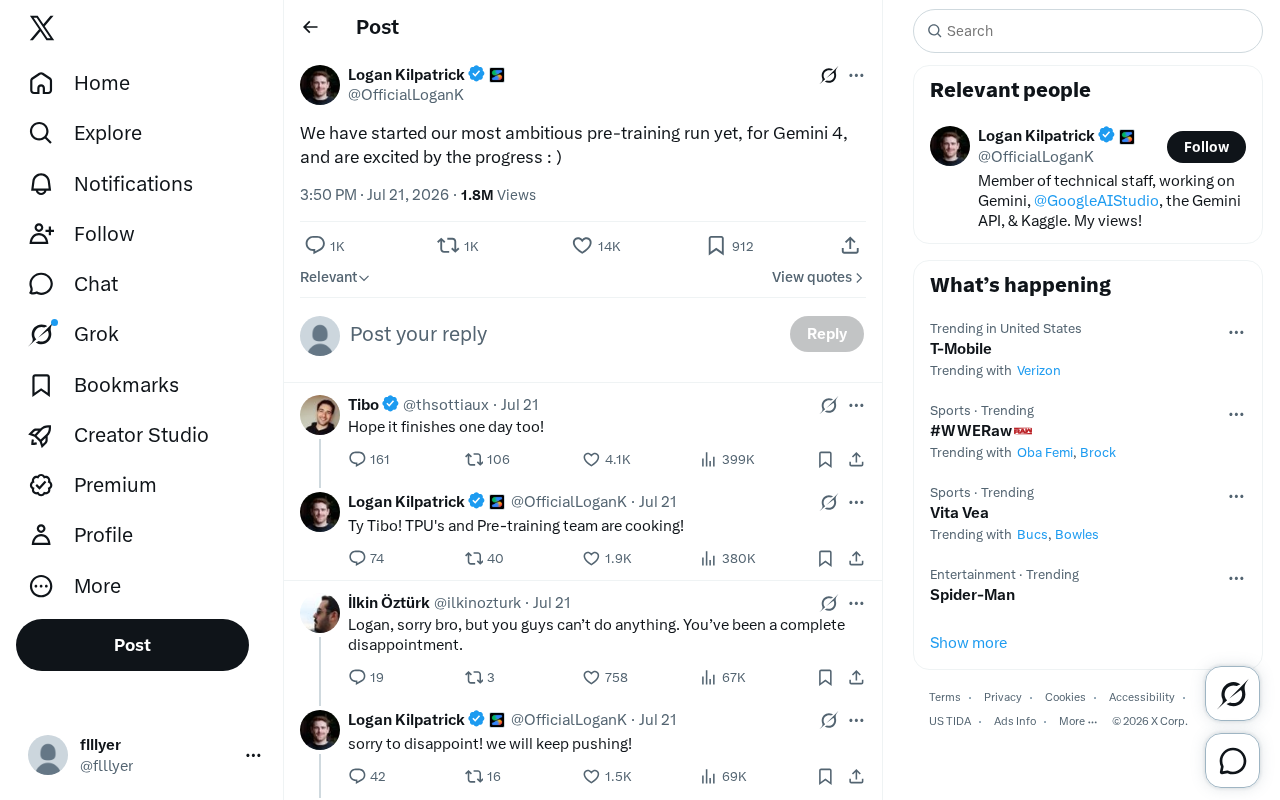
Google Launches Gemini 4 Pre-training: Its Most Ambitious AI Model Training Yet
Google DeepMind announces Gemini 4 pre-training has begun, calling it their most ambitious training yet. A deep dive into its technical direction, compute scale, multimodal breakthroughs, and competitive impact.
Read more →

·4 min
AI Agent Development in Practice: A Complete Path from Zero to Production
A systematic guide to AI Agent development covering core modules, framework selection, tool calling, data preparation, and production deployment to help developers build production-ready Agent applications.
Read more →

·3 min
Jensen Huang's First Tweet Backs AI Open Source — But It's Really About NVIDIA's Ecosystem Anxiety
Jensen Huang's first tweet backs AI open source, but behind it lies NVIDIA's deep anxiety over CUDA ecosystem displacement. We analyze why open-source models matter and what's really at stake.
Read more →

·5 min
Liang Wenfeng's In-Depth Confession: DeepSeek's Philosophy of Restraint, Open-Source Strategy, and AGI Roadmap
DeepSeek founder Liang Wenfeng systematically explains: a KPI-free culture, 10-month break-even pricing, long-term open-source strategy, continual learning to break the AGI bottleneck, and his prediction of a mature domestic chip ecosystem within a year.
Read more →

·6 min
How the Creator of Redis Squeezed a 284-Billion-Parameter DeepSeek Into an Ordinary Laptop
Redis author antirez built the pure-C inference engine DS4 "Dwarf Star," compressing DeepSeek V4 Flash from 500GB to 80.8GB via asymmetric quantization for local deployment on 128GB unified memory at 26.7 tokens/sec.
Read more →

·2 min
Voice AI Agent Architecture: Pipecat Flows vs Vapi Squad — A Deep Comparison
A deep comparison of Pipecat Flows and Vapi Squad for voice AI agent architecture — covering latency, accuracy, multi-agent handoffs, and when to use each.
Read more →

·2 min
Getting Started with ChatGPT Codex: Key Differences Between an AI Coding Agent and ChatGPT
Codex is OpenAI's AI coding agent that autonomously reads code, fixes bugs, and runs tests — far beyond ChatGPT's code generation. Learn the key differences.
Read more →

·2 min
Ego Vision: A Deep Dive into the YOLO11-Based Driving Action Prediction System
Ego Vision is an open-source autonomous driving perception project integrating YOLO11, ByteTrack, and Depth Anything V2 to predict GO/SLOW DOWN/STOP/EMERGENCY BRAKE actions.
Read more →
llmfit: One Command to Check Which Loc…
·2 min
llmfit: One Command to Check Which Local LLMs Your Hardware Can Run
llmfit is an open-source Rust CLI tool that predicts whether your local hardware can run a given LLM — no model download required. Covers hundreds of models and backends like Ollama and llama.cpp.
Read more →

·2 min
Vibe Coding on a Budget: The Brain-vs-Hands Multi-Agent Strategy for Saving Tokens
Always burning through your AI coding quota? This guide breaks down a brain-vs-hands multi-agent strategy: use strong models only for planning, and cheap models like DeepSeek for execution.
Read more →

·4 min
Can AI Discover Alpha? A Deep Dive into Qlib and RD-Agent
Can AI truly discover Alpha automatically? This deep dive into Microsoft's open-source Qlib and RD-Agent reveals the 3 critical backtest pitfalls and 6 overfitting prevention gates every quant researcher needs to know.
Read more →

·2 min
AI Predicts the World Cup: 6 Models Backed France, Claude Alone Picked Spain — and Got It Right
8 AI models predicted the World Cup winner: 6 picked France, only Claude picked Spain. After Spain knocked France out 2-0, this experiment raises deep questions about AI herd behavior and independent judgment.
Read more →