#Supervisor pattern
79 related articles

·2 min
Multilingual Relation Extraction in Practice: Label Leakage and Evidence Sparsity Pitfalls Explained
Deep analysis of two hidden pitfalls in multilingual relation extraction: label order leakage enabling model cheating, and evidence sparsity being more critical than label sparsity. Practical guide for GLiNER-style zero-shot model training.
Read more →

·2 min
$100 Million Deal: AI Gives 50,000 Ukrainian Kamikaze Drones Autonomous Target Lock
A U.S. company struck a $100M deal with Ukraine to deploy AI visual lock-on capabilities on 50,000 cheap kamikaze drones, enabling terminal autonomous guidance to defeat electronic warfare jamming.
Read more →

·3 min
Airtop Review: Automating Google Ads Management with Conversational AI Agents
Airtop is an AI agent-powered Google Ads automation tool that handles keyword research, campaign creation, budget optimization, and reporting through natural language conversation — no SEM expertise needed.
Read more →

·3 min
Tigriden: A 40MB Lightweight AI Development Workbench Redefining Human-AI Collaboration
Tigriden is a Rust-native desktop workbench using only 40MB of memory, designed for AI Agent collaboration. Its Diff Tracker and Time Machine help developers review AI code changes and roll back quickly.
Read more →

·4 min
Walsh Multi-Agent Trading System: How Risk Management Veto Power Ensures AI Autonomous Decision-Making Safety
Deep dive into the Walsh multi-agent trading system architecture, exploring how its risk management agent with veto power establishes safety boundaries for AI autonomous decision-making.
Read more →

·3 min
Tigriden: A 40MB Rust Minimalist IDE Designed Specifically for AI Coding Agents
Tigriden is a minimalist Rust workbench using only 40MB of memory, designed for AI coding agents like Claude Code. No Electron, no LSP—leaving resources for AI.
Read more →

·3 min
Graph Engineering: The Core Paradigm and Design Patterns for AI Agent Orchestration
Deep dive into how graph engineering uses state machines and directed graphs to constrain AI agent behavior, covering reflection, routing, human-in-the-loop, and parallel execution patterns.
Read more →

·4 min
Tiling Window Management: A New Interaction Paradigm for Multi-Agent Conversations
Exploring tiling window management for multi-agent AI conversations: how it solves parallel monitoring and observability challenges, real-world limitations, and the evolution from chat boxes to control consoles.
Read more →

·5 min
witr: A Linux Process Tracing Tool for Quickly Identifying Why a Process Is Running
witr (Why Is This Running) is an open-source Linux process tracing tool that traces startup chains from processes, ports, containers, or files to quickly identify whether a process was launched by systemd, cron, or supervisor.
Read more →

·3 min
What Kind of GUI Do AI Agents Need? The Evolution from Chat Boxes to Task Consoles
Exploring GUI design for AI Agents: why chat boxes fall short, and how ideal agent interfaces need task visualization, human-in-the-loop intervention, state presentation, and multi-agent orchestration.
Read more →

·2 min
Openbase Review: Managing AI Coding Agent Teams with Voice, Anytime, Anywhere
Openbase is a voice-driven AI coding agent management tool that lets developers dispatch tasks, steer agents, and approve code changes via phone. Deep analysis of its cross-platform sync and voice interaction advantages and limitations.
Read more →
·3 min
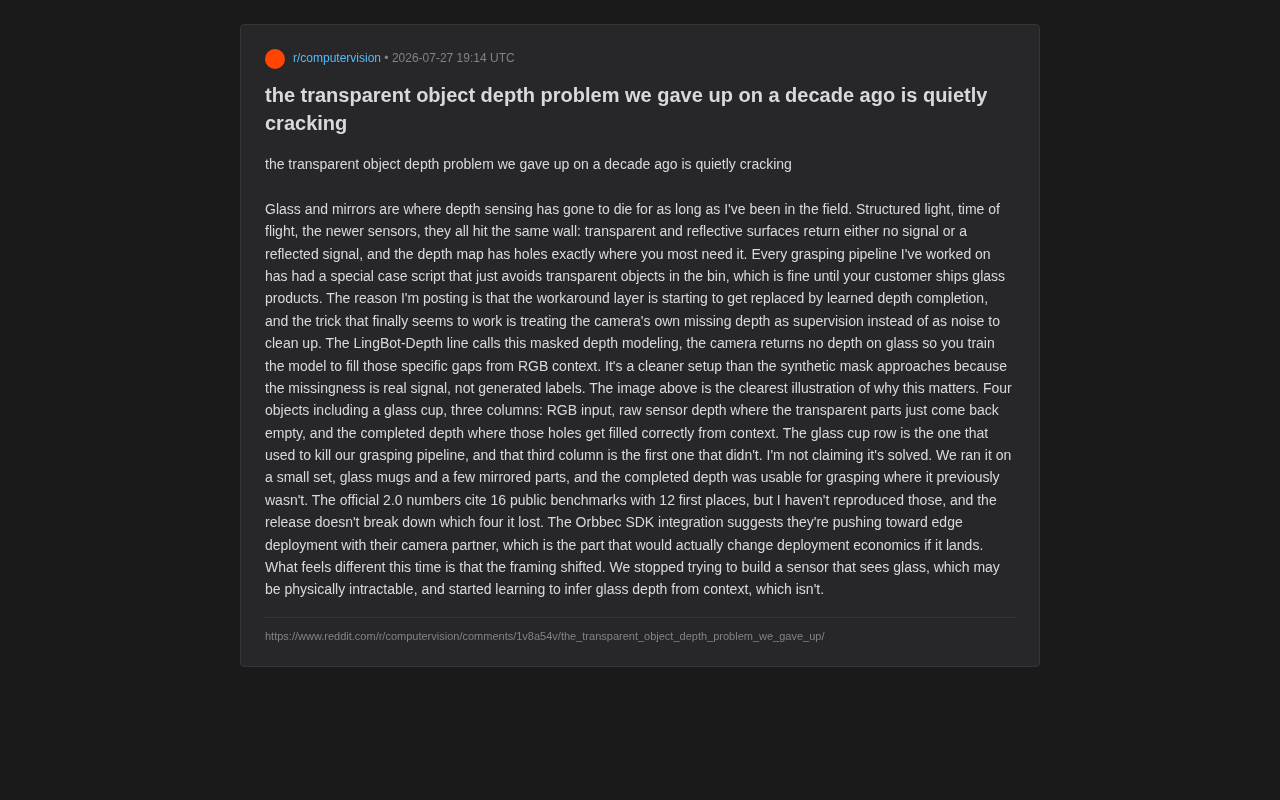
The Depth Perception Challenge for Transparent Objects: How LingBot-Depth Breaks Through with Masked Depth Modeling
Depth perception for transparent and reflective objects has long been a core challenge in robotic grasping. LingBot-Depth uses masked depth modeling to turn sensor failure into supervisory signals, inferring glass depth from RGB context.
Read more →
·3 min
The Depth Perception Challenge for Transparent Objects: How LingBot-Depth Breaks Through with Masked Depth Modeling
Transparent and reflective object depth perception is a core challenge in robotic grasping. LingBot-Depth uses masked depth modeling to turn sensor failure into supervision, inferring glass depth from RGB context.
Read more →

·5 min
Complete Breakdown of Core Competencies for AI Agent Engineers: From Demo to Production-Grade Systems
Deep breakdown of 4 core AI Agent engineer competencies: business decomposition, multi-Agent architecture, quantitative evaluation, and engineering delivery—bridging the gap from Demo to production.
Read more →

·4 min
The More Complex the AI Agent, the More It Hallucinates? The Hidden Cost of Architectural Complexity
Why do AI Agents hallucinate more as they grow more complex? This article analyzes the causes from error accumulation, context noise, and model completion nature, with 5 practical production strategies.
Read more →

·3 min
Pinterest Medic: Engineering an AI Agent for Automated Spark Failure Diagnosis
How Pinterest engineers built Medic for Apache Spark — a multi-agent auto-diagnosis tool — covering the evolution from a single ReAct agent, observability, log denoising, and end-to-end testing.
Read more →

·3 min
LangChain v1.3 Hands-On Tutorial: Deep Dive into Agents, RAG, and Local Model Deployment
Deep dive into LangChain v1.3: compare LangChain, LangGraph, and DeepAgent paradigms, explore RAG pipelines, multi-agent systems, and local LLM deployment for enterprise AI apps.
Read more →
·3 min
Agent Loop: A Design Guide for AI Autonomous Reasoning-Action-Verification Workflows
A deep dive into AI Agent Loops: from single loops to multi-agent collaboration. Master goal definition, validation mechanisms, and stop conditions to avoid blindly building agent fleets.
Read more →

·3 min
AI Agent Production Guide: Four Orchestration Patterns That Actually Work
Most AI agents never make it past the demo stage. This guide covers four production-grade agent patterns—workflow orchestration, policy-constrained execution, anomaly handling, and load routing—to help teams build reliable agent systems.
Read more →

·2 min
LangGraph Multi-Agent Architecture in Practice: From Core Components to Production Deployment
A deep dive into LangGraph multi-agent architecture — covering hierarchical, network, and pipeline patterns with three hands-on projects using LangGraph 0.3.
Read more →