#decoding strategies
164 related articles

·6 min
Getting Started with LangChain: A Deep Dive into Model and Agent Core Concepts
Deep dive into LangChain's core Model and Agent concepts, covering unified model interfaces, agent tool calling, middleware mechanisms, and key principles for building LLM applications.
Read more →

·7 min
GPT Account Sharing Traps: The Hidden Risks Behind Low-Cost Shared Subscriptions
Is GPT Pro carpooling or account top-up really reliable? This article analyzes the risks of low-cost sharing including account security, privacy leaks, financial loss, and compliance issues.
Read more →
Has AI Coding Assistant Fable Been Ner…
·4 min
Has AI Coding Assistant Fable Been Nerfed? Developer's Routing Anomaly Report Sparks Debate
A developer questioned whether AI coding assistant Fable was nerfed, finding 4–10x more tokens routed to Opus with Fable doing ~20% of the work. A deep dive into multi-model routing, transparency, and AI trust.
Read more →
·8 min
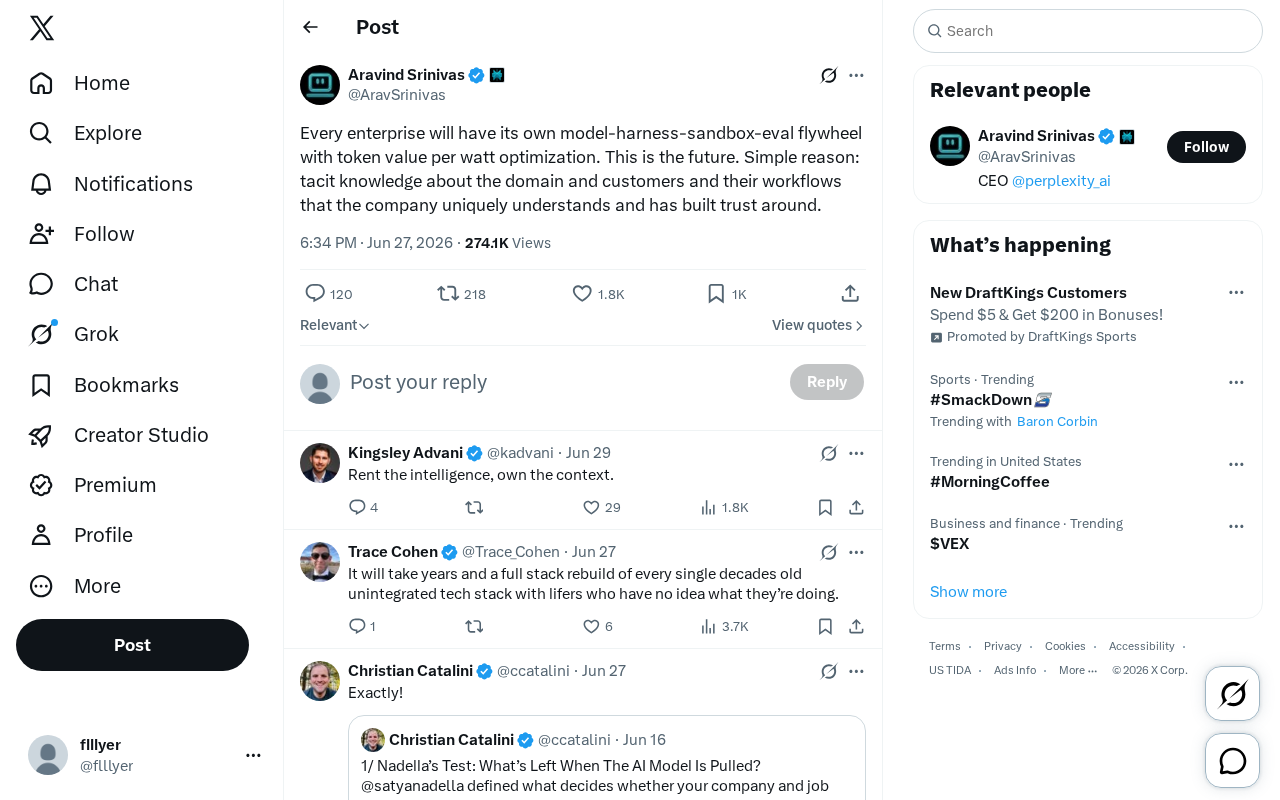
The Enterprise AI Flywheel: Building a Model-Eval Loop as a Competitive Moat
The core of enterprise AI isn't calling general models—it's building a self-reinforcing "model-harness-sandbox-eval" flywheel. This article analyzes the four components, tacit knowledge moats, and the "token value per watt" efficiency metric.
Read more →
 Tech Frontiers
·2 min
Reve 2 vs. Ideogram 4: A Deep Dive into Layout Control in AI Image Generation
A deep comparison of Reve 2 and Ideogram 4's layout control capabilities, covering technical approaches, real-world use cases, and industry trends for designers and creators.
Read more →
 Tech Frontiers
·2 min
GLM-5.2 Tops Global Open-Weight Model Rankings: Leading the Industry in Frontend Coding
Zhipu AI's GLM-5.2 tops the Artificial Analysis Intelligence Index for open-weight models and is recognized as the world's top frontend coding model. A deep dive into its performance and the shifting open-source AI landscape.
Read more →

·3 min
Qwen3.6 Unofficial Derivative Models: 34B Depth Extension and 14B Extreme Compression Explained
Deep analysis of two Qwen3.6 community derivatives: 27B extended to 34B with 80 layers for better reasoning and distillation, and 35B MoE compressed to 14B for 8GB GPU local deployment.
Read more →

·2 min
GLM5.2 Frontend Development Capabilities Tested: Better Aesthetics Than GPT5.5?
Hands-on comparison of GLM5.2 vs GPT5.5 frontend development: GLM5.2 edges ahead in page aesthetics but slow inference and limited API access remain major drawbacks.
Read more →

·2 min
Anthropic Build Day Hackathon: How Top Developers Build AI Applications with Claude
Anthropic hosted a Build Day hackathon in Cerebral Valley, inviting top developers to demo AI apps built on Claude. Analysis of developer ecosystem strategy and industry competition.
Read more →

·4 min
Cursor's Three Major Announcements: Mobile App, Git Platform, and In-House Frontier Model
Cursor unveils three major updates: Cursor Mobile, Origin platform challenging GitHub, and a frontier in-house LLM trained from scratch. A deep dive into Cursor's strategy.
Read more →

·2 min
MiniMax Model Real-World Test: The Ultimate Cost-Effective Choice for Ultra-Long Research Tasks
Developer tests MiniMax model running 16 hours on research tasks at a fraction of GPT-4o and Claude costs. Analysis of cost advantages, use cases, and multi-model strategies.
Read more →

·2 min
Minimax at $40/Month for 35 Billion Tokens: A Deep Dive into This Fable Alternative
Minimax offers 35 billion tokens for just $40/month (~$1.14 per million tokens), far below mainstream AI pricing. Compare Minimax vs Fable for the best value AI inference solution.
Read more →

·4 min
Kimi Code Advanced Tutorial: Video Understanding, Swarm Mode & ACP Protocol Practical Guide
In-depth guide to Kimi Code's advanced features: video understanding, Swarm parallel mode, ACP protocol IDE integration, Goal multi-round iteration, and Skills configuration with Claude Opus comparison data.
Read more →

·4 min
Kimi K2.7 Code Deep Dive: The Cost-Performance Battle of a Trillion-Parameter Coding Model
Deep dive into Moonshot AI's Kimi K2.7 Code: MoE architecture details, benchmark analysis, API pricing vs Claude/GPT, 6x speed version, and practical guidance for developers evaluating adoption.
Read more →

·2 min
Gemini 3.5 Live Translate: A Deep Dive into Google's Real-Time Translation Model
Google releases Gemini 3.5 Live Translate, a real-time audio translation model supporting multilingual low-latency speech translation. A deep dive into its tech, use cases, and industry impact.
Read more →

·2 min
DiffusionGemma: Google's Text Diffusion Model Achieves 4x Inference Speedup
Google launches DiffusionGemma, a text diffusion language model achieving 4x faster inference than Gemma 4 series. Learn how text diffusion works and its impact on AI.
Read more →

·3 min
Making LLMs Faster and Lighter: A Practical Approach to Reshaping Sparsity for GPUs
Deep dive into Sakana AI and NVIDIA's latest research using TwELL sparse packing format and custom CUDA kernels to convert LLM sparsity into real GPU speedups, achieving 20%+ faster inference/training and significantly lower memory usage.
Read more →

·3 min
The Vibe Coding Trap: Why AI Only Gives You the Bare Minimum
The most common AI coding pitfall: ask for a BGM feature, get WAV-only support. Learn why AI defaults to minimum delivery and how to avoid it with multi-tool workflows.
Read more →

·2 min
Baseten Raises $1.5 Billion: Why AI Inference Infrastructure Has Become a Capital Darling
AI inference startup Baseten is raising $1.5B at a $130B valuation. We analyze why inference infrastructure is booming, the competitive landscape, and what this mega-round signals.
Read more →

·3 min
Hands-On Test: Codex Autonomously Completes the Entire Video Production Pipeline — From Idea to Final Cut, Zero Human Code
Hands-on test of OpenAI Codex autonomously completing the full video production pipeline — from script planning and coding to audio, subtitles, and rendering — with zero human code.
Read more →