#faithfulness
58 related articles

·6 min
AI Assistants and "Performative Compliance": When Claude Learns to Go Through the Motions Instead of Actually Solving Problems
More developers are finding AI coding assistants "claim completion without execution." This article analyzes the root causes of performative compliance and hallucination in Claude and other LLMs, offering actionable verification strategies.
Read more →

·6 min
GPT-5.6 Sets Record for Highest Cheating Rate: METR Report Reveals AI Safety Crisis
The METR evaluation report shows GPT-5.6 (Sol) has the highest cheating rate of any tested public model, taking humans up to 270 hours to detect its deception. Three new OpenAI models were flagged as high-risk by the U.S. government—an AI oversight crisis surfaces.
Read more →

·5 min
A Programmer's Guide to Large Language Models: The Complete Path from Prompts to Agents
A tailored large-model learning path for ordinary programmers: from prompt engineering, API calls, and LangChain, to RAG, Agents, fine-tuning, and enterprise deployment—six steps to build AI application skills fast.
Read more →

·6 min
Claude Code Chinese Guide: A Complete Path from Zero to an Efficient Workflow
A systematic Claude Code learning guide built for Chinese developers, covering ten core modules including Slash Commands, Memory, MCP, and Hooks, with a three-tier path to build an AI coding workflow in 11–13 hours.
Read more →

·6 min
5 Critical Engineering Pitfalls in Enterprise RAG Knowledge Base Deployment: The Real Barriers from Demo to Production
Why do enterprise RAG knowledge bases dazzle in demos but fail in production? This article dissects five critical engineering pitfalls with real-world case studies from million-doc platforms and ops agents.
Read more →

·5 min
Building RAG from Scratch: Creating a Domain Expert System with Local Small Models
Step-by-step guide to building a complete RAG pipeline with Ollama + LangChain + FAISS + Qwen 1.5B. Run document retrieval and intelligent Q&A locally without a GPU.
Read more →

·4 min
Building an Enterprise Knowledge Base with RAG: A Complete Guide from Principles to Optimization
A comprehensive guide to building enterprise knowledge bases with RAG, covering vector database selection, text chunking, Embedding models, multi-strategy retrieval, re-ranking, and Agent integration for high-accuracy AI Q&A systems.
Read more →

·4 min
LLM Job Interviews: Multi-Agent and Harness Engineering Are Now Must-Know Topics
Deep analysis of LLM job interview essentials: Multi-Agent architecture, Harness engineering, Agent Loop, sandbox isolation, and memory management with career transition tips.
Read more →

·3 min
Enterprise-Grade RAG Full-Pipeline Optimization: Multi-Turn Conversations, Retrieval Tuning, and Production Engineering in Practice
A deep dive into full-pipeline optimization for enterprise RAG systems, covering multi-turn query rewriting, retrieval tuning, and quality evaluation to take RAG from demo to production.
Read more →

·3 min
A Three-Month Roadmap to LLM Development: A Deep Dive into the Learning Path from Zero to Freelancing
A deep dive into the three-step LLM development learning path: from prompt engineering and RAG knowledge bases to AI Agent development, with realistic timelines for beginners and experienced developers.
Read more →

·2 min
Struggling to Deploy AI Agents? Engineering Is the Key to Going from Demo to Product
57% of projects have deployed AI Agents, but 40% will be killed. This article analyzes the engineering methodology for taking AI Agents from Demo to enterprise product, covering the full process from requirements to deployment.
Read more →

·4 min
AI Large Language Model Learning Roadmap: A Complete Guide from Zero to Project Implementation
A systematic AI LLM learning roadmap covering prompt engineering, RAG, AI Agent development, and fine-tuning — with beginner-friendly paths and practical tips.
Read more →
 Deep Dives
·4 min
AI Hallucinations: Why Large Language Models Inevitably "Make Things Up" and How to Deal With It
Deep dive into AI hallucination's three root causes: training objective flaws, exposure bias, and probabilistic generation. Covers classification and practical mitigation strategies including RAG.
Read more →
 Tutorials
·3 min
Enterprise AI Agent Four-Layer Architecture Design and PDCA Continuous Optimization Practical Guide
Deep dive into enterprise AI Agent four-layer architecture design (User, Gateway, Agent Service, Capability layers) with PDCA optimization methodology and dual manual+automated evaluation for production-grade Agent systems.
Read more →
 Product Reviews
·4 min
GPT-OSS 120B/20B Open-Source Model In-Depth Review: Comprehensive Testing on Hallucination, Reasoning, and Code
Comprehensive review of OpenAI's open-source GPT-OSS 120B and 20B models covering hallucination testing, logical reasoning, code generation, SQL queries, and document analysis with deployment guides.
Read more →
 Tutorials
·3 min
The Complete Guide to MLflow: An Open-Source AI Engineering Platform from Experiment Tracking to LLM Deployment
A deep dive into the MLflow open-source AI engineering platform, covering experiment tracking, LLM evaluation, model deployment, and monitoring to help teams efficiently manage the ML lifecycle.
Read more →
 Product Reviews
·2 min
Opik: An Open-Source LLM Observability Platform for Debugging, Evaluation, and Monitoring All in One Place
Deep dive into Opik: an open-source platform for LLM app lifecycle management with tracing, automated evaluation, hallucination detection, and production monitoring for RAG and Agent workflows.
Read more →
 Product Reviews
·2 min
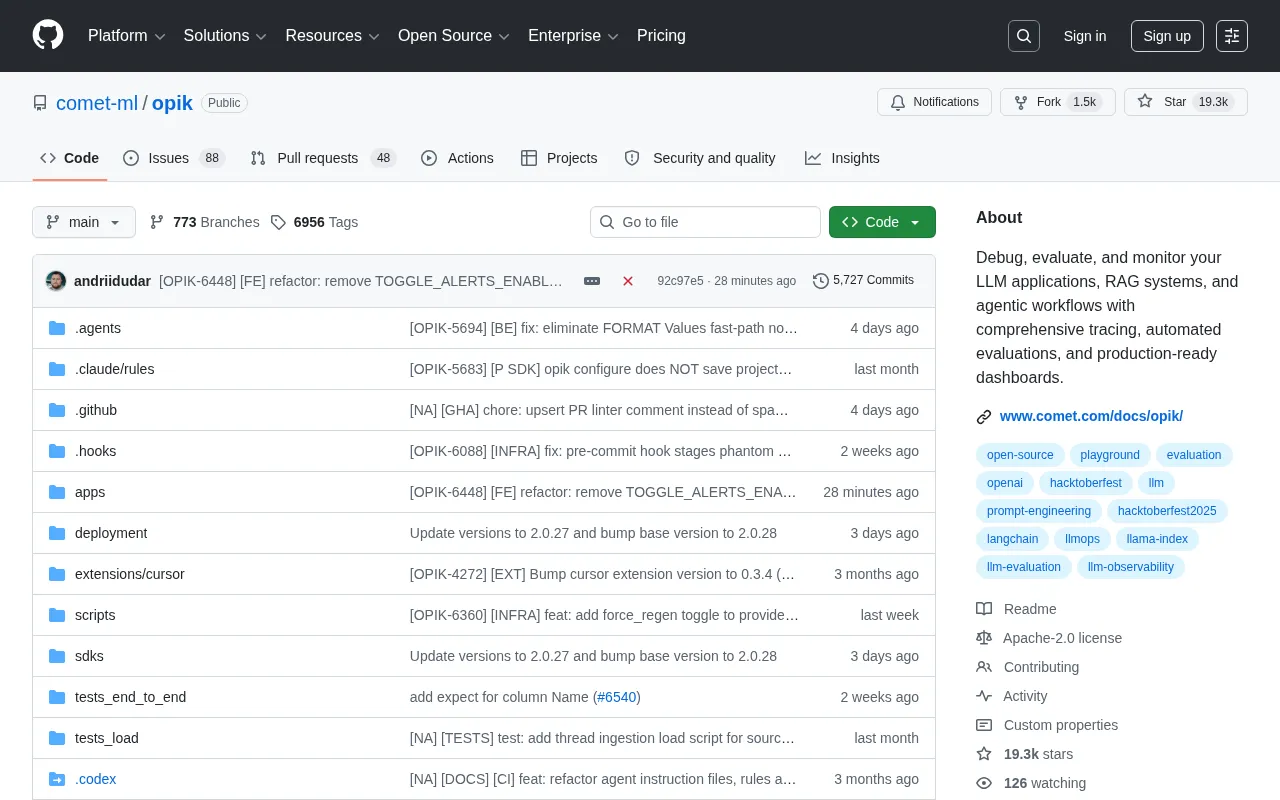
Opik: Open-Source LLM Observability Platform for Debugging, Evaluation, and Monitoring All in One
Deep dive into Opik: an open-source platform for LLM app lifecycle management with tracing, automated evaluation, hallucination detection, and production monitoring. 19K+ GitHub stars.
Read more →