#hardware design
2055 related articles

·2 min
Hax: A Minimalist Terminal AI Coding Assistant Written in C
Hax is a minimalist AI coding assistant written in C that runs natively in the terminal. Zero dependencies, ultra-lightweight, and instant startup — built for terminal workflows.
Read more →

·2 min
Google's SL2T Model: Real-Time Sign Language-to-Text Technology Arrives on Pixel 11
Google launches SL2T sign language-to-text model supporting real-time ASL-to-English conversion, integrated with Gboard and Live Transcribe, deploying on-device on Pixel 11 for system-level accessibility.
Read more →
·3 min
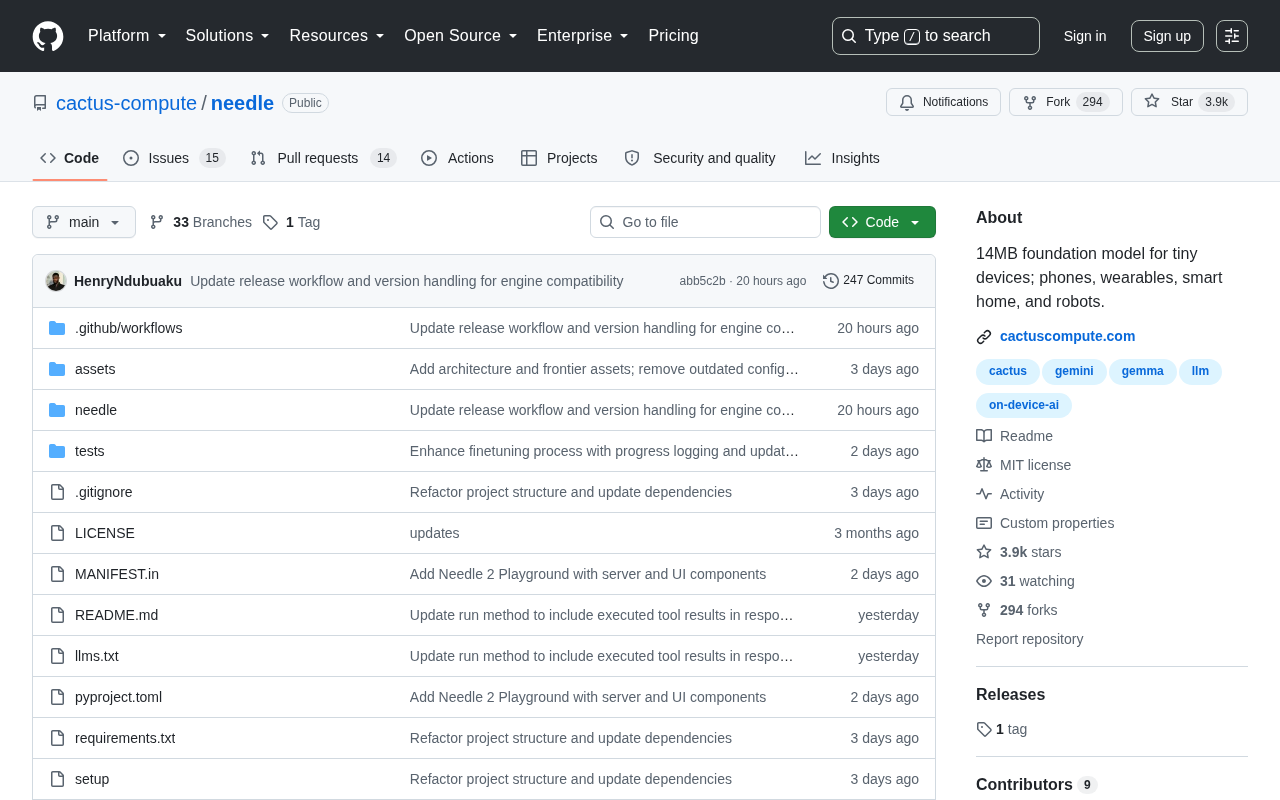
Needle: How a 14MB Foundation Model Is Unlocking Edge AI Deployment
Needle is a 14MB open-source foundation model from cactus-compute, designed for phones, wearables, smart home devices, and robots. Explore its edge AI potential.
Read more →

·2 min
Understanding GGUF Quantization: The Real Difference Between Q4_K_M and Q4_K_S
Detailed explanation of the core differences between GGUF model Q4_K_M and Q4_K_S: why same-Q4 files differ in size, k-quant protection strategies, quantization selection guide, and VRAM planning tips.
Read more →

·3 min
Java Backend to AI: A Practical Guide to Multi-Agent Collaboration with Spring AI
How can Java backend engineers transition to AI Agent development? This guide covers the evolution from Chat to Agentic AI, ReAct decision-making, MCP tool calling, and multi-Agent orchestration with Spring AI.
Read more →

·3 min
ml-pipes: Building Software Engineering Best Practices Into ML Inference Pipelines
ml-pipes is an open-source framework that builds pre-run validation, pipeline inspection, tracing, and benchmarking into ML inference pipelines, bridging the MLOps engineering gap.
Read more →

·2 min
Aquifer Open Source: A Traffic Smoothing Solution for Peak Shaving Bursty GPU Inference Workloads
Aquifer is an open-source traffic smoothing runtime that uses durable queue buffering and backend backpressure to solve burst traffic challenges in GPU inference services, enabling peak shaving and cost reduction.
Read more →

·5 min
Building Data Agents with BigQuery and ADK: AgentOps in One Line of Code
Deep dive into Google Cloud's complete stack for building data Agents with BigQuery and ADK, covering MCP Toolbox parameterized SQL, managed MCP servers, and Agent Analytics one-line observability.
Read more →

·2 min
Chrome DBSC Technology Explained: How Device Bound Session Credentials End Cookie Theft
A deep dive into Chrome's DBSC (Device Bound Session Credentials) technology and how it prevents session Cookie theft through hardware-level key binding to fundamentally solve account hijacking.
Read more →

·3 min
A Universal Orchestration Layer for Deep Learning: Why MLOps Still Lacks a Standard Framework
Deep learning training code is just the tip of the iceberg. This article explores why MLOps still lacks a standard framework-agnostic orchestration layer and offers practical tool combination advice.
Read more →

·4 min
Directing AI Game Development from a Phone: A Programmer Couple Builds a Complete RPG with AI Coding
A programmer couple built a complete RPG using only a phone-based AI workbench, revealing how foundational knowledge amplifies AI-assisted development.
Read more →

·2 min
LFM2.5 Released: How a 2.6B Small Model Rivals Models 4x Its Size
Liquid AI releases LFM2.5: a 2.6B parameter model rivaling 10B-class models on multiple benchmarks. Exploring its architectural innovation, training strategy, and implications for AI efficiency.
Read more →

·3 min
GitHub Daily · August 13: Local AI Tools Surge in Popularity, Privacy-First Becomes the Dominant Theme
GitHub Trending Aug 13: Local-first AI tools dominate with FluidVoice, unsloth, and modly, while Agent integration projects like holaOS and obsidian-skills reshape workflows.
Read more →

·3 min
The Fatal Flaw of Gaussian Splatting: Oxford's Survey-Grade Dataset Reveals the Truth About Off-Trajectory Collapse
Oxford Robotics Institute releases survey-grade Spires dataset, first to quantify 3D Gaussian Splatting's geometric collapse under off-trajectory views using Leica RTC360 millimeter-precision ground truth.
Read more →

·4 min
OpenCode Practical Guide: Installation, Configuration & Usage Tutorial for This Open-Source Claude Code Alternative
Complete guide to OpenCode, the open-source Claude Code alternative: covers desktop and WSL installation, model configuration, rule files, custom commands, and MCP service integration.
Read more →

·3 min
Unsloth Desktop: The First Open-Source AI Desktop App Supporting Local Training + Inference
Unsloth Desktop is an open-source app for Mac/Windows/Linux that integrates local model training and inference with 2x speed, 70% VRAM savings, GGUF/MLX support, and Claude Code connectivity.
Read more →

·2 min
LTX-2.5 Released: Complete Breakdown of Native Multishot Generation and Dynamic Compute Allocation
LTX-2.5 launches with native multishot generation, Diffusion Fidelity Rendering for dynamic compute allocation, and improved distilled models—runs on consumer GPUs with full open-source access.
Read more →

·3 min
Boreas Dataset: A Multimodal Autonomous Driving Dataset with 44 Drives Through Wind and Snow
Boreas dataset from University of Toronto captures 44 traversals of the same route across all seasons with 128-beam lidar, 360° radar, and camera, featuring 326K+ 3D annotations for adverse weather autonomous driving research.
Read more →

·3 min
GenSpark SecondBrain Note Review: A 2.95mm Card-Sized AI Recorder That Auto-Generates Meeting Notes
GenSpark's SecondBrain Note is a 2.95mm MagSafe AI recorder with 5m pickup range and 35-hour battery life that auto-converts meetings into structured notes. SOC 2 Type II and ISO 27001 certified.
Read more →

·3 min
Claude's Invisible Watermark Technology Explained: How AI Text Tracing Works
Anthropic embeds invisible text watermarks in all Claude outputs for machine-readable tracing. Deep dive into the watermark technology, C2PA file provenance standard, and industry impact.
Read more →