#learn AI
5604 related articles

·2 min
AI Can Write Copy Now — Is Learning Copywriting Still Worth It?
With AI-generated copy reaching passing-grade quality, is learning copywriting still worthwhile? This article analyzes from three dimensions: taste as a moat, mid-tier market value, and skill displacement.
Read more →

·4 min
SELENE Open-Source Project: An Interactive Notebook Library for Systematically Learning AI and Machine Learning from Scratch
SELENE is an open-source AI learning resource built on Jupyter Notebooks, systematically covering ML, deep learning, Transformers, and LLMs with interactive code and math derivations for beginners.
Read more →

·3 min
Explorative Modeling: How Best-of-K Training Strategies Improve Model Learning Efficiency
Explorative modeling lets models generate K candidate predictions and learn from the best one, introducing exploration into training. This article analyzes Best-of-K training strategy principles, applications, and challenges.
Read more →

·3 min
Are AI-Generated Learning Roadmaps Reliable? A Beginner's Guide to Verification and Use
AI-generated learning roadmaps have pitfalls like resource hallucinations and outdated info. Learn how to verify AI roadmaps and use them effectively as a beginner.
Read more →

·5 min
Robynn AI: Automated Website Repair and SEO Optimization Through Self-Learning Agents
Robynn AI is a self-learning website operations tool that uses intelligent auditing, natural language editing, and data-driven auto-rollback to solve post-launch decay issues like broken links and ranking drops.
Read more →

·3 min
BrainFeed: Turning Mindless Scrolling into Learning with an AI-Powered Personalized Knowledge Feed
BrainFeed is an AI-powered personalized learning feed that turns articles and videos into swipeable knowledge cards with spaced repetition, transforming mindless scrolling into effective learning.
Read more →

·2 min
ChatGPT Explains Better Than Professors? The Real Experience and Limits of AI-Assisted Learning
A student's Reddit post about ChatGPT explaining concepts better than professors sparks debate. We analyze AI-assisted learning's strengths, limits, and implications for education.
Read more →

·2 min
ChatGPT Explains Better Than Professors? The Real Experience and Limits of AI-Assisted Learning
A student's Reddit post about ChatGPT explaining concepts better than professors sparks debate. We analyze AI-assisted learning's strengths, limits, and implications for education.
Read more →

·3 min
What Are AI Model Weights, Really? The Deep Learning Truth Revealed by a Meme
Starting from a viral Reddit meme, we dive deep into AI neural network weights — what they are, why they can't be read visually, and how open weights drive technological democratization.
Read more →

·2 min
Vimgolf.ai: Learn Vim Through a Level-Based Game
Vimgolf.ai is a gamified Vim learning tool that helps users progressively master Vim commands through level-based challenges. We analyze its approach and compare it with VIM Adventures and similar tools.
Read more →
·2 min
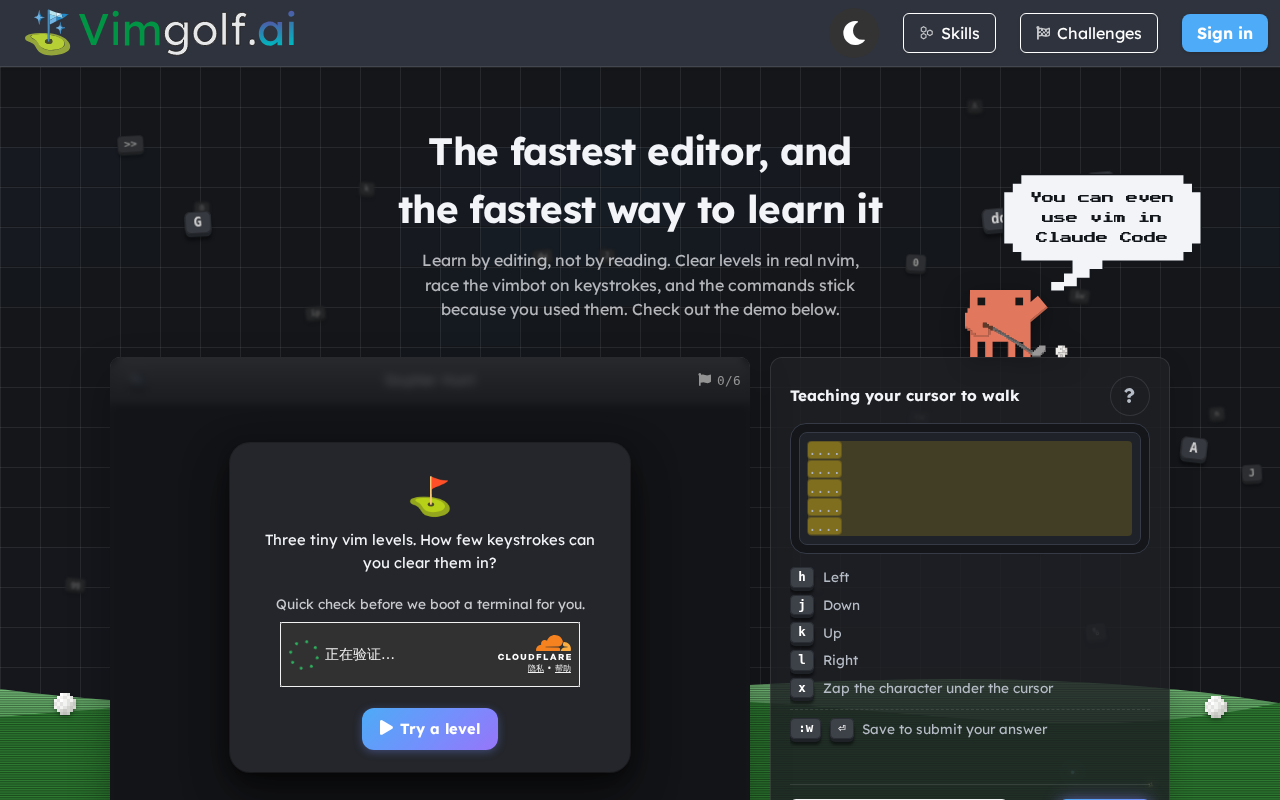
Vimgolf.ai: Learn the Vim Editor Through a Level-Based Game
Vimgolf.ai is a gamified Vim learning tool that helps users progressively master Vim commands through level-based challenges. We explore its core philosophy, gamification advantages, and compare it with tools like VIM Adventures.
Read more →

·2 min
Andrew Ng's New Company LearnVector: Achieving One-on-One Personalized Learning with AI
Andrew Ng launches LearnVector, using generative AI to deliver one-on-one personalized learning. Explore its core vision, potential capabilities, challenges, and how LLMs can solve education's scalability problem.
Read more →

·2 min
Andrew Ng's New Company LearnVector: Achieving One-on-One Personalized Learning with AI
Andrew Ng launches LearnVector, leveraging generative AI to create one-on-one personalized learning experiences. Explore its core vision, potential capabilities, challenges, and how LLMs could solve education's scalability problem.
Read more →

·2 min
Training AI to Play Devil May Cry 3 with Reinforcement Learning: Challenges and Practices in Action Game AI
An indie developer trains AI to autonomously play Devil May Cry 3 using reinforcement learning. Explore the core challenges of action game AI including sparse rewards, high-dimensional action spaces, and real-time decision-making.
Read more →

·2 min
Training AI to Play Devil May Cry 3 with Reinforcement Learning: Challenges and Practices for Action Game AI
An indie developer trains AI to autonomously play Devil May Cry 3 using reinforcement learning. This article analyzes the core challenges including sparse rewards, high-dimensional action spaces, and real-time decision-making.
Read more →

·3 min
PIRL Framework Explained: A Smooth Transition from Open-Loop Exploration to Closed-Loop Reinforcement Learning
Deep dive into the PIRL reinforcement learning framework: how to smoothly transition from open-loop exploration to closed-loop RL, mitigating the exploration-exploitation dilemma and improving sample efficiency.
Read more →

·2 min
What AI Developers Can Learn from Bukowski: Authenticity, Restraint, and the Philosophy of Slowness
Exploring Bukowski's creative philosophy for AI developers: avoid over-engineering, fight hallucinations, stay humble. Authenticity and patience are key to building reliable AI systems.
Read more →

·3 min
Learning AI Large Language Models: A Complete Roadmap from Beginner to Practitioner
A systematic breakdown of the AI LLM learning roadmap covering prompt engineering, AI Agent development, RAG knowledge bases, model fine-tuning, and hands-on projects for beginners.
Read more →

·5 min
Learn AI Agent Development from Scratch: A 3-Step Practical Path to Get Started Quickly
How to learn AI Agent development from scratch? This article outlines a clear 3-step path: Python crash course, LLM theory & practice, and LangChain framework project implementation.
Read more →

·3 min
Backend Developer Transition to AI/LLM: 4 Core Skills and a Practical Learning Roadmap
Complete guide for backend developers transitioning to AI/LLM engineering. Covers the 4 core skills—Python, RAG, Fine-tuning, and Agents—with a phased learning roadmap and practical project advice.
Read more →