#multi-model coding tool
365 related articles

·2 min
Ycode AI Agents: In-Depth Analysis of an Open-Source Multi-Model AI Website Builder
Deep dive into Ycode AI Agents, an open-source AI website builder supporting Claude, OpenAI, Gemini, and Grok for natural language-driven design, CMS management, and component building.
Read more →

·2 min
SenseNova-Vision Training Data Pipeline Explained: A Guide to Fine-Tuning Unified Vision Models
SenseNova-Vision adds a complete training data pipeline with dataset registration, format converters, and end-to-end docs, making unified vision model fine-tuning for segmentation, OCR, and editing far more accessible.
Read more →

·4 min
Pure Vibecoding Builds a 130+ Card Multiplayer CCG: Full AI Tech Stack Breakdown
An indie dev built a 130+ card multiplayer CCG entirely through vibecoding with Claude Code, GPT, and ElevenLabs. Full AI tech stack breakdown and analysis of vibecoding's capabilities and limits.
Read more →

·2 min
OpenWork: Open-Source Alternative to Claude Cowork with 17,000+ Stars
OpenWork is an open-source alternative to Claude Cowork built on opencode with TypeScript. With 17,000+ GitHub stars, it offers data privacy, flexible model switching, and deep customization.
Read more →

·3 min
Implementing Zanzibar in Lean4: A Formally Verified Permission Engine for AI Projects
Deep dive into a Datalog permission DSL built on Google Zanzibar using Lean4 theorem prover. How formal verification strengthens AI permission management.
Read more →

·6 min
Harness Engineering: From Context Engineering to the Third Phase of AI Programming
Explore Harness Engineering: the next evolution beyond context engineering for AI programming. Learn how to build enterprise-grade Skill systems and deliver real projects with mid-tier models.
Read more →

·4 min
Cursor Start India Plan at ₹649/Month: Decoding the Regional Pricing Strategy for AI Coding Tools
Cursor launches its Start plan for India at ₹649/month (~$7.70), featuring Grok 4.5 and Composer Agent. A deep dive into the PPP pricing strategy and its market implications.
Read more →

·3 min
Grok 4.5 Feels Weaker in Cursor? A Deep Dive into AI Coding Tool Integration Differences
Users report Grok 4.5 underperforms in Cursor vs. the official terminal. We analyze how system prompts, context management, parameters, and tool calling create AI coding tool integration gaps.
Read more →

·3 min
Cursor Alternatives Compared: A Guide to 5 AI Coding Tools
Compare 5 Cursor alternatives — from GitHub Copilot and Windsurf to open-source Cline and Continue — covering model freedom, workflow integration, cost, and privacy.
Read more →

·5 min
Getting Started with Codex: Four Product Forms Explained & How to Choose Between Cursor, Claude Code, and Codex
In-depth analysis of OpenAI Codex's four forms (CLI, web, plugin, app), comparing Codex, Claude Code, and Cursor on price, stability, and use cases to help developers choose the right tool.
Read more →
·3 min
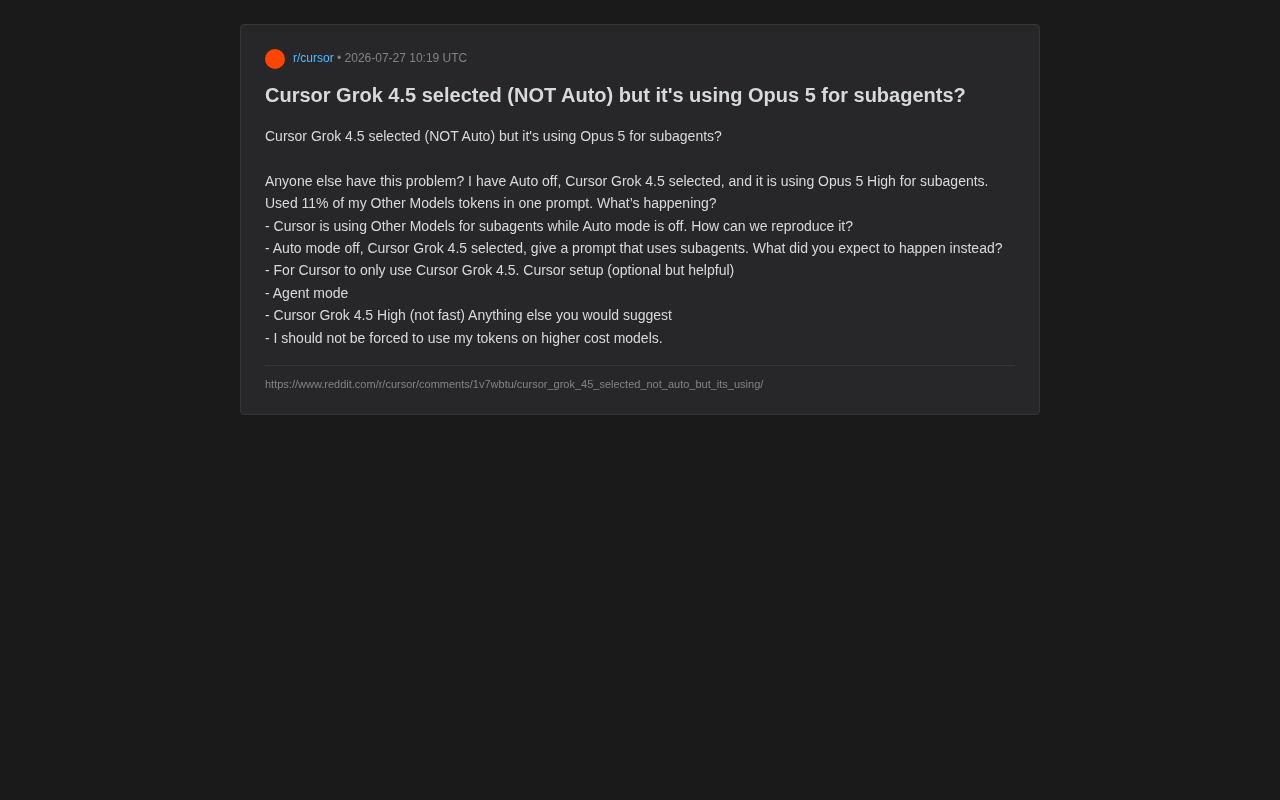
Cursor Selects Grok but Calls Opus: Subagent Model Substitution and Cost Control Issues Explained
Cursor users selecting Grok 4.5 find subagents secretly calling expensive Opus 5, consuming 11% quota per prompt. Analysis of model decoupling, cost transparency, and user strategies.
Read more →

·5 min
Ollama Performance Degrades After Connecting to OpenWebUI? A Complete Troubleshooting Guide
Complete guide to troubleshooting Ollama performance degradation with OpenWebUI, covering num_ctx truncation, sampling parameter differences, GPU resource contention, and system prompt interference.
Read more →

·4 min
Notion Co-founder: From Note-Taking Tool to AI Agent Workspace
Notion co-founder Simon Last shares Notion's journey from note-taking tool to AI agent workspace: from first tasting GPT-4 to personal and custom agents.
Read more →

·4 min
Do Cursor Promo Codes Still Work? A Developer's Guide to Saving on AI Coding Tools
Are Cursor referral codes and discount codes still valid? This guide analyzes Cursor's pricing model, promotional policy trends, and practical savings strategies including annual billing, education discounts, and competitor comparisons.
Read more →

·4 min
Beyond Vibe Coding: A Complete Guide to Enterprise-Grade AI Engineering
Hit the Vibe Coding ceiling? This guide covers the three-stage AI coding progression path, Claude Code vs. Codex, SuperPower SDD, and how to go from vibe coding to enterprise-grade AI engineering.
Read more →

·6 min
The Complete Guide to Using Claude in China: In-Depth Comparison of 4 Solutions and How to Choose
How can users in China use Claude? This article deeply compares four solutions: official subscription, proxy subscription (WildCard), relay platforms (2233/0011.ai), and API aggregation (OpenRouter).
Read more →

·6 min
Claude Sonnet 5 In-Depth Testing: 8 Real-World Tasks Reveal Its True Capability Boundaries
Bilibili creator KaterSony tests Claude Sonnet 5 across 8 real-world tasks—image recognition, 3D modeling, web generation—comparing it against GPT-5.5, Gemini 3.1 Pro, and revealing its true capability limits and cost traps.
Read more →
Microsoft's Two-Track AI Coding Strate…
·3 min
Microsoft's Two-Track AI Coding Strategy: A Deep Dive into Claude Code and GitHub Copilot CLI
Microsoft plans to launch Claude Code and GitHub Copilot CLI, making the terminal the new frontier for AI coding. A deep dive into Microsoft's multi-model strategy and its impact on developer workflows.
Read more →

·3 min
Opal: A Designer Built an AI Pet Assistant on Raspberry Pi Using OpenClaw
Microsoft designer Tua Nguyen built Opal, an AI rabbit assistant on Raspberry Pi using OpenClaw — capable of browsing the web, finding recipes, and operating GitHub.
Read more →
transcribe.cpp: A Unified Speech Recog…
·2 min
transcribe.cpp: A Unified Speech Recognition Engine Built on ggml, Supporting 16+ Model Families
transcribe.cpp is an open-source ggml-based speech recognition engine supporting 16+ model families in a single C++ codebase — lightweight, cross-platform, and quantization-ready for local STT.
Read more →