#open-source borrowing
117 related articles

·3 min
Cosmonapse: A Decentralized Multi-Agent Framework Built on an Event Bus
Cosmonapse is an open-source multi-agent framework that replaces central orchestrators with peer nodes, using typed signals and an event bus to fully decouple tool calls, memory, and HITL. Supports Python and TypeScript under Apache 2.0.
Read more →

·3 min
Coze Deep Dive: Core Capabilities and Tips for a Multi-Agent Collaboration Platform
A deep dive into Coze 3.0's multi-agent collaboration, covering project workspace architecture, credit economics, local tool integration, and a Dify comparison.
Read more →

·2 min
BrowserSkill: A Controlled Channel for AI Agents to Safely Borrow Your Logged-In Browser
Tencent's open-source BrowserSkill (BSK) lets AI agents reuse your real browser login state via a separate window, single-tab borrowing, and human takeover — safely and within clear boundaries.
Read more →

·2 min
Text-Only Models Controlling a Linux Desktop: Inside PawFlow's Dual-Model Architecture
PawFlow decouples vision and reasoning into two models, letting a text-only LLM reliably control a Linux desktop. A deep dive into its dual-model architecture, pre-click guard, and caching strategy.
Read more →

·3 min
Bun Rewrote a Million Lines of Code in 11 Days with Claude Code: A New Paradigm for AI-Assisted Programming
Bun author Jared Sumner used Claude Code's dynamic workflows to rewrite 1M+ lines of Zig code into Rust in 11 days for $165K — what 3 engineers would need a year to do.
Read more →

·4 min
Agent Loop in Practice: A Guide to Building Self-Improving Automation with Guardrails
A deep dive into building verifiable, self-evolving Agent automation loops with Claude Code and Codex — covering Loop Contracts, four trigger types, three-phase execution architecture, and Evolve Loops.
Read more →

·3 min
The Deterministic Factual Substrate for Multi-Agent AI: A Deep Dive into Knowledge Kernel's Reproducible Grounding Design
A deep dive into how Knowledge Kernel builds a deterministic factual substrate for multi-agent AI through layered decoupling of reality, evidence, facts, and reasoning — with dataset_hash fingerprinting, atomic reloads, and observable telemetry.
Read more →
Terrence Tao on AI Coding Agents: How …
·2 min
Terrence Tao on AI Coding Agents: How a Mathematician Sees the Transformation of App Development
Fields Medalist Terry Tao shares his experience with AI coding agents—rebuilding legacy apps and rapidly building new tools. A mathematician's view on their capabilities and impact.
Read more →

·1 min
Gesture-Controlled Robot Marty with MediaPipe: Breathing New Life into Old Hardware
A crowdfunded Kickstarter robot named Marty, idle for years, gets revived using Google's open-source MediaPipe gesture recognition. Explore the full tech pipeline from hand tracking to full-body pose estimation.
Read more →

·3 min
The OpenHaldex Controller "Open Source" Controversy: A Debate Over Name vs. Reality, and a Consumer's Guide
Forbes Automotive's OpenHaldex-C6 and S3 controllers sparked heated Reddit debate over the "open source" label. An in-depth look at open-source licensing in car tuning, community trust, and how to spot genuine open-source products.
Read more →

·5 min
Can a Mixture of Experts Beat a Single Large Model? A Deep Dive into the Hermes 2.0 Architecture
A hands-on analysis of the Hermes 2.0 hybrid multi-agent system: can multi-model collaboration beat a single top-tier LLM? We break down how the Mixture of Experts (MoE) architecture works, AgentOS features, and model-agnostic design.
Read more →
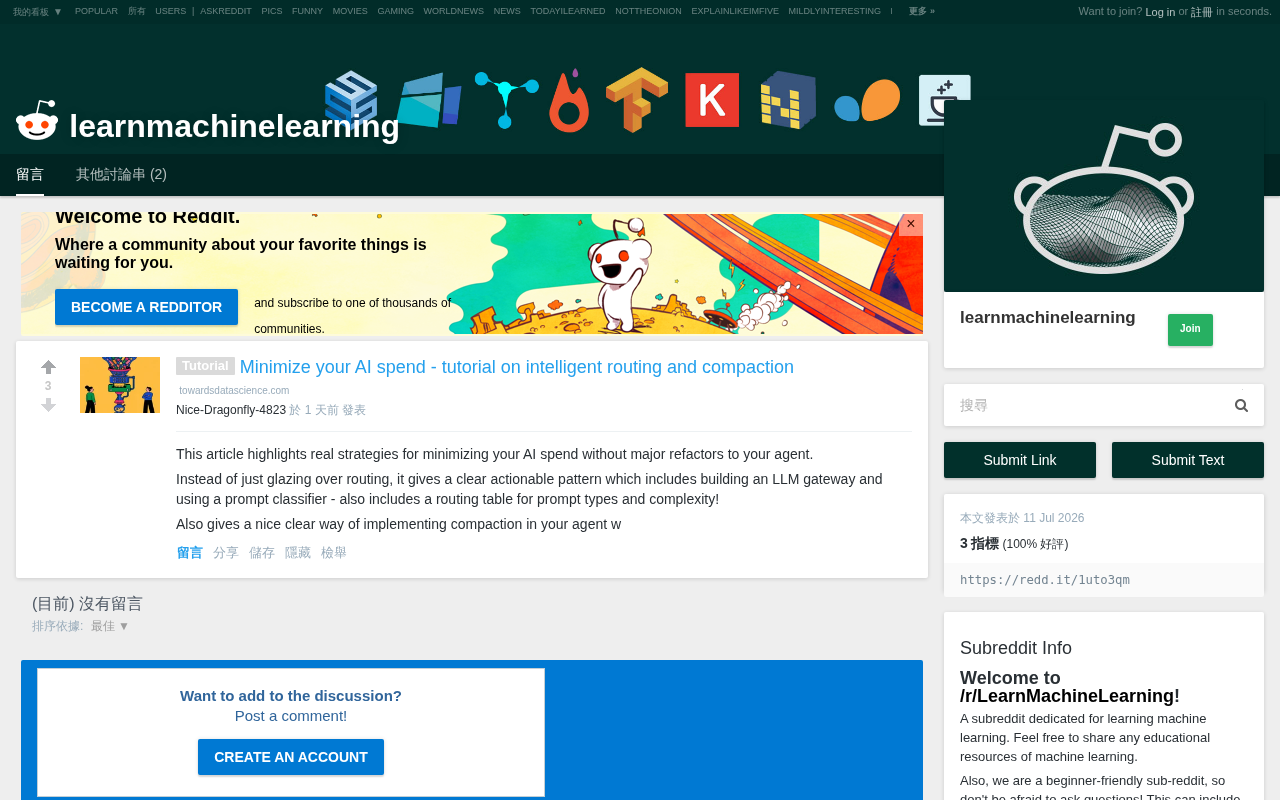
·5 min
Practical AI Cost Optimization: A Deep Dive into Intelligent Routing and Context Compaction
AI bills keep soaring? This article breaks down two core cost-reduction strategies: intelligent routing via an LLM Gateway, and context compaction to cut Token usage—no major refactoring needed.
Read more →

·4 min
Learn ML Free at Public Libraries: A Complete Guide to O'Reilly Tech Book Resources
Getting O'Reilly machine learning books free at public libraries? It's no myth. This article reveals hidden tech learning resources at libraries, including online platform subscriptions and digital database access, helping self-learners build AI knowledge at zero cost.
Read more →

·5 min
Hands-On with PageAgent: Add AI Agent Capabilities to Web Pages with a Single Line of Code
In-depth hands-on review of Alibaba's open-source web automation tool PageAgent: three integration methods, script execution analysis, and a full breakdown of current limitations. Add AI Agent capabilities to web pages with one line of JS.
Read more →

·5 min
ECC: An Agent Enhancement Framework for AI Coding Assistants — Five Core Capabilities Explained
ECC is an agent optimization framework for AI coding assistants like Claude Code, Cursor, and Codex, enhancing them with skills, memory, security, and research-first development capabilities.
Read more →

·5 min
A €35 IKEA Coffee Table Hides an Entire Home Server: Where Aesthetics Meets Function
A Reddit user hid a NAS, hard drive array, and modem inside a €35 IKEA Gillersberg coffee table, winning his partner's approval. Here's how this high-WAF home server solution works.
Read more →

·5 min
Practical Guide to Deploying Invoice Analysis AI: Model Selection and Architecture Pitfalls
How can enterprises process 50+ invoice formats with AI? This article analyzes visual document understanding approaches—multimodal LLMs, OCR+LLM, and hybrid architecture—with key decision advice for non-technical AI leads.
Read more →

·4 min
How to Choose a Machine Learning Course for Beginners: A Complete Roadmap
Not sure where to start with machine learning? This guide covers the community-approved ML roadmap: from math and Python basics to Andrew Ng, fast.ai, Kaggle, and CS229.
Read more →

·4 min
Electrical Engineer to AI Engineer: A Real Story and Practical Transition Roadmap
A 6-year electrical engineer from Brazil weighs transitioning to AI engineering. This deep-dive covers the stability vs. freedom tradeoff, transition advantages, and a practical roadmap for engineers with similar backgrounds.
Read more →

·7 min
Google's $250K Bounty: Linux VM Escape Vulnerability Sets a Historic Record
Google paid a security researcher $250K for a Linux kernel VM escape vulnerability, setting a VRP record. An in-depth analysis of VM escape principles, kCTF incentives, and cloud security impact.
Read more →