#peer-to-peer
105 related articles
·3 min
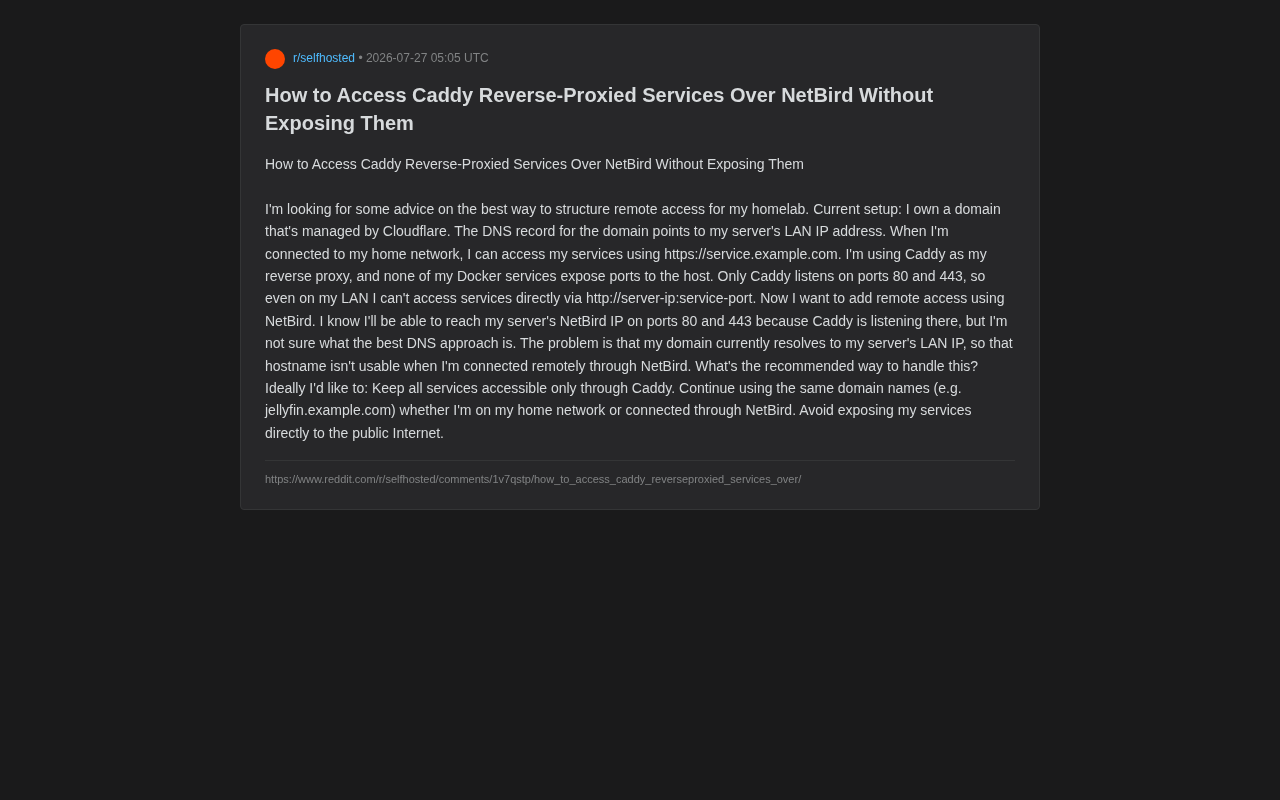
NetBird + Caddy: Remote Access Without Exposing Public Ports
Learn how to use NetBird WireGuard mesh networking with Caddy reverse proxy for homelab remote access without exposing public ports. Covers Split DNS, TLS certificates, and ACL controls.
Read more →
·4 min
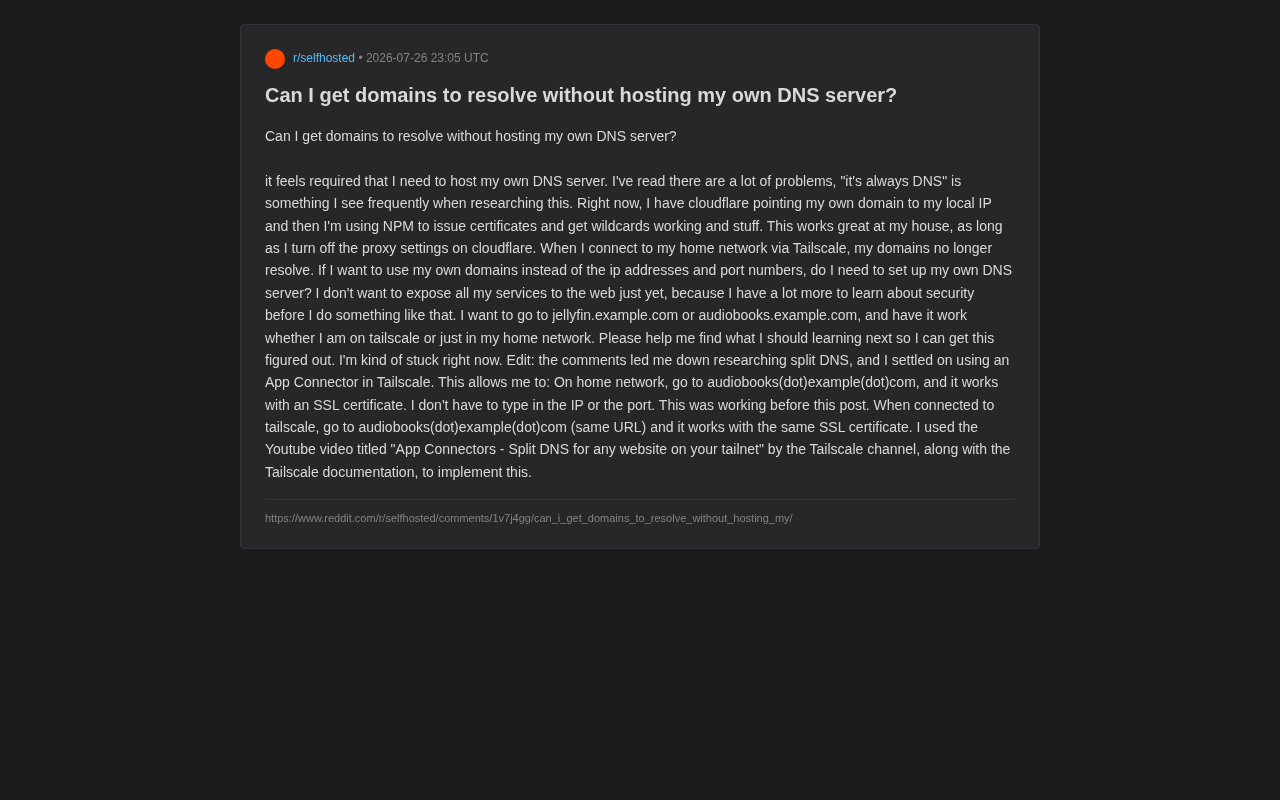
Self-Hosted Service Domain Resolution in Practice: A Deep Dive into Split DNS and Tailscale Solutions
A deep dive into domain resolution challenges for self-hosted home servers, covering Split DNS concepts and how Tailscale App Connector enables unified domain access across internal and external networks.
Read more →

·4 min
Frontend Engineer Driven to Homelab by AI: From React Specialist to Full-Stack Self-Rescue
A 7-year frontend engineer, fearing AI-driven job loss, builds a homelab to learn Docker, databases, and networking. A pragmatic roadmap for developers building breadth in the AI era.
Read more →

·3 min
Why IPFS and Filecoin Failed to Gain Traction in the Self-Hosting Community
IPFS and Filecoin promise decentralized storage and censorship resistance, yet the self-hosting community ignores them. This article analyzes why simpler tools like Syncthing and BitTorrent win.
Read more →
GitHub Daily · July 25: Where Decentra…
·2 min
GitHub Daily · July 25: Where Decentralized Communication Meets AI-Native Tools
GitHub Trending July 25: bitchat's Bluetooth Mesh chat gains 1,700 stars in a day, palmier-pro reimagines AI-native video editing, and aisuite unifies LLM access.
Read more →

·6 min
30-Minute Hands-On: Building a Working AI Agent from Scratch
Skip the dry theory and get hands-on! This article demonstrates step by step how to build a working AI Agent from scratch in 30 minutes using AI coding tools—covering the agent skeleton, tool system, memory mechanism, Flask web UI, and DeepSeek API integration.
Read more →

·3 min
LangChain v1.3 Hands-On Tutorial: Deep Dive into Agents, RAG, and Local Model Deployment
Deep dive into LangChain v1.3: compare LangChain, LangGraph, and DeepAgent paradigms, explore RAG pipelines, multi-agent systems, and local LLM deployment for enterprise AI apps.
Read more →
croc: Open-Source CLI File Transfer To…
·2 min
croc: Open-Source CLI File Transfer Tool — Secure, Cross-Platform, Zero Config
croc is an open-source Go-based CLI file transfer tool with PAKE end-to-end encryption. Cross-platform, resumable, zero config — send files securely with one command.
Read more →

·2 min
ROS2 for Beginners: The Essential Framework for Robot Development
A complete introduction to ROS2 for beginners: what ROS is, how ROS1 and ROS2 differ, and how to choose the right version to kickstart your robot development journey.
Read more →
Multi-Agent Collaboration: A GPT Team …
·2 min
Multi-Agent Collaboration: A GPT Team Engineering Paradigm and Practical Guide
Explore multi-agent collaboration architecture: role division, communication protocols, coordination mechanisms, and how Workbench templates help developers build efficient AI agent teams.
Read more →
The Lost Joy of Music Piracy: What We …
·2 min
The Lost Joy of Music Piracy: What We Gave Up in the Streaming Era
When Napster and LimeWire became history and streaming replaced MP3 collections, what did we actually lose? A deep dive into piracy-era discovery culture, ownership, and the hidden cost of algorithmic recommendation.
Read more →

·3 min
Cosmonapse: A Decentralized Multi-Agent Framework Built on an Event Bus
Cosmonapse is an open-source multi-agent framework that replaces central orchestrators with peer nodes, using typed signals and an event bus to fully decouple tool calls, memory, and HITL. Supports Python and TypeScript under Apache 2.0.
Read more →
WebRTC P2P Local File Transfer Explain…
·2 min
WebRTC P2P Local File Transfer Explained: How It Works, Benefits, and Limitations
A deep dive into WebRTC-based P2P local file transfer: no cloud relay, end-to-end encrypted direct connections via DataChannel. Covers NAT traversal, privacy benefits, large-file challenges, and comparisons with Snapdrop.
Read more →

·2 min
LangGraph Multi-Agent Architecture in Practice: From Core Components to Production Deployment
A deep dive into LangGraph multi-agent architecture — covering hierarchical, network, and pipeline patterns with three hands-on projects using LangGraph 0.3.
Read more →

·2 min
Transitioning to AI/ML: Why Finding a Study Buddy Matters More Than Picking the Right Course
Transitioning from software dev to AI/ML is hard to do alone. Discover why finding a study buddy beats picking the perfect course — and how peer accountability solves the consistency, judgment-free questioning, and foundation-building challenges.
Read more →
AI Coding Agents Have Amnesia — An Ope…
·2 min
AI Coding Agents Have Amnesia — An Open-Source SSH-Synced Memory System Wants to Fix That
Tired of AI coding agents forgetting everything? Explore an open-source SSH-synced memory system that lets Cursor, Claude Code, and other agents retain project context across sessions and devices — no cloud required.
Read more →
Privacy Messaging App Briar Enters Mai…
·2 min
Privacy Messaging App Briar Enters Maintenance Mode: What Should Users Do Next?
Briar, the decentralized encrypted messaging app, has entered maintenance mode. Learn what this means for users, why open-source privacy tools struggle, and which alternatives like Signal or Session to consider.
Read more →

·3 min
Can GPT-5.6 Prove a 50-Year Graph Theory Conjecture? The Boundaries and Verification of AI Mathematical Reasoning
GPT-5.6 Soul Ultra claims to prove the 50-year-old Cycle Double Cover Conjecture in under an hour using 64 parallel agents. We examine the technical path, missing peer review, and formal verification gaps.
Read more →

·3 min
UPnP Security Warning: A Real Case of NAS Auto-Exposing SSH Ports to the Public Internet
A real homelab case: a UGREEN NAS used UPnP to automatically expose SSH port 22 to the internet, triggering brute-force attacks. Full breakdown of the incident, UPnP risks, and NAS security tips.
Read more →

·2 min
P2P Student GPU Sharing Network: A Full Breakdown of Technical Feasibility and Real-World Challenges
A deep dive into the technical feasibility and real-world challenges of P2P student GPU sharing networks, covering distributed computing, latency, security, and incentive design.
Read more →