#reasoning context persistence
275 related articles

·4 min
Infrastructure Architecture for Agent Applications: Four Core Patterns Explained
A deep dive into infrastructure architecture patterns for production-grade Agent applications, covering state persistence, sandbox isolation, LLM observability, and cost control.
Read more →

·4 min
Infrastructure Architecture for Agent Applications: Four Core Patterns Explained
Deep dive into infrastructure architecture patterns for production-grade Agent applications, covering state persistence, sandbox isolation, LLM observability, and cost control.
Read more →

·2 min
agent-manager: An Open-Source Tool for Managing Multiple AI Coding Assistants with tmux
agent-manager is a lightweight tmux-based TUI tool that helps developers manage multiple AI coding assistants like Claude Code, Codex, and OpenCode from a unified interface for status monitoring, interaction, and code review.
Read more →

·4 min
11-Node LangGraph in Practice: Complete Architecture Breakdown of a Compliance-Grade RAG Agent
Deep dive into an 11-node Agentic RAG agent built with LangGraph, featuring 6-way intelligent routing, hallucination guards, PII masking, circuit breakers, and zero-cost deployment.
Read more →

·3 min
Kimi K3 Launch: A 2.8 Trillion Parameter Flagship Model Makes Its Grand Entrance
Moonshot AI launches Kimi K3 with 2.8 trillion parameters and 1M token context. Google delays Gemini 3.5 Pro, AI coding tools upgrade collectively as competition shifts to coding and Agent capabilities.
Read more →

·4 min
Harness Engineering: The Core Infrastructure for Taking AI Agents from Demo to Production
Deep dive into Harness Engineering: why AI Agents need memory management, durable execution, guardrails & approvals to reach production. Based on Scott Moss's workshop.
Read more →

·5 min
Running GPT-5.6 Inside Claude Code: Best Practices for Subagent Orchestration and System Prompts
Deep dive into running OpenAI GPT-5.6 inside Claude Code: comparing Codex vs Claude Code on subagent orchestration, workflow design, and system prompt quality, revealing how harness engineering determines model output.
Read more →

·4 min
Fable 5 vs GPT-5.6: An In-Depth Head-to-Head Comparison of Two Top-Tier Coding Models
In-depth comparison of Fable 5 vs GPT-5.6 (Sol) for AI coding. Real-world data on token efficiency, code quality, design capability, and cost from $10K+ testing.
Read more →

·4 min
Fable 5 vs GPT-5.6: An In-Depth Head-to-Head Comparison of Two Top-Tier Coding Models
In-depth comparison of Fable 5 vs GPT-5.6 (Sol) for AI coding. Covering token efficiency, code quality, design, cost, and safety based on $10K+ real usage data.
Read more →
·3 min
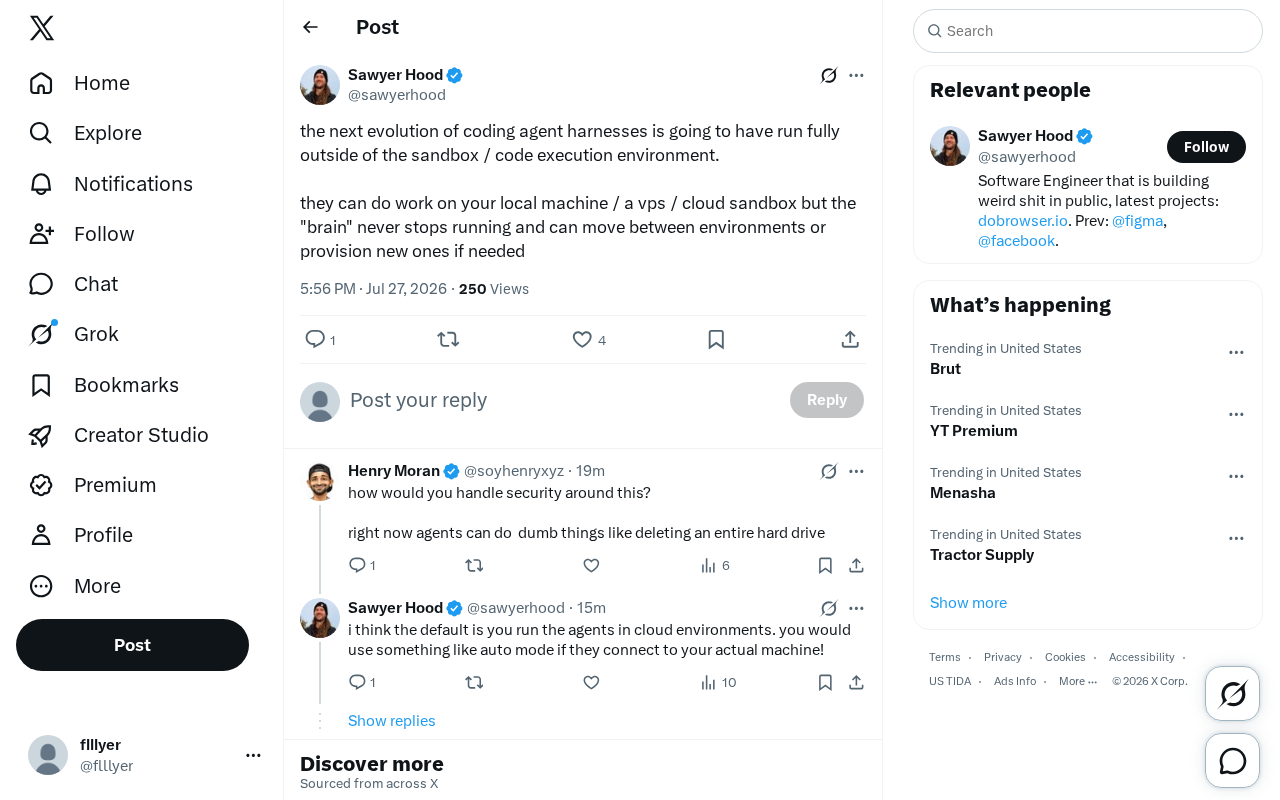
The Next Evolution of Coding Agents: Letting the Brain Break Free from the Sandbox
Exploring the key evolution in coding agent architecture: separating the reasoning core from code execution environments to decouple control and execution planes.
Read more →

·2 min
LLM Agent Long-Term Memory Security: A Six-Stage Attack Surface and Defense Framework
Deep analysis of LLM agent long-term memory security threats, covering persistence, statefulness, and propagation of memory poisoning, with a six-stage lifecycle defense framework.
Read more →

·5 min
The Five Stages of AI Agent Architecture Evolution: The Real Path from Model Calls to Production Runtime
Deep dive into the five evolution stages of AI Agent architecture: model calls, tool calls, workflows, Agent loops, and production runtime. Learn the responsibility boundaries and design principles.
Read more →
·3 min
The Next Evolution of Coding Agents: Letting the Brain Escape the Sandbox
Exploring the next evolution in coding agent architecture: decoupling the reasoning core from code execution environments to separate control and execution planes.
Read more →

·2 min
ag-kit: A Deep Dive into the TypeScript-Based AI Agent Development Toolkit
An in-depth analysis of ag-kit, a TypeScript-based AI Agent development toolkit covering core architecture, modular design, use cases, and tech selection advice for full-stack developers.
Read more →

·3 min
Spring AI Alibaba Graph in Practice: Building a Full-Process HR Recruitment Agent
A detailed guide on building a full-process HR recruitment Workflow Agent with Spring AI Alibaba Graph, covering resume parsing, multi-dimensional screening, tiered questions, human-in-the-loop, and state rollback.
Read more →

·4 min
Gemini API in Practice: Building AI Agents with Files
Google's official hands-on: how to go from idea to production fast with AI Studio and build AI Agents using the now-GA Interactions API. The core idea—Agents are just combinations of files.
Read more →

·5 min
Gemini API in Practice: Building AI Agents with Files
Official Google hands-on: go from idea to production fast with AI Studio, and build AI Agents with the now-GA Interactions API. The core idea: an Agent is just a composition of files—Markdown plus a few scripts, no complex Python loops needed.
Read more →
·3 min
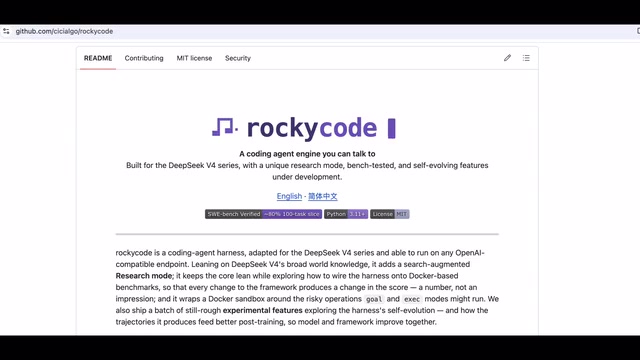
Rocky: An Open-Source Coding Agent with Minimal Architecture and Native DeepSeek Integration
Rocky is a minimal, transparent open-source coding agent with a core loop under a few hundred lines of Python, native DeepSeek search, Research mode, and built-in SWE benchmarking for reproducible agent experiments.
Read more →

·3 min
OpenAI Releases GPT-5.6 and ChatGPT Work: The Era of Autonomous AI Has Arrived
OpenAI launches GPT-5.6 (Sol, Terra, Luna), ChatGPT Work, a new desktop app, and Sites hosting. AI evolves from a Q&A tool into an autonomous work partner for finance, file management, and more.
Read more →

·3 min
LoRA Fine-tuning or Prompt Engineering? Two Paths to Solving LLM Long-Conversation Memory
A developer fine-tunes a small model with LoRA to extract conversation state, tackling the LLM long-conversation memory problem. A deep dive into the technical approach, dataset design, and the real trade-offs between fine-tuning and prompt engineering.
Read more →