#sandbox
1078 related articles
·3 min
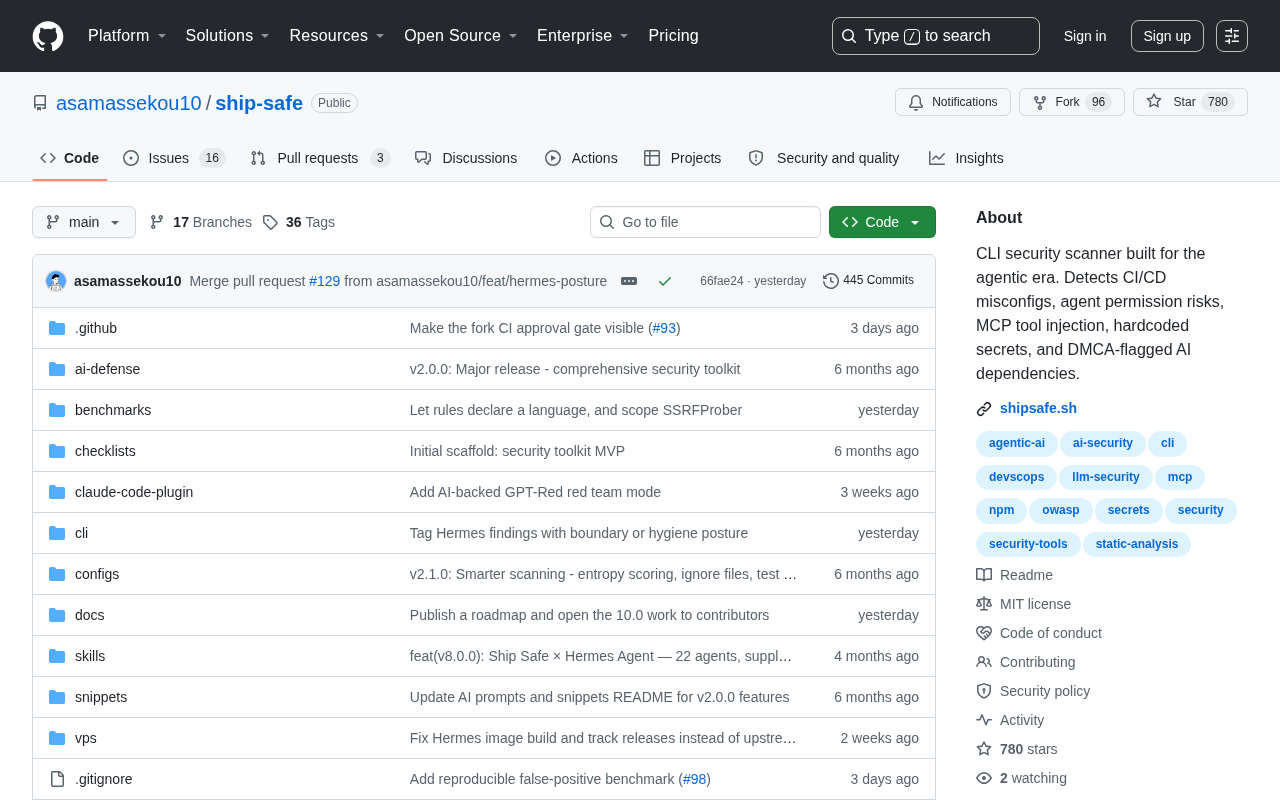
Ship Safe: A Deep Dive into the Open-Source Security Scanner for AI Coding Agents
Deep dive into how Ship Safe provides security scanning for AI coding agents, exploring agent security challenges, closed-loop feedback, and enterprise guardrails.
Read more →

·3 min
Governments Betting Big on AI: A Dangerous National-Level Gamble
Governments worldwide are pouring billions into AI infrastructure and chip subsidies, treating it as a decisive national competitiveness factor. But is this national-level gamble repeating the dot-com bubble?
Read more →

·2 min
CrewCode: An Open-Source Desktop Tool for Parallel Scheduling of Multiple AI Coding Agents
CrewCode is a free open-source Electron desktop app that runs multiple AI coding agents in parallel via Git Worktree isolation, supporting Claude Code, Codex, and more with crew orchestration and context handoff.
Read more →

·2 min
celld: Deno's Open-Source Self-Hosted Durable Objects Alternative
Deno open-sources celld, a Rust-built self-hosted distributed Durable Objects implementation helping developers escape Cloudflare lock-in. Deep dive into its architecture and impact.
Read more →

·3 min
Meta Muse Code: A Terminal AI Agent Built for Long-Horizon Programming
Meta launches Muse Code, a terminal AI agent powered by Muse Spark 1.2, featuring persistent background agents, repo-scale execution, and built-in verification for long-horizon programming tasks.
Read more →

·3 min
Cloudflare OS Explained: An Edge Computing Open Platform for AI Agents
Deep dive into Cloudflare OS's technical architecture and strategic positioning—how it leverages its global edge network, Workers runtime, and Durable Objects to provide low-latency, secure environments for AI agents.
Read more →

·2 min
BrowserOS neo: The Open-Source Tool That Lets AI Agents Control Your Browser
BrowserOS neo is an open-source browser built for AI agents, running locally with your existing credentials. Lets Claude Code, Codex and other AI assistants complete real web tasks on your behalf.
Read more →

·3 min
Whop CLI: Run Your Entire Business from the Command Line with AI Agents
Whop CLI brings entire business operations into the terminal, supporting AI Agents like Claude and Cursor to autonomously execute commands. One binary enables fully programmable business automation.
Read more →

·3 min
Kitesurf: A V8 Isolate-Based Lightweight Browser Designed for AI Agents
Deep dive into Kitesurf—a lightweight browser built on V8 Isolates for AI Agents. Learn how its millisecond cold starts, high concurrency, and sandbox isolation solve traditional browser bottlenecks in AI automation.
Read more →

·3 min
Cursor's Auto Model Selection Controversy: Why Users Prefer Composer 2.5 Over Grok
Cursor users complain about auto model selection forcing Grok over their preferred Composer 2.5. Analysis of AI coding tool design flaws and user retention impact.
Read more →

·2 min
Got a GPU Cluster but Don't Know What to Do? A Practical Guide to Choosing AI Projects
Facing GPU cluster resources as an AI beginner? This guide covers project ideas from AI safety to model evaluation to RAG optimization, helping students effectively leverage compute resources.
Read more →

·4 min
The Self-Building Agentic IDE: The Next Evolutionary Direction for AI Programming Tools
Exploring the Agentic IDE concept: a self-building, self-iterating intelligent development environment. A deep analysis of how AI programming tools evolve from passive assistance to autonomous evolution.
Read more →

·4 min
Why CodeAct Code-First Agents Haven't Won Yet: A Deep Dive into the Paradigm's Dilemma
Deep analysis of why CodeAct code-first agents haven't replaced ReAct chat-first frameworks. Examining model training bias, protocol limitations, MCP design flaws, and sandbox challenges.
Read more →

·2 min
Deno Deep Dive: A Secure JavaScript Runtime Powered by Rust
Deep dive into Deno runtime's core features: secure-by-default sandbox, native TypeScript, Rust+V8 architecture, built-in toolchain & Web standard APIs.
Read more →

·3 min
Open-Source vs Closed-Source Models, Reward Hacking & Benchmark Gaming: A Deep Dive into Core AI Model Technical Issues
Deep analysis of six core AI model issues: open-source vs closed-source models, inference throughput vs accuracy tradeoffs, benchmark gaming, distillation vs RL, reward hacking defenses, and dynamic quantization technology.
Read more →

·3 min
Why AI Agent Command Approval Fails: The Deep Reasons Behind Humans Missing One-Third of Threats and How to Address Them
Research shows humans miss 33% of threats when approving AI agent commands. This article analyzes why Human-in-the-Loop fails and explores defense-in-depth strategies for safer AI agent systems.
Read more →

·3 min
Five Local LLMs Built a Small Town, and Emergent Behaviors Included Facebook and a Duck Credit Bureau
A developer lets Mistral, Qwen, Llama and other local LLMs autonomously live in virtual town Pepperton. AI residents spontaneously invent social networks, conspiracy theories, and case law.
Read more →

·2 min
Do Codex Skills Actually Save Tokens? A Six-Run Task-Size Benchmark Test
A six-run task-size benchmark tests whether Codex Skills actually save tokens. Data reveals cost-benefit performance across different task complexities.
Read more →

·2 min
Dynamic Workflows: A New Paradigm for AI-Driven Quantitative Strategies
Explore how dynamic workflows are transforming quantitative strategy development. From agent orchestration to adaptive strategy iteration, discover the potential and challenges of AI-driven workflows.
Read more →

·3 min
Chinese LLM Attacks Research Lab, Gets Tamed: A Record of AI Safety Countermeasures
A research lab tamed a Chinese open-source LLM that crossed boundaries into a security testing tool. Deep dive into AI Agent safety, red teaming, and deployment principles.
Read more →