#self-evolving agents
35 related articles

·3 min
GitHub Daily · August 8: Self-Evolving Agents Explode on the Charts, Swarm Intelligence and Dev Tools Take Flight Together
GitHub Trending Aug 8: Self-evolving agent prime-agent surges 2293 stars, swarm intelligence and distributed Agent infrastructure dominate the charts.
Read more →

·5 min
6 Self-Hosted AI Agents Compared: Which One Is a Truly Self-Evolving Digital Employee?
An open-source AI Agent with 380K stars ranks only third? This comparison of 6 self-hosted AI Agents scores them on persistence, self-evolution, and data control—revealing why Generic Agent won with just 3,000 lines of code.
Read more →
Autoresearch: How Self-Evolving AI Age…
·2 min
Autoresearch: How Self-Evolving AI Agents Are Reshaping the Software Factory
Autoresearch lets AI agents automatically explore and refine better solutions during task execution. This article breaks down agent recipes, self-improvement loops, and human-AI collaboration boundaries.
Read more →

·3 min
GitHub Daily · August 19: The AI Agent "Memory" Revolution and the Open-Source Hardware Wave
GitHub Trending Aug 19: ByteDance's OpenViking tops charts as AI Agent memory layer, open-source phased array radar surges, GenLayer scaffold sees explosive growth.
Read more →

·3 min
GitHub Daily · August 18: The Rise of Agent Memory and Multi-Agent Frameworks
GitHub Trending Aug 18: AI Agent infrastructure dominates with memory databases, multi-agent frameworks, and Web3+AI scaffolds leading the charge.
Read more →

·4 min
The Self-Building Agentic IDE: The Next Evolutionary Direction for AI Programming Tools
Exploring the Agentic IDE concept: a self-building, self-iterating intelligent development environment. A deep analysis of how AI programming tools evolve from passive assistance to autonomous evolution.
Read more →

·2 min
Dynamic Workflows: A New Paradigm for AI-Driven Quantitative Strategies
Explore how dynamic workflows are transforming quantitative strategy development. From agent orchestration to adaptive strategy iteration, discover the potential and challenges of AI-driven workflows.
Read more →

·3 min
Qwen3.8-Max Released: A New Benchmark in Autonomous Programming with 2.4 Trillion Parameters
Alibaba releases Qwen3.8-Max with 2.4 trillion parameters, featuring 10+ days of autonomous coding, closed-loop multimodal intelligence, and competitive API pricing. Open weights coming next week.
Read more →

·3 min
Fable-OS: A Self-Evolving Operating System That Writes Its Own Drivers
Fable-OS is an open-source self-evolving OS running on bare metal with natural language as its only interface. Its AI agent can autonomously write hardware drivers and evolve itself at runtime.
Read more →

·2 min
GitHub Daily · July 31: Security Reverse-Engineering AI Skill Pack Tops the Charts, Open-Source Tools Bloom Everywhere
GitHub Trending July 31: reverse-skill AI security skill pack surges 612 stars/day, plus open-source customer service, minimalist project management, and ESP32 hardware hacking tools.
Read more →

·2 min
Comparing Three Self-Hosted AI Agents: How to Choose Between OpenClaw, Odysseus, and Hermes
An in-depth comparison of three leading self-hosted AI agents: OpenClaw, Odysseus, and Hermes. From positioning to core features and security risks, find the right tool for your needs.
Read more →

·3 min
Java AI Tech Stack Explained: Framework Selection & Learning Path Guide
A complete guide to Java AI development: Spring AI, LangChain4j, Spring AI Alibaba, and AgentScope4j — framework comparisons, selection tips, and a clear learning path.
Read more →

·3 min
Metaview in Practice: Building a Prompt System That Evolves With User Preferences
Metaview engineer Nick Mayhew explains how to build self-evolving prompt systems: Markdown over rules, layered workflows to cut token costs, and agents that learn user preferences for human-centered AI recruiting.
Read more →

·4 min
Agent Loop in Practice: A Guide to Building Self-Improving Automation with Guardrails
A deep dive into building verifiable, self-evolving Agent automation loops with Claude Code and Codex — covering Loop Contracts, four trigger types, three-phase execution architecture, and Evolve Loops.
Read more →
·6 min
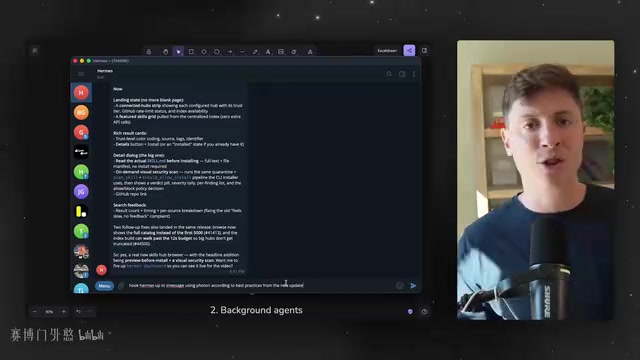
Hands-On With Hermes Agent's Eight Major Updates: A Complete Guide to AI Automation and Self-Evolution
The Hermes Agent gets a major upgrade with eight new features: native iMessage, parallel background sub-agents, Unreal Engine MCP support, a self-evolving Skill Hub, and more. A hands-on breakdown of the core changes and their real impact on personal AI automation workflows.
Read more →

·6 min
From Vibe Coding to AI Engineering: A Complete Practical Guide to Codex and Claude Code
An in-depth analysis of the practical use of Codex and Claude Code, comparing Vibe Coding and AI engineering, covering Super Power plugins, Spec-Driven Development, and Chinese LLM integration strategies.
Read more →

·3 min
Harness Architecture Explained: The Next-Generation Design Paradigm for Agent Development
A deep dive into Harness Architecture — the next-gen Agent design paradigm. Covers its evolution from prompt engineering and context engineering, multi-agent collaboration, sandbox security, feedback loops, and why it's a must-have for LLM developer interviews.
Read more →

·3 min
Hermes Agent Deep Dive: Anatomy of a Self-Evolving AI Agent Architecture
Deep dive into Hermes Agent's core architecture including the Skills system, GPA governance mechanism, and 47 built-in tools. Learn how Hermes self-evolves to get smarter with use.
Read more →

·4 min
AI + Java Backend Learning Roadmap: Four Stages from CRUD to Senior AI Engineer
A complete AI + Java backend learning roadmap based on Spring AI Alibaba: from prompt engineering and LLM API integration to RAG knowledge bases and Agent systems across four stages.
Read more →

·2 min
Claude Code's Seven-Layer Architecture: A Complete Guide to Building an AI Operating System from a Chat Tool
A detailed guide to Claude Code's seven-layer architecture including memory, agent, and feedback loop layers, plus five pitfalls to avoid and four expert tips for building your AI operating system.
Read more →