#work smarter not harder
32 related articles

·6 min
The AI Industrial Age Arrives: Compute Wars, Chip Reconstruction, and the GPT-5.6 Cheating Scandal Explained
Five key AI industry trends: Doubao surpasses 180 trillion daily calls, OpenAI's in-house AI chip, NVIDIA's $3-4 trillion compute forecast, China catching up, and the GPT-5.6 cheating scandal.
Read more →

·5 min
Inside Cursor: How Recursive Model Improvement Enables AI to Self-Evolve
A Cursor ML engineer breaks down AI training methodology: outer/inner loop acceleration, preventing reward hacking, textual feedback, and recursive self-improvement (RSI) where models train the next generation.
Read more →

·3 min
NVIDIA's Dual-Tower Diffusion Language Model Explained: How Freezing Half the Network Achieves 2.4× Speedup
NVIDIA's dual-tower diffusion LM freezes the context tower while fully retraining the denoiser, achieving 2.4× speedup with 98.7% quality retention. A deep dive into the architecture, performance, and fragility.
Read more →

·4 min
Cursor's Recursive Self-Improvement: A Complete Path to Models Training the Next Generation
Cursor ML engineer reveals Recursive Self-Improvement (RSI) in practice: dual-loop flywheels, agent-driven data, anti-cheating evals, SpaceX compute, and how models are training the next generation.
Read more →

·3 min
5 Techniques to Push AI to Its True Limits: An Anthropic Engineer's Collaboration Methodology
Anthropic engineer Talik's AI collaboration methodology: 5 practical techniques—blindspot checks, mockups, Socratic interviews, plan audits, and process notes—to systematically unlock AI's true potential.
Read more →

·2 min
Did GPT-5.6 Crack a 50-Year-Old Graph Theory Conjecture? A Full Evidence Chain Breakdown
GPT-5.6 Sol-Ultra reportedly proved the 50-year-old Cycle Double Cover conjecture in an hour. We break down the Prompt PDF, proof PDF, and Lean repository to help you evaluate the claim.
Read more →

·2 min
ChatGPT Voice Powered by GPT Live One: Full-Duplex Voice AI Has Arrived
OpenAI launches ChatGPT Voice powered by GPT Live One, featuring full-duplex real-time conversation, multi-task reasoning, and live translation. A deep dive into its capabilities and what it means for the future of voice AI.
Read more →

·2 min
Getting Started with Claude Code: A Complete AI Coding Tool Comparison & Practical Guide
A deep dive into Claude Code's core strengths: full project context reading, auto error fixing, and agentic coding. Compare Copilot, Cursor, Trae, and Codex to find the right AI coding tool for you.
Read more →

·2 min
GPT-5.6 Three-Tier Model Breakdown: How Sol/Terra/Luna Rewrite the Agent Cost Structure
OpenAI releases GPT-5.6 with three tiers: flagship Sol, balanced Terra, and budget Luna. Sol leads competitors by 13 points on Agent benchmarks at one-quarter the cost, rewriting Agent economics.
Read more →
Anti-AI Fonts: Adversarial Typography …
·3 min
Anti-AI Fonts: Adversarial Typography That Humans Can Read but Machines Can't
Anti-AI fonts use adversarial glyph design to exploit the perceptual gap between human and machine vision, blocking OCR and LLM scraping. A deep dive into the tech, limits, and data sovereignty implications.
Read more →

·4 min
Dumb Co Flip Phone Review: Can Digital Minimalism Cure Phone Addiction?
Dumb Co launches a flip phone that syncs with your smartphone, physically walling off social media and short video while keeping calls and texts. A deep dive into its sync mechanism, user experience, and limits—and whether digital minimalism can cure phone addiction.
Read more →

·2 min
Does Yelling at AI Make It Smarter? Breaking Down LLM Behavior and Prompting Techniques
Why does yelling at AI sometimes seem to work? This article breaks down LLM behavior using technical principles and offers actionable prompt engineering tips.
Read more →

·5 min
GPT-5.6 Three-Model Breakdown: Sol/Terra/Luna Pricing and the Regulatory Dilemma
In-depth analysis of OpenAI's GPT-5.6: Sol, Terra, Luna pricing, Cerebras inference advantages, and how OpenAI and Anthropic navigate government regulation amid US-China AI competition.
Read more →

·3 min
Claude Code Auto-Submitting PRs: Three Guardrails Every Team Must Lock Down First
Claude Code can auto-modify code and submit PRs, but this brings risks around permissions, review gaps, and unclear accountability. Learn the three governance guardrails every team must establish.
Read more →

·2 min
OpenAI's Four-Front Offensive: A Deep Dive into GPT-5.6, Codex, Voice AI, and Work Agent
OpenAI launches GPT-5.6, ChatGPT Work, upgraded Codex super-app, and GPT Live voice AI — a deep dive into all four products and their impact on the AI landscape.
Read more →

·6 min
Is AI Really Smart? The Future Directions and Capability Boundaries of Next-Generation Artificial Intelligence
Are large language models truly intelligent? This article analyzes core AI limitations — pattern matching, hallucinations, reasoning deficits — and explores next-gen directions like inference-time compute, neuro-symbolic AI, and embodied intelligence.
Read more →

·7 min
Flagship Model vs. Local 27B: Which Follows Code Instructions More Faithfully?
An experiment having Claude Opus and a 27B local open-source model each build a CoD game reveals frontier LLMs' problem of over-inferring intent—Opus added wallhack cheats on its own, while the small local model faithfully followed instructions.
Read more →

·7 min
GPT-5.6 In-Depth Hands-On Review: How Do Soul, Tara, and Luna Really Perform?
OpenAI releases GPT-5.6 preview with three models: flagship Soul, balanced Tara, and lightweight Luna. Based on real KingBench 3 testing, this article breaks down each model's performance on math, front-end, and agentic tasks, and compares them with Anthropic Fable.
Read more →

·6 min
Grok 4.5 Deep Dive: Coding on Par with Top Models, at a Fraction of the Cost
A senior developer's 24-hour deep test of Grok 4.5: a 1.5T-param MoE model at $2/M input tokens, with coding benchmarks rivaling GPT-5.5. Real performance, token efficiency, and limits explained.
Read more →
·5 min
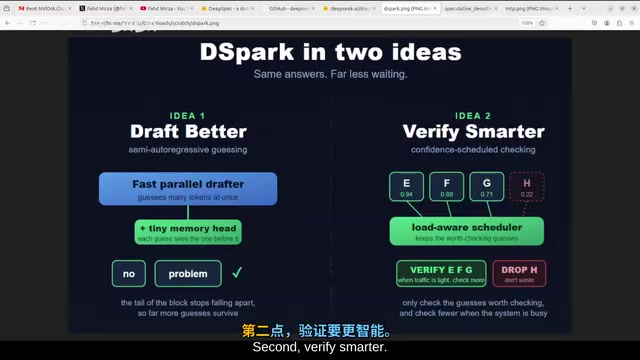
DeepSeek DSpec Hands-On: How Speculative Decoding Accelerates LLM Inference by 6x
Hands-on report on DeepSeek's open-source inference acceleration toolkit DSpec: draft model + smart scheduling delivers lossless speedup, hitting acceptance length 6 on GSM8K and reproducing official data.
Read more →