#模型选型
18 related articles

The Gemini 4 Naming Puzzle: Argon, Carbon, and Hydrogen Compared
Analyzing the naming logic and positioning differences of Gemini 4's Argon, Carbon, and Hydrogen models, with pricing and architecture inferences to guide developer model selection.
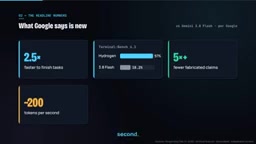
Gemini 4 Hydrogen Released: Faster and Cheaper, but Cost-per-Task Is What Really Matters
Google releases Gemini 4 Hydrogen, a fast everyday model with near-frontier scores. Token price doubled but cost per task dropped sharply. Thinking levels, Orchestrator, and model selection explained.

Gemini 4 Hydrogen Explained: Google's Lightweight, High-Speed AI Model
Analyzing Google's Gemini 4 Hydrogen: a lightweight, fast AI model with four thinking levels, multimodal support, ~100K token context, and the Carbon/Argon family roles.
How Much Does It Actually Cost to Run a Task on Opus 5.5?
Starting from a brief Hacker News question, this breaks down the cost structure of running a single task on Opus 5.5: the three layers of token bill, quality cost, and opportunity cost—and why the lack of a task baseline makes unit-price comparison meaningless, plus a reproducible measurement method.

Amazon Replaced Sonnet 4.6 with a Decision Model: 44x Cheaper, But Don't Rush to Copy It
Amazon engineers swapped Claude Sonnet 4.6 for a small decision model, Strands Decider, on 20-label ticket classification, cutting list cost ~44x. We analyze the boundaries, rollout pattern, and the full cost math.

AI Gateway Index Reveals: New Paying Teams Choose Anthropic Models Nearly 2:1 Over OpenAI
AI Gateway Index shows new paying teams choose Anthropic models nearly 2:1 over OpenAI. We unpack the safety, cost-effectiveness, and multi-model gateway factors behind this trend, plus OpenAI's response and what it means for developers.
 Tech Frontiers
Comparing Routing Mechanisms of 10 Open-Source MoE Models: DeepSeek, Qwen, Mixtral, Llama 4, gpt-oss
A configuration-based comparison of routing mechanisms in 10 open-source MoE models, analyzing DeepSeek, Qwen, Mixtral, Llama 4, and gpt-oss on expert count, top-k, shared experts, gating, and load balancing.

Deploying Open-Weight Models in Enterprise AI: A Databricks Field Engineer's Perspective
A Databricks field engineer shares real-world experience deploying open-weight models in enterprise AI: data sovereignty, cost structure, customization advantages, and deployment paths with hybrid architectures on Databricks.

How to Choose the Right Model for Each Agent in a Multi-Agent System
Which model should each agent use in a multi-agent system? This article breaks down the practice of per-agent model allocation: small models for high-frequency queries, frontier models for tone and judgment, local models for data compliance, plus fallback design, evals-first, and per-task cost decisions.

How LLM Evaluation Benchmarks Produce Comparable Scores: Deconstructing the LFORLA Mechanism
LFORLA's LLM benchmark uses fixed prompts, a fixed judge, dimension-level scoring, and public verbatim records to make model scores comparable. We break down the mechanism and offer a practical checklist for reading leaderboards.

Sonnet 5.5 vs Opus 5.5: Why the Cheaper Claude Actually Costs More
Anthropic's three Claude 5.5 models compared: Haiku, Sonnet, and Opus differ in pricing, reasoning effort, and actual token usage. Find out why Sonnet can cost more per task than Opus at max effort, plus selection advice for five real-world tasks.

How to Build Your Personal AI Benchmark: 5 Steps to Find the Right LLM for You
New models drop every 11 days, but public benchmarks are less reliable than ever. Learn the 5-step personal AI benchmark method to find which LLM actually fits your workflow.

Upgrading Your AI Model Broke Your Automation? Ask These Three Questions First
Upgraded your AI model and broke your automation? The issue usually isn't the AI. Learn the 3 root causes and 3 questions to ask before swapping models.

Trained Classifier vs. Zero-Shot LLM: How to Choose for Classification Tasks
Trained classifier or zero-shot LLM? We break down cost, accuracy, iteration speed, and deployment trade-offs — plus a practical decision checklist by project stage.

Sonnet 5.5 Closing in on Opus: Does Claude's Model Tiering Still Make Sense?
Reddit debates Claude's model tiers: as Sonnet 5.5 nears Opus 5.5, how capable could Haiku 5.5 be? We break down Claude's three-tier logic and what capability compression means for developers.

Choosing from 11,000+ Models: A Practical Guide to Microsoft Foundry Model Selection
How do you pick the right model from 11,000+ options in Microsoft Foundry? This guide covers filtering, benchmarks, real-world cost vs. latency testing, and quota planning.

Choosing the Best LLM for Your Budget: A Daily-Updated Model Selection Framework
How do you pick the best LLM for your budget? This guide breaks down model selection across price, capability, and latency, with a practical tiered approach and daily-update tooling.
 Industry Insights
Enterprise LLM Selection Guide: In-Depth Comparison of Llama 3.1, Qwen 2.5, and DeepSeek
How should enterprises choose open-source LLMs? This guide compares Llama 3.1, Qwen 2.5, DeepSeek, and Mistral across model capabilities, hardware requirements, and business scenarios.