#AI Agent browser
1363 related articles

·3 min
Verification Browser for AI Agents: How 13ms Ultra-Fast Validation Solves the Trust Problem in Automation
Deep dive into the verification browser for AI agents: how 13ms verification windows and one-call checks solve hallucination problems in browser automation, enabling the leap from capability to trustworthiness.
Read more →

·5 min
WebMCP in Practice: Building Browser AI Agent Tools & DevTools Debugging Guide
A detailed guide to Google's WebMCP standard proposal, covering imperative and declarative tool building, smart home and car configuration demos, and Chrome DevTools debugging for AI agent tools.
Read more →
Ego-lite: An Open-Source Browser Desig…
·3 min
Ego-lite: An Open-Source Browser Designed for Humans and AI Agents to Work in Parallel
ego-lite is an open-source AI-native browser by citrolabs that lets humans and AI Agents work in parallel in the same environment. Explore its design and value.
Read more →

·2 min
BrowserSkill: A Controlled Channel for AI Agents to Safely Borrow Your Logged-In Browser
Tencent's open-source BrowserSkill (BSK) lets AI agents reuse your real browser login state via a separate window, single-tab borrowing, and human takeover — safely and within clear boundaries.
Read more →

·3 min
AI Coding Agents Explosion: CodeWell Goes Open Source, Kimi K3 Launches, Claude Gets Browser Access
CodeWell open-sources a multi-model terminal coding agent, Kimi K3 launches with ultra-long context, MiniMax Code 2.0 rebuilds its Agent architecture, and Claude gets browser access. AI is accelerating from content generation to task execution.
Read more →
·3 min
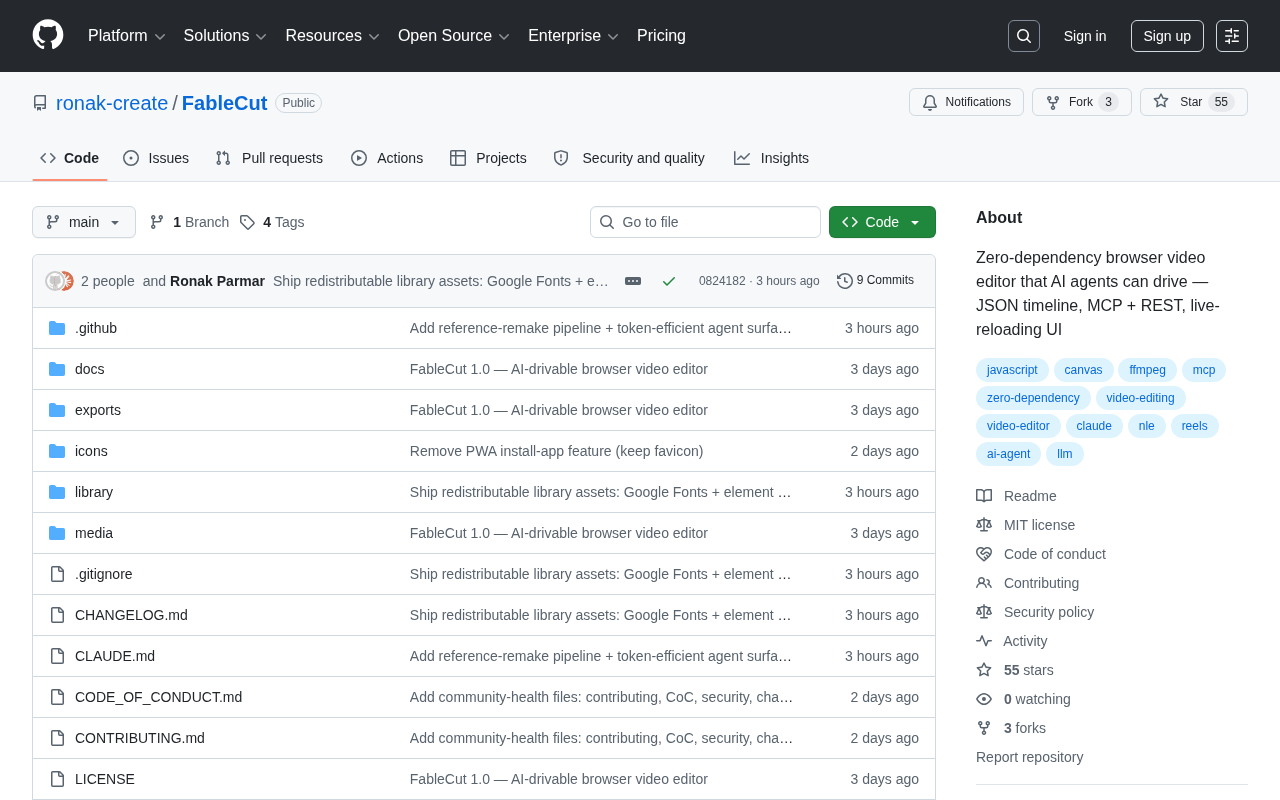
FableCut: A Zero-Dependency Browser Video Editor Built for AI Agents
FableCut is an open-source browser video editor built on a zero-dependency architecture and programmable AI-agent-driven design. A deep dive for AI automation developers.
Read more →

·5 min
Browser Use: A Deep Dive into the Event-Driven Browser AI Agent Framework
Browser Use is an open-source AI Agent framework that lets LLMs autonomously drive browser operations via natural language. This article breaks down its four-layer architecture, core Agent loop, CDP perception layer, dynamic Tools dispatch, and its Skills, Sandbox, and MCP extension capabilities.
Read more →

·3 min
Fortress: The Stealth Browser Built for AI Agents to Bypass Anti-Bot Detection
Fortress is an open-source stealth Chromium built for AI Agents. It eliminates automation fingerprints to bypass Cloudflare and other anti-bot systems.
Read more →
 Tutorials
·3 min
Hermes Agent + Playwright: A Practical Guide to AI-Driven Browser Automation
A complete guide to AI-driven browser automation with Hermes Agent and Playwright, covering setup, three AI modes (snapshot decisions, multi-turn dialogue, autonomous exploration), retry mechanisms, and optimization tips.
Read more →
 Product Reviews
·2 min
Page Agent: Alibaba's Open-Source AI Browser Extension for Form Automation
Page Agent is Alibaba's open-source AI browser extension that automates form filling and data entry via natural language. Supports Chrome, multiple LLMs, and backend integration.
Read more →
 Product Reviews
·2 min
89K Stars: Deep Dive into the Open-Source Tool That Lets AI Agents Take Over Your Browser
Deep dive into the 89K-star AI browser automation open-source project on GitHub — how it lets LLMs autonomously control browsers for web tasks, covering core capabilities, use cases, and getting started.
Read more →
 Product Reviews
·1 min
Tasi Harness: Local AI Agent for Browser Automation
Tasi Harness is a locally deployed AI Agent browser automation tool that drives browsers via natural language to complete searches, data collection, and form filling. A deep dive into its features, technical highlights, and use cases.
Read more →
 Tutorials
·4 min
Browser Use Tutorial: AI Browser Automation Agent Installation, Configuration & Practical Guide
Complete guide to Browser Use, the open-source AI browser automation agent: installation, Web UI usage, code integration, architecture, and token optimization tips for automating web tasks with natural language.
Read more →
 Tech Frontiers
·2 min
SWE-agent Multimodal Released: Image Viewing + Browser Debugging, A New Power Tool for Frontend AI Development
SWE-agent Multimodal officially released with image viewing and web browser debugging capabilities for automated frontend visual bug detection and fixes, plus the new SWE-bench Multimodal benchmark.
Read more →
 Deep Dives
·3 min
Auto-Use Open Source Project Explained: One AI Agent to Handle Your OS, Browser, and Code
Deep dive into the Auto-Use open source project—an end-to-end AI Computer Use Agent that unifies OS control, browser automation, and coding. Analysis of architecture, competitors, and industry trends.
Read more →
 Deep Dives
·2 min
Computer Agent: An Open-Source Rust AI Desktop Agent That Automatically Controls Mouse, Keyboard, and Browser
Computer Agent is an open-source AI desktop agent built in Rust that controls terminals, browsers, mice, and keyboards via natural language. Explore its features, architecture, and security.
Read more →

·2 min
Kimi K3 Integrates with Devin Platform: A Long-Horizon Coding Agent with Outstanding Debugging Capabilities
Kimi K3 launches on Devin Desktop and CLI, surpassing GPT-5.5 on FrontierCode 1.1 with standout debugging skills. Explore its long-horizon agentic coding performance.
Read more →

·3 min
Tigriden: A 40MB Lightweight AI Development Workbench Redefining Human-AI Collaboration
Tigriden is a Rust-native desktop workbench using only 40MB of memory, designed for AI Agent collaboration. Its Diff Tracker and Time Machine help developers review AI code changes and roll back quickly.
Read more →

·3 min
Fable-OS: A Self-Evolving Operating System That Writes Its Own Drivers
Fable-OS is an open-source self-evolving OS running on bare metal with natural language as its only interface. Its AI agent can autonomously write hardware drivers and evolve itself at runtime.
Read more →

·4 min
Claude Pro Quota Mysteriously Depleted: User Grievance Dilemmas and the AI Subscription Transparency Crisis
Claude Pro users report quota depletion without usage. Anthropic support can't investigate or explain. Analysis of AI subscription transparency, support limitations, and security risks.
Read more →