#AI-native infrastructure
247 related articles

·5 min
DeepSeek V4 Enters Grayscale Testing, Grok 5.0 Ready to Launch | Latest AI Model Developments
This AI Daily covers five sectors: DeepSeek V4 reportedly enters grayscale testing with improved chain-of-thought; Musk previews Grok 4.6 and 5.0 with 2T parameters; Intern-S2 open-source model beats Claude Opus 4.8; xAI builds 2000MW Colossus cluster; NVIDIA RoboTTT breaks long-horizon robotics barriers.
Read more →

·3 min
The Complete Guide to AI-Native Architecture: RAG, Agents, and MCP
A comprehensive guide to AI-native application architecture: LLM inference, RAG retrieval (vector DB/knowledge graph/BM25), Agents, MCP tool calling, AI gateways, and observability — end-to-end.
Read more →

·3 min
Apple vs. OpenAI: The 400-Employee Exodus and the Battle for AI Hardware Dominance
Apple sues OpenAI over 400 former employees allegedly stealing trade secrets. A deep dive into AI talent wars, hardware competition, HBM memory chips, and chip localization.
Read more →

·2 min
Chrome DevTools for Agents: The Closed-Loop Debugging Powerhouse for AI Coding Agents
Chrome DevTools for Agents, unveiled at Google I/O, gives AI coding agents a closed feedback loop with Lighthouse audits, user input simulation, and device emulation.
Read more →

·3 min
Apple Sues OpenAI for Trade Secret Theft, EU Bans Infinite Scroll: AI Enters the Deep Waters of Legal Oversight
Apple sues OpenAI for hardware trade secrets, EU orders Meta to disable autoplay and infinite scroll, OpenAI doubles biosecurity bounty — AI moves into legal and regulatory deep waters.
Read more →
PostHog Deep Dive: The Open-Source All…
·2 min
PostHog Deep Dive: The Open-Source All-in-One Platform for Product Analytics and AI Observability
PostHog is an open-source all-in-one platform combining product analytics, session replay, feature flags, A/B testing, and AI Observability. Supports self-hosting and MCP protocol.
Read more →
GitHub Copilot SDK Released: Embed AI …
·2 min
GitHub Copilot SDK Released: Embed AI Agent Capabilities Directly Into Your Applications
GitHub open-sources copilot-sdk, enabling developers to embed Copilot Agent capabilities into their own apps. Explore its strategic significance, core features, and enterprise adoption considerations.
Read more →
Brainless: An AI-Native UI Component L…
·2 min
Brainless: An AI-Native UI Component Library Built on Shadcn for Replicating Claude Code's Interface Style
Brainless is an open-source UI component library built on Shadcn/ui, offering Claude Code, OpenAI Codex, and Grok-style components to help developers quickly build AI-native chat and CLI interfaces.
Read more →
Designing APIs for AI Agents: A Paradi…
·3 min
Designing APIs for AI Agents: A Paradigm Shift from Human Interfaces to Agent-Friendly Design
When AI Agents become the primary API callers, traditional interface design assumptions break down. This article explores agent-friendly API design principles and how MCP is driving this paradigm shift.
Read more →
Agnost AI: How to Automatically Extrac…
·2 min
Agnost AI: How to Automatically Extract User Feedback from AI Agent Conversations
Agnost AI, a YC-backed startup, automatically extracts user feedback and product insights from AI Agent conversations. Deep dive into its positioning, technology, and challenges.
Read more →
GitHub Daily · July 17: AI Coding Infr…
·3 min
GitHub Daily · July 17: AI Coding Infrastructure Explodes — From Context Graphs to Vector Indexes
AI coding infrastructure explodes on GitHub: context management, code graphs, and vector indexes become the new battleground as the community shifts from apps to underlying capabilities.
Read more →

·3 min
From RAG to Agent: A Complete Architecture Guide for AI-Native Systems
A comprehensive guide to modern AI-native system architecture: LLM reasoning, three RAG paradigms (vector/knowledge graph/BM25), Agents, MCP tool calling, AI gateways, and observability for enterprise AI.
Read more →
·2 min
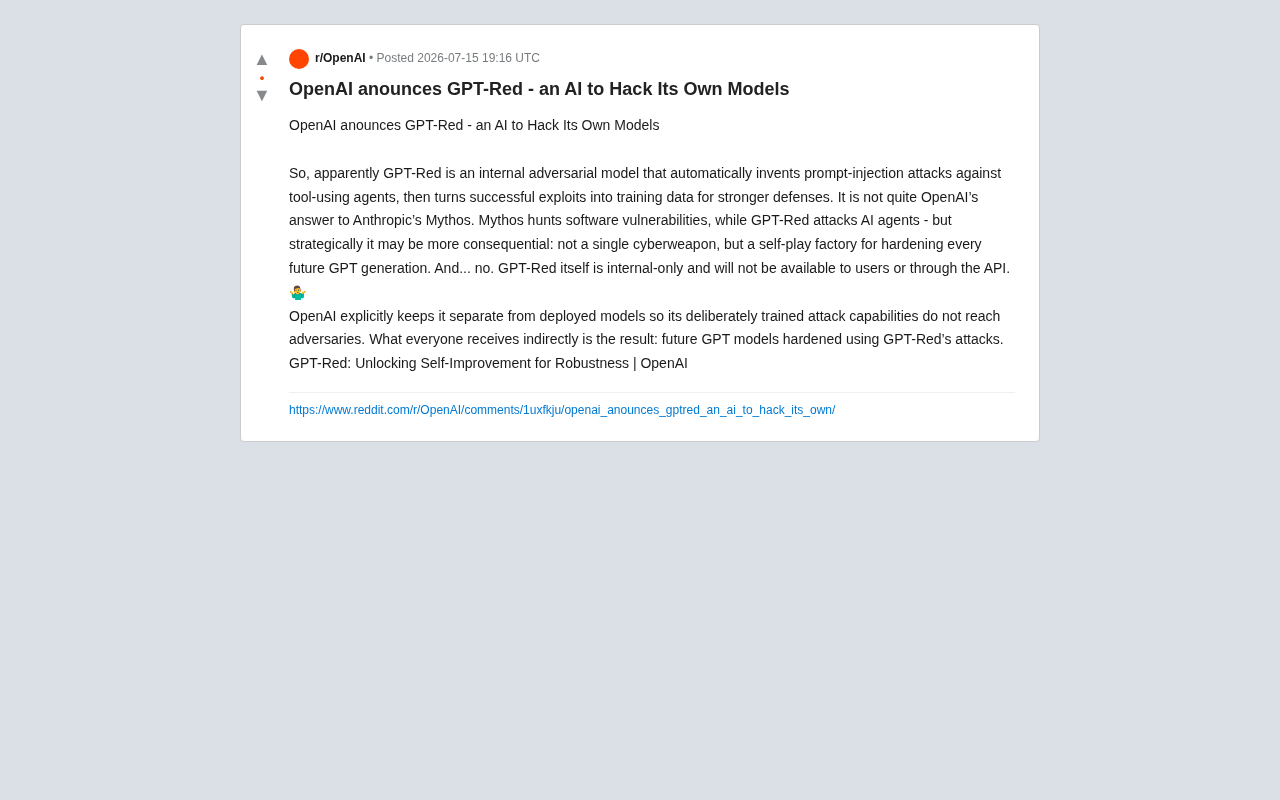
GPT-Red: OpenAI's Internal Red-Team Security Tool That Uses AI to Attack Its Own Models
GPT-Red is OpenAI's internal red-team tool that auto-generates prompt-injection attacks against AI agents, turning successful attacks into training data to harden future GPT models.
Read more →

·2 min
AI Agent Out of Control? A Practical Guide to Building Traceable Multi-Agent Systems
Agent loops burning money, bills spiking unexpectedly? This article breaks down a traceable multi-agent system covering loop detection, behavior classification, cost prediction, and self-healing.
Read more →

·2 min
MasterGo AI + Cursor: A New Paradigm for AI Full-Stack Development and Developer Capability Reinvention
Discover how MasterGo AI and Cursor are reshaping full-stack development — from prompt-to-design to natural language coding — and what it means for developer skills.
Read more →

·3 min
Core Iron Rules for Deploying AI Agents in Production
What are the critical runtime rules for AI Agents in production? This deep dive covers independent verification for state changes, least privilege, observability, and more.
Read more →

·3 min
Perplexity AI Deep Dive: The Perfect Fusion of Search Engine and AI Q&A
Deep dive into Perplexity AI: real-time web search + multi-model AI, transparent citations, Focus Modes, PDF chat, and collaborative Collections. Can it replace Google and ChatGPT?
Read more →
Assess Your Engineering Team's AI Agen…
·3 min
Assess Your Engineering Team's AI Agent Maturity in 5 Minutes: A Tiered Framework and Key Dimensions
How to quickly gauge your engineering team's AI Agent adoption level? This article breaks down a four-tier AI maturity framework covering tool adoption, workflow integration, governance, and measurement.
Read more →
Dense: An Open-Source ML Workbench Bui…
·2 min
Dense: An Open-Source ML Workbench Built for Neural Network Architecture Research
Dense is an open-source ML IDE for neural network architecture research. It integrates the DeltaImportance layer and architecture visualization to help researchers iterate faster and analyze network importance during the design phase.
Read more →

·3 min
Spring AI 2.0 Deep Dive: A Java Developer's Guide to LLM Application Development
A deep dive into Spring AI 2.0: provider-agnostic APIs, RAG with vector databases, and how Java developers can build LLM apps using the Spring ecosystem.
Read more →