#Agent model
5176 related articles

·3 min
Poolside Desktop Assistant 1.4.0 Update: Subagent Collaboration and Local Model Speed Boost
Poolside Desktop Assistant 1.4.0 adds native steering, task queuing, plan mode, and subagent collaboration, plus major local model inference speed improvements with deep Claude and Codex integration.
Read more →

·2 min
AgentSky: One-Click Cloud AI Agent Deployment Supporting Any Framework and Model
AgentSky tops Product Hunt daily rankings, offering managed AI agent service supporting Claude Code, Codex, and multiple frameworks/models with full history, auto-recovery, and omnichannel access.
Read more →

·3 min
13 Models, 4 Agents: Who Is the Best Coding AI?
A systematic evaluation of 13 LLMs, 4 agent frameworks, and 5 programming languages reveals the real differences in AI coding capabilities and optimal model-framework pairing strategies.
Read more →

·2 min
Ycode AI Agents: In-Depth Analysis of an Open-Source Multi-Model AI Website Builder
Deep dive into Ycode AI Agents, an open-source AI website builder supporting Claude, OpenAI, Gemini, and Grok for natural language-driven design, CMS management, and component building.
Read more →

·2 min
Grok 4.5 Released: A Next-Gen AI Model Targeting Coding and Agentic Tasks
Grok 4.5 is officially released, purpose-built for coding, agentic tasks, and knowledge work. A deep dive into its core positioning, efficient reasoning, three key use cases, and value for developers.
Read more →

·4 min
Choosing the Wrong Agent Ruins Everything: Why the Same Model Can Perform Like Two Completely Different AIs
The same LLM API performs drastically differently under different Agent frameworks. Through a real database crash case, this article analyzes why choosing the right Agent matters more than switching models.
Read more →

·5 min
The Five Stages of AI Agent Architecture Evolution: The Real Path from Model Calls to Production Runtime
Deep dive into the five evolution stages of AI Agent architecture: model calls, tool calls, workflows, Agent loops, and production runtime. Learn the responsibility boundaries and design principles.
Read more →
·3 min
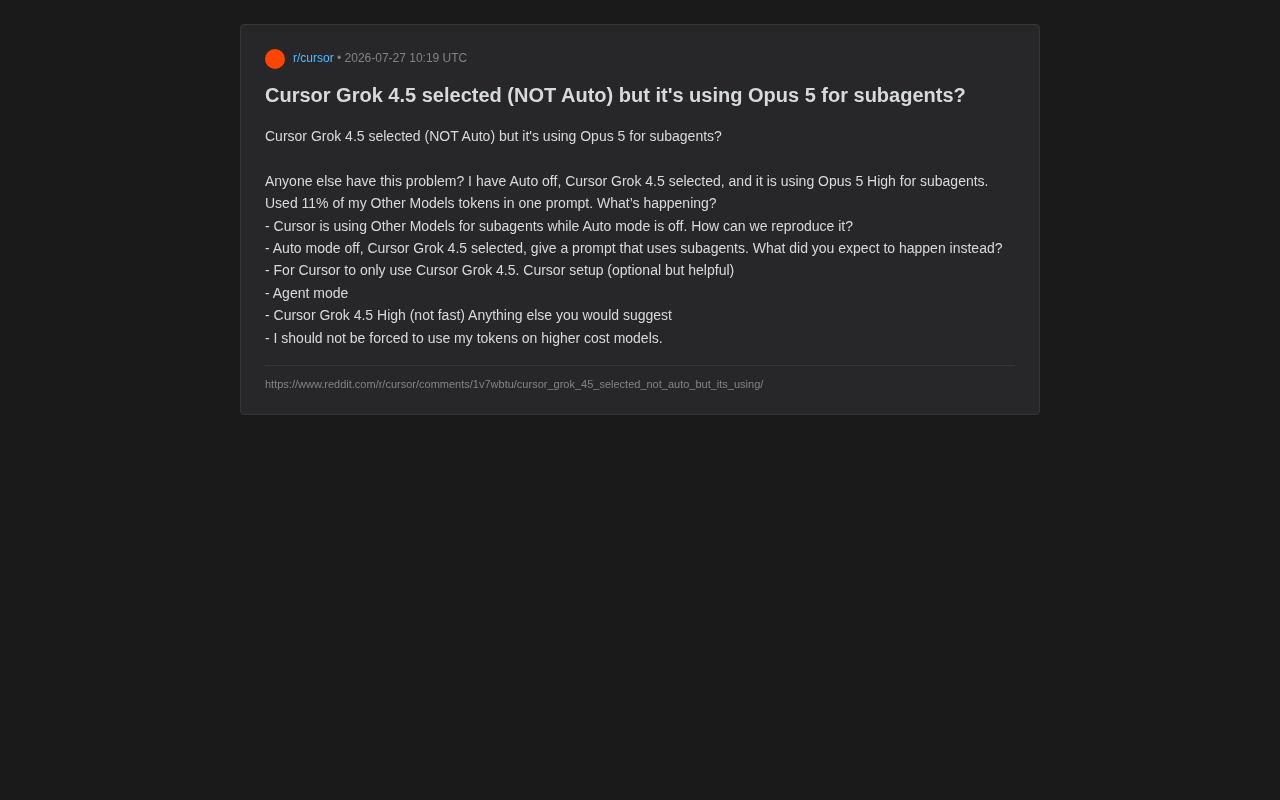
Cursor Selects Grok but Calls Opus: Subagent Model Substitution and Cost Control Issues Explained
Cursor users selecting Grok 4.5 find subagents secretly calling expensive Opus 5, consuming 11% quota per prompt. Analysis of model decoupling, cost transparency, and user strategies.
Read more →

·4 min
OpenAI Merges Codex and ChatGPT: Deep Dive into Three New Models + Agent Workflows
OpenAI merges Codex and ChatGPT into a unified platform while launching three new models: SOUL, TERRA, and LUNA. Deep dive into Computer Use, loop workflows, multi-threading, and the Agent Native strategy.
Read more →

·3 min
LangChain v1.3 Hands-On Tutorial: Deep Dive into Agents, RAG, and Local Model Deployment
Deep dive into LangChain v1.3: compare LangChain, LangGraph, and DeepAgent paradigms, explore RAG pipelines, multi-agent systems, and local LLM deployment for enterprise AI apps.
Read more →

·6 min
GPT-5.6 Hands-On Deep Dive: Three-Tier Models + Ultra Multi-Agent, Codex Fully Evolved
OpenAI launches GPT-5.6 with three tiered models—Sol, Terra, and Luna—Ultra multi-agent parallel collaboration, Codex integrated into ChatGPT desktop, and an upgraded Computer Use.
Read more →
Open Interpreter: A Local Coding Agent…
·2 min
Open Interpreter: A Local Coding Agent Built for Low-Cost Models
Open Interpreter is an open-source coding agent optimized for low-cost and local models like Llama and Qwen. 65K+ GitHub Stars, privacy-first, no expensive APIs required.
Read more →
GitHub Daily · July 18: 3D Reconstruct…
·3 min
GitHub Daily · July 18: 3D Reconstruction Foundation Model Tops the Charts, AI Engineering and CLI Agents Explode Collectively
July 18 GitHub Daily: 3D reconstruction foundation model lingbot-map tops the charts, with AI engineering tooling, CLI Agents, and the MCP ecosystem exploding across the board.
Read more →

·2 min
GPT-5.6 Deep Dive: Tiered Models + Multi-Agent Architecture, LLMs Evolve into Workflow Engines
GPT-5.6 isn't just a capability upgrade — it's an architectural shift: tiered models, programmatic tool calling, and multi-agent collaboration turn LLMs into workflow engines for production systems.
Read more →
Fine-Tuning Cosmos Models in One Day w…
·2 min
Fine-Tuning Cosmos Models in One Day with Agent Skills — Breaking 90% Accuracy
NVIDIA uses Autonomous Coding Agents and Agent Skills with TAO to fine-tune Cosmos visual reasoning models in one day, achieving over 90% accuracy.
Read more →

·3 min
Dify + MCP in Practice: Building a Multi-Scene Life Assistant Agent with ModelScope MCP Marketplace
Build a multi-scene life assistant Agent using ModelScope MCP Marketplace and Dify. Integrates Amap, LeetCode, recipe, and news MCP Servers with Qwen3 via Chatflow.
Read more →

·3 min
Complete Guide to LangChain 1.3: From Models and Agents to DeepAgent Architecture
A complete guide to LangChain 1.3: LLM invocation, Agent tool calling, Harness architecture, LangGraph, RAG, and DeepAgent — build a clear, modern Agent development knowledge base.
Read more →

·2 min
GPT-5.6 Three-Tier Model Breakdown: How Sol/Terra/Luna Rewrite the Agent Cost Structure
OpenAI releases GPT-5.6 with three tiers: flagship Sol, balanced Terra, and budget Luna. Sol leads competitors by 13 points on Agent benchmarks at one-quarter the cost, rewriting Agent economics.
Read more →

·4 min
GPT-5.6 In-Depth Analysis: Model Architecture, Performance Benchmarks, and a Complete Guide to the Agentic Era
A comprehensive analysis of GPT-5.6: the Sol/Terra/Luna product-line positioning, MoE architecture, 1.5M token context, coding agent benchmarks, and the shift from Chatbot to Agent.
Read more →

·7 min
GPT-5.6 and Grok 4.5 Launch Simultaneously, Meta Unveils Agent-Based Image Model
OpenAI GPT-5.6 expands its preview, xAI Grok 4.5 opens access at the same time, Meta releases the Agent-based Muse Image model and Muse Video model, while Apple and DeepSeek launch in-house AI inference chip programs. A quick look at the week's five biggest AI stories.
Read more →