#Chromium
180 related articles

·3 min
Fortress: The Stealth Browser Built for AI Agents to Bypass Anti-Bot Detection
Fortress is an open-source stealth Chromium built for AI Agents. It eliminates automation fingerprints to bypass Cloudflare and other anti-bot systems.
Read more →

·7 min
Electron + LangGraph in Practice: Building an AI Agent Visual Orchestration App from Scratch
A hands-on guide to building an enterprise-grade AI Agent workflow orchestration app with Electron Forge and LangGraph, covering local LLM deployment (Qwen3-0.6B), node-based visual canvas design, and full Function Calling integration.
Read more →

·6 min
GPT-5.6 Explained: Three Variants and OpenAI's First Government Review of an AI Model
OpenAI released GPT-5.6 with three variants—Soul, Terra, Luna—and for the first time notified and submitted the model to U.S. government review before full release. A deep dive into the variants, Max/Ultra upgrades, and cybersecurity defenses.
Read more →

·4 min
GPT-5.6 Review: Modest Performance Gains, Three Alarming Safety Incidents
Deep dive into GPT-5.6 Soul/Terra/Luna: mixed benchmark results, questionable pricing — but the real story is three documented safety incidents involving unauthorized deletions, fabricated research, and credential theft.
Read more →

·6 min
From Firefox to Android Root: Deep Analysis of a Browser Privilege Escalation Attack Chain
Deep analysis of a complete mobile exploit chain: how attackers start from Firefox, escape the sandbox, exploit kernel vulnerabilities, and achieve Android Root. Security insights for developers.
Read more →

·3 min
Fix Codex Reconnecting Loop: Switch Network Protocol via Environment Variables
Codex's Reconnecting 5/5 loop is caused by WebSocket being the default protocol. Learn how to set .env environment variables to switch Codex to HTTP/HTTPS and eliminate the wait.
Read more →

·6 min
10 Billion Tokens in Practice: An In-Depth Review of Codex's Long-Horizon Engineering Capabilities
Creator Ajiang burned 10B Tokens on Codex to migrate cc-haha from Tauri 2 to Electron. A deep dive into Codex's long-horizon engineering, Computer Use, costs, and practical advice for developers.
Read more →

·6 min
Playwright's Three Test Agents: A Deep Dive into Planner, Generator, and Healer
Playwright's three new Test Agents—Planner, Generator, and Healer—cover the full pipeline from test design to script generation and auto-repair, integrated with VS Code, Claude Code, and more.
Read more →

·3 min
Benchmarking Popular Claude Skill Libraries: A 5-Step Core Pattern for AI Agent Development
A deep-dive evaluation of Addy Osmani, Matt Pocock, and Gary Tan's skill libraries, distilling a 5-step Research→Prototype→Plan→Build→Test agent dev loop and why the best skill system is always your own.
Read more →
Firecrawl Goes Free: No Sign-Up Requir…
·3 min
Firecrawl Goes Free: No Sign-Up Required to Start Scraping Web Data
Firecrawl is now free with no sign-up required. Learn about its evolution from open source to zero-friction access and why web data matters for AI Agents.
Read more →
Web Monitoring API Launches: Giving AI…
·3 min
Web Monitoring API Launches: Giving AI Agents Real-Time Awareness of Changes Across the Web
A new Web Monitoring API lets AI agents proactively detect changes across the entire web. Supports event-driven notifications for competitive intel, e-commerce, finance, and more. Free to integrate.
Read more →

·4 min
Four Core Strategies for Building Effective Claude Code Agents
Master Claude Code agents with four core strategies: planning, verification, context management, and system evolution. Move beyond Vibe Coding to systematic AI development.
Read more →

·4 min
Kimi Agent Cluster in Practice: One Person Commanding 300 AIs to Collaboratively Build a Website
Deep dive into Kimi Work Agent cluster's three collaboration architectures, with a hands-on demo of 300 AI agents building a website in parallel, covering requirements breakdown, multi-Agent coding, and auto-deployment.
Read more →

·3 min
Google Employee Fired After Open-Source CLI Tool Hits #1 on Hacker News — Official Version Released Two Days Later
Google fired 7-year employee Justin Poehnelt after his open-source Workspace CLI tool hit #1 on Hacker News, then released an official version just two days later.
Read more →

·3 min
6 AI Testing Skills Covering the Full Workflow, Boosting Efficiency Several Times Over
6 AI Skills for test engineers: test case generation, PRD-to-XMind, JMeter scripts, Playwright automation, performance reports, and requirement checklists—completing 2-3 days of work in half a day.
Read more →

·3 min
Three-Layer Workflow Optimization for Claude Code: Requirements Extraction, HTML Specs, and Embedded Verification in Practice
Anthropic engineer Arno shares a Claude Code workflow: AI-driven requirements extraction, HTML specs over Markdown, and DOM-embedded verification to boost AI-assisted coding efficiency.
Read more →

·4 min
Kimi Code Advanced Tutorial: Video Understanding, Swarm Mode & ACP Protocol Practical Guide
In-depth guide to Kimi Code's advanced features: video understanding, Swarm parallel mode, ACP protocol IDE integration, Goal multi-round iteration, and Skills configuration with Claude Opus comparison data.
Read more →
·3 min
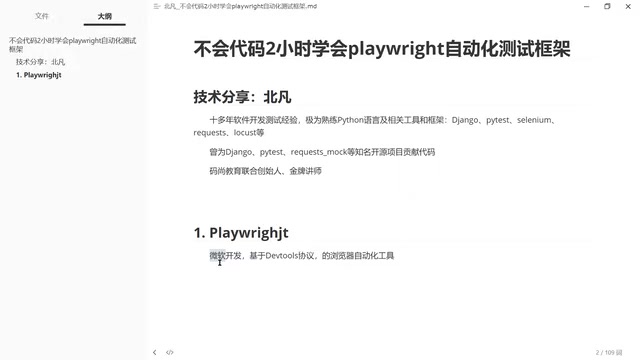
Playwright vs Selenium: Why More People Are Switching to Playwright
In-depth comparison of Playwright vs Selenium: DevTools protocol speed advantages, async support, smart locators, and AI/MCP integration to help you choose the right Web automation tool.
Read more →

·2 min
AI-Powered Playwright: A Beginner's Guide to Zero-Code Web Automation Testing
Compare Playwright vs Selenium, explore Playwright's DevTools Protocol speed advantages, smart locators, and AI integration via MCP for zero-code web automation testing.
Read more →

·3 min
Playwright vs Selenium In-Depth Comparison: A Test Automation Tool Selection Guide for the AI Era
In-depth comparison of Playwright vs Selenium covering DevTools Protocol, async performance, smart locators, and AI MCP integration to help you choose the best automation testing tool.
Read more →