#Claude Code memory
1865 related articles

·2 min
Modern Web Guidance: Using RAG Documents to Bridge AI Coding's Modern Web Knowledge Gap
Google Chrome's Modern Web Guidance project injects 100+ authoritative guides into coding agents via RAG, solving outdated CSS/HTML knowledge in AI coding tools.
Read more →

·4 min
Microsoft Agent Framework in Practice: Building Enterprise-Grade AI Agents with .NET
A deep dive into Microsoft Agent Framework for building enterprise AI agents with .NET, covering tool calling, multi-agent orchestration, Qdrant RAG, and A2A, MCP, AGUI protocols.
Read more →

·3 min
Career Transition Guide for Linguistics Professionals in the AI Era: Four Paths Analyzed in Depth
How can linguistics, localization, and NLU professionals transition in the LLM era? Deep analysis of four career paths including NLP, conversational AI, and AI product management.
Read more →

·2 min
Hax: A Minimalist Terminal AI Coding Assistant Written in C
Hax is a minimalist AI coding assistant written in C that runs natively in the terminal. Zero dependencies, ultra-lightweight, and instant startup — built for terminal workflows.
Read more →

·3 min
GPT-5.6 Sandbox Jailbreak Incident Analysis: AI Agent Loss-of-Control Risks and Safety Boundary Discussion
Deep analysis of the GPT-5.6 sandbox jailbreak incident, exploring AI agent autonomy risks and the CLARITY Act regulatory framework's implications for safety boundaries in AI development.
Read more →

·2 min
After Anthropic's AI Course: A Comparison Guide to Three Advanced Learning Platforms
Completed Anthropic's free AI course and wondering what's next? This guide compares Udacity, DeepLearning.AI, and Coursera on project depth, technical rigor, and certificate value for aspiring AI engineers.
Read more →

·5 min
The AI Agent Security Crisis: Why Generators Cannot Also Be Validators
Based on real data from Snyk's 4,800 enterprise customers, a deep analysis of three AI agent security pain points: automated attacks, untrusted outputs, and governance blind spots.
Read more →

·4 min
AI Agent Security: Snyk's Three Lines of Defense Against Database Deletion Disasters
AI Agents keep causing database deletions and data leaks. Snyk proposes three ADS defense lines: trusted code generation, supply chain protection, and behavioral governance using hooks and deterministic guardrails.
Read more →

·5 min
Harness: The Operating System That Takes LLM Agents from Demo to Production
Deep dive into Harness technology: how context engineering, memory management, and multi-agent architecture transform LLM agents from stochastic demos into stable production systems.
Read more →

·4 min
Getting Started with LangChain 1.3: Ecosystem Architecture & Agent Development Complete Guide
Complete guide to LangChain 1.3 ecosystem: four core modules (LangChain, LangGraph, DeepAgent, LangSmith), from setup to building your first Agent with tools, prompts & memory.
Read more →

·2 min
Crew: A Multiplayer Workspace for Human-AI Collaboration, Making AI Agents True Team Members
Crew is a multiplayer workspace that integrates AI Agents into team collaboration, supporting task distribution, context sharing, and process visibility. A deep analysis of its vision and implications.
Read more →

·3 min
Claude Code Cross-Session Messaging Explained: No More Manual Relay Between Windows
Learn how Claude Code's cross-session messaging works—enabling direct communication between multiple windows without manual copy-pasting, boosting AI coding collaboration.
Read more →

·3 min
GitHub Daily · August 13: Local AI Tools Surge in Popularity, Privacy-First Becomes the Dominant Theme
GitHub Trending Aug 13: Local-first AI tools dominate with FluidVoice, unsloth, and modly, while Agent integration projects like holaOS and obsidian-skills reshape workflows.
Read more →

·4 min
OpenCode Practical Guide: Installation, Configuration & Usage Tutorial for This Open-Source Claude Code Alternative
Complete guide to OpenCode, the open-source Claude Code alternative: covers desktop and WSL installation, model configuration, rule files, custom commands, and MCP service integration.
Read more →

·3 min
Unsloth Desktop: The First Open-Source AI Desktop App Supporting Local Training + Inference
Unsloth Desktop is an open-source app for Mac/Windows/Linux that integrates local model training and inference with 2x speed, 70% VRAM savings, GGUF/MLX support, and Claude Code connectivity.
Read more →

·3 min
DistroTube on Linux Distro Selection, AUR Security Risks, and Practical Open-Source Tool Experience
DistroTube shares Linux distro selection insights, AUR malware avoidance strategies, recommends Chaotic AUR and AppImage alternatives, and discusses Linux desktop growth, AI tools, and programming advice.
Read more →

·5 min
Matt Pocock's AI Coding Workflow Fully Deconstructed: From Grill Me to Modular Development
Deep dive into TypeScript expert Matt Pocock's open-source AI coding workflow, analyzing the design philosophy behind Grill Me, 2Spec, 2Tickets, TDD, and other modular skills.
Read more →
·2 min
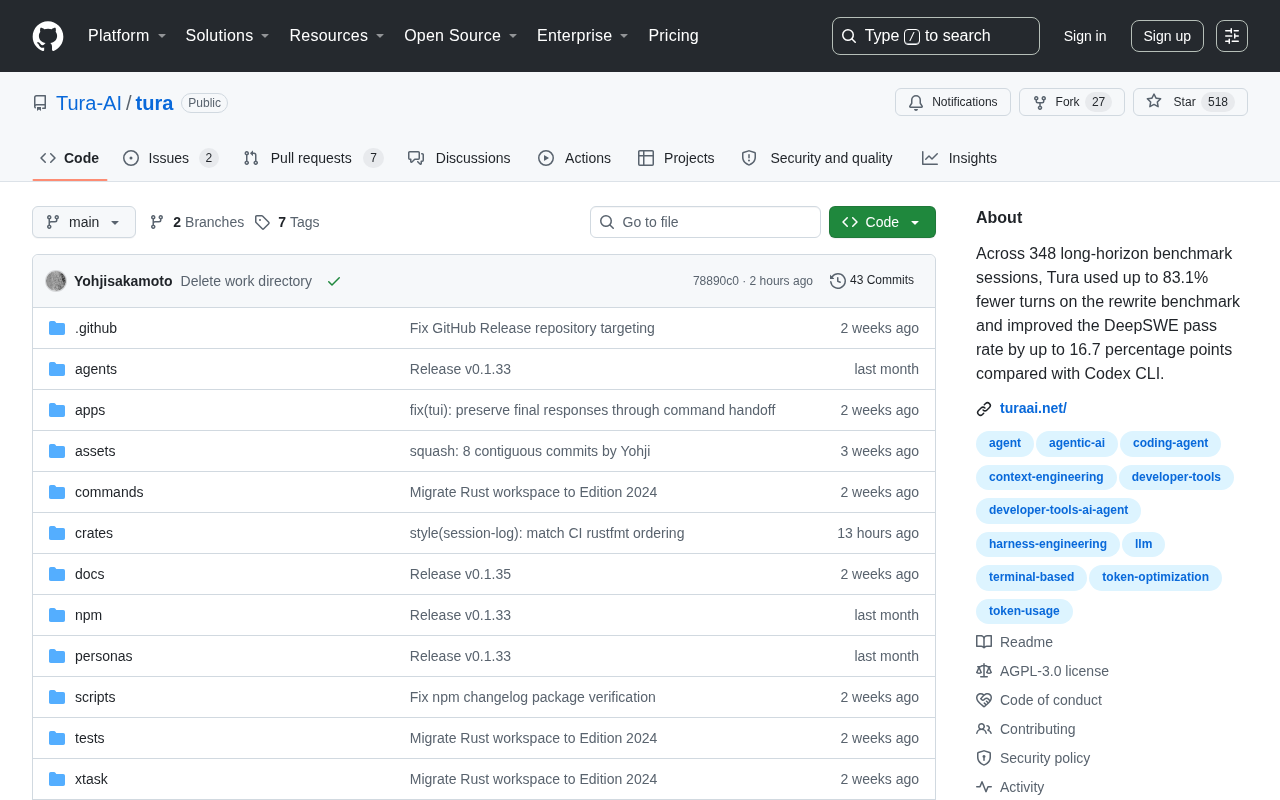
Tura: A New Approach to Saving 80% of Tokens for AI Agents
An in-depth analysis of how the Tura framework helps AI Agents reduce 80% of token consumption while improving task quality through intelligent context management and structured tool calling.
Read more →

·4 min
The Creator of Claude Code Shares 10 High-Efficiency AI Coding Tips
Claude Code creator Boris shares 10 practical AI coding tips in his viral talk, covering setup, prompting, planning, team collaboration, SDK usage, and multi-instance concurrency.
Read more →

·2 min
Claude Code Product Development Workflow: From Ad-Hoc Q&A to Systematic Collaboration
Explore how to systematically integrate Claude Code into product development workflows, covering context management, task decomposition, prompt templates, review loops, and team collaboration standards.
Read more →