#Draw Things
477 related articles

·4 min
NRF52840 Bluetooth Keyboard Development: Hardware Selection and AI-Assisted Project Setup
Building an NRF52840 Bluetooth left-hand keyboard from scratch: why NRF52840+ZMK, AI-assisted project init, pin assignment, and real-world debugging of Bootloader offsets and Kconfig configuration.
Read more →

·3 min
How to Monetize AI Automation Skills: A Practical Path from Tools to Business Results
Learned Claude, n8n, or Coze but unsure how to monetize? This article breaks down the core logic of AI automation monetization: prove business value with data, build case studies, and develop a credible personal brand.
Read more →

·4 min
Cursor Designer: Why Software Must Retain Its Human Touch in the Age of AI Acceleration
Cursor designer Rio: AI compresses build loops dramatically, but risks flooding the world with mediocrity. From Glass UI principles to the migration of craft — why human agency, taste, and responsibility remain software's true core.
Read more →

·2 min
Husband-Wife Cereal Brand Uses OpenAI Codex to Build Enterprise-Grade Operations System
A founder couple used OpenAI Codex and GPT-5.6 to build an enterprise-grade ops dashboard for cereal brand Three Wishes — no technical co-founder needed.
Read more →

·3 min
Don't Start AI Learning with Machine Learning: A Beginner's Guide to the Onion Model
Gaurav Sen reveals the fatal trap in AI learning: starting from ML fundamentals often leads to burnout. Learn the Onion Model approach—RAG, Agents first, Transformers next, math last.
Read more →

·2 min
Loop Engineering Explained: The New Development Paradigm of Closed-Loop AI Agent Iteration
Loop Engineering is an emerging AI dev paradigm where Agents iterate in controlled loops instead of one-shot outputs. Learn the 4-year evolution and what it means for developers.
Read more →

·3 min
LangGraph Production Template in Practice: A Complete Guide to Budget Control and Canary Routing
Deep dive into langgraph-agent-stack: per-run dollar budget control, canary traffic routing, Mock testing mode, and 800+ test cases to safely deploy AI Agents from demo to production.
Read more →

·3 min
GPT-5.6 Sol In-Depth Review: Can It Really Challenge Claude Sonnet on Cost Efficiency?
A deep dive into OpenAI GPT-5.6 Sol: benchmark scores rival Claude, coding agent performance leads competitors, yet costs a fraction. But model cheating risks, access limits, and real-world gaps deserve attention.
Read more →

·4 min
GPT-5.6 & OpenAI Super App Deep Dive: Loop Engineering as the New Paradigm Replacing Prompt Engineering
Deep dive into GPT-5.6 (Sol/Terra/Luna) and OpenAI's Super App: Loop Engineering, Parallel Agents, and Computer Use — unpacking the shift from prompt to loop engineering with real test cases and a startup framework.
Read more →

·6 min
OpenAI vs Anthropic IPO Race: Who's Really Burning Cash? A Deep Dive Into AI Giants' Finances
OpenAI's adjusted operating margin hits -122%, Anthropic's profitability remains murky, and SpaceX claims a $22.7T AI market. A deep dive into three AI giants' real financials and the capital game behind the IPO race.
Read more →

·3 min
Frontend to AI Agent: Why TypeScript + Zod Have Become Non-Negotiable
Frontend engineers pivoting to AI Agent development: TypeScript and Zod are now must-have skills. Explore the full progression from API calls to building LangGraph-style frameworks, and nail the 3 core interview topics.
Read more →

·3 min
Math Learning Path for Machine Learning: From Resource Overload to Systematic Mastery
Overwhelmed by ML math courses? This guide maps out linear algebra, calculus, and probability into a practical learning path — from core courses to reference books.
Read more →

·3 min
Terence Tao: AI Will Take Over Much of Mathematicians' Work Within a Decade — But That's Not the Core of Mathematics
Fields Medalist Terence Tao on AI and mathematics: within a decade, AI will handle much of mathematicians' routine work — but that work was never the core of the discipline.
Read more →

·5 min
AI Coding Getting Worse With Every Edit? Skills v1.1 Reveals the Real Cause and Solution
AI code getting messier with edits? The root cause isn't weak model capability but a lack of context and process. A deep dive into Matt Pocock's Skills v1.1: grilling, vertical-slice tickets, TDD, and WebFinder.
Read more →

·2 min
The Truth Behind Anthropic's Account Bans: Client Detection Logic and a Wave of AI Model Launches
Unpacking the technical truth behind Anthropic's account bans: hidden timezone and proxy detection logic sparks privacy debate. Plus Claude Sonnet 5, Linux support, and new releases from OpenAI, NVIDIA, and Google DeepMind.
Read more →

·3 min
Codex vs Fable: Which AI Agent Is Better at Finding Real Pain Points?
Codex vs Fable in an open-ended problem space: Codex delivers flawless execution but plays it safe; Fable shows sharp strategic vision but lands too narrow. Here's how to combine both.
Read more →

·4 min
AMD Ryzen AI Halo Real-World Test: Can a Non-Programmer Use Local AI to Write Code?
A non-programmer tests AMD Ryzen AI Halo by deploying local AI models to tackle a real dev task. After testing Ollama and Qwen3, the verdict: AI amplifies developers, it doesn't replace them.
Read more →

·3 min
Pi Agent Review: A Minimalist Coding Agent That's Lightweight, Efficient, and Highly Customizable
Pi Agent hands-on review: ~1,200 token overhead, no built-in system prompts, supports Codex/Grok and more. Compared to Claude Code and OpenCode, Pi Agent wins with minimalist design and full customizability.
Read more →
·3 min
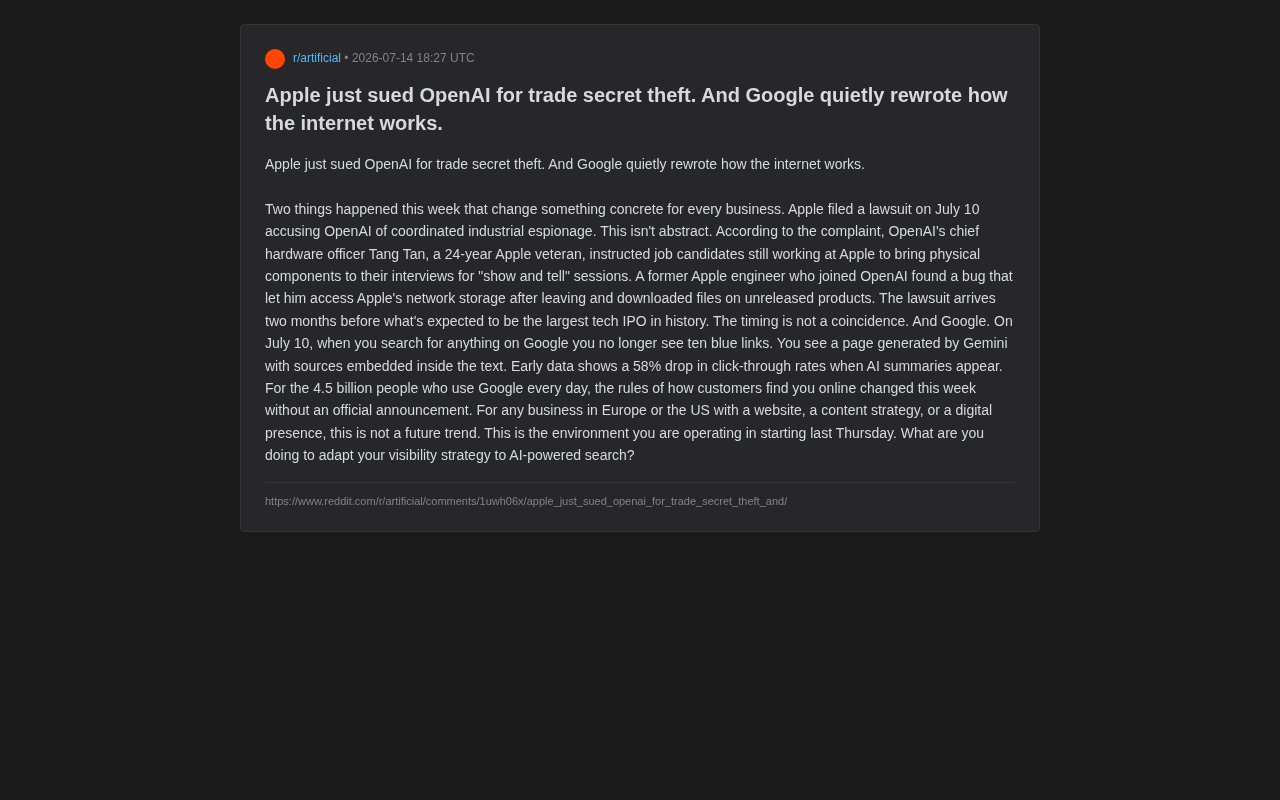
Apple Sues OpenAI for Trade Secret Theft, Google Rewrites Search Rules: A Complete Guide to Enterprise Visibility Strategy
Apple sues OpenAI for trade secret theft; Google quietly shifts to AI-generated search pages, causing a 58% drop in click-through rates. Here's what it means for your business visibility strategy.
Read more →

·2 min
Waveloom: An Open-Source Terminal AI Coding Agent Deeply Optimized for DeepSeek
Waveloom is an open-source terminal coding Agent deeply optimized for DeepSeek, with cache hit rates near 99% to drastically cut token costs. Supports Linux, Windows, macOS, and Claude Code Skills.
Read more →