#INT8 quantization
841 related articles

·3 min
Google AI Models Suddenly Getting Dumber? Causes and Coping Strategies for Model Degradation
Deep analysis of Google AI model performance fluctuations and model degradation, exploring technical causes like dynamic quantization and silent updates, with practical strategies for benchmarking, version pinning, and building robust AI applications.
Read more →

·3 min
Sign Language to Text AI: How the SL2T Model Enables Barrier-Free Communication
Explore the SL2T sign-language-to-text AI model's technical breakthroughs and how it converts sign language into text in real time, breaking communication barriers for deaf and hard-of-hearing communities.
Read more →

·4 min
RAG in Practice: Building a Million-Scale Medical Consultation AI System with Retrieval-Augmented Generation
Learn how to build a medical AI assistant using RAG covering 790 diseases and 1.7M consultation records, with complete implementation of knowledge base construction, vector retrieval, BERT fine-tuning, and recall-ranking optimization.
Read more →

·3 min
From OpenCV to Industrial-Grade Vision: An Advanced CV Learning Path and Practical Guide
A complete advanced path from mastering OpenCV and YOLO basics to building industrial-grade computer vision systems, covering deep learning, custom model training, real-time inference, edge deployment, and spatial perception.
Read more →

·3 min
DLLM: A Deep Dive into the Minimalist Local Coding Agent Built on llama.cpp
Deep dive into DLLM, a minimalist coding agent built directly on llama.cpp. Explore its zero-overhead architecture, local privacy advantages, use cases, and trade-offs vs. cloud AI coding tools.
Read more →

·2 min
Google's SL2T Model: Real-Time Sign Language-to-Text Technology Arrives on Pixel 11
Google launches SL2T sign language-to-text model supporting real-time ASL-to-English conversion, integrated with Gboard and Live Transcribe, deploying on-device on Pixel 11 for system-level accessibility.
Read more →

·3 min
LLM Learning Roadmap: A Three-Phase Practical Guide
A systematic LLM learning roadmap: from Python basics to LangChain & LlamaIndex frameworks, RAG, Agent, and fine-tuning core skills, plus hands-on projects to master LLM app development in 3 months.
Read more →
·3 min
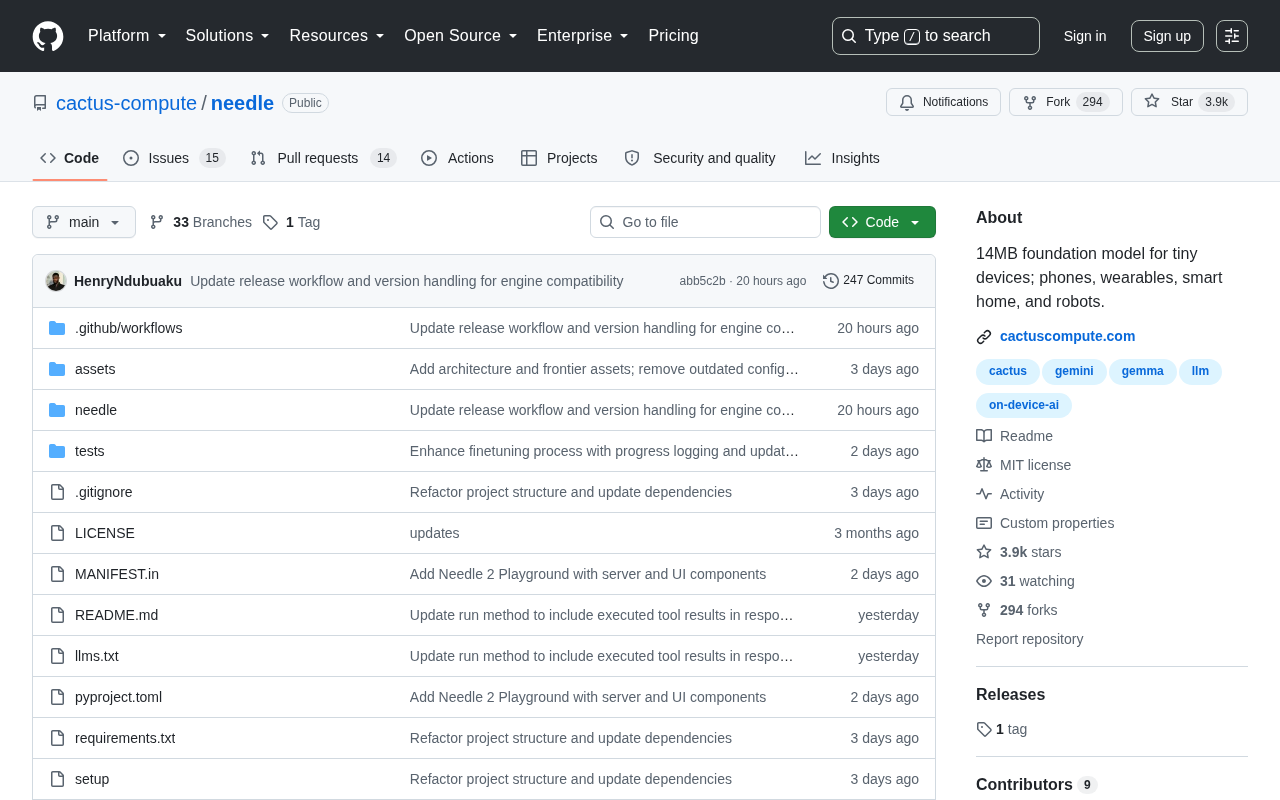
Needle: How a 14MB Foundation Model Is Unlocking Edge AI Deployment
Needle is a 14MB open-source foundation model from cactus-compute, designed for phones, wearables, smart home devices, and robots. Explore its edge AI potential.
Read more →

·2 min
NVIDIA Open-Sources Switchyard: An AI Task Scheduling Engine Built with Rust
NVIDIA-NeMo team open-sources Switchyard, a high-performance AI task scheduling engine built in Rust. Explore its technical positioning, why Rust was chosen, and its strategic role in the NeMo ecosystem.
Read more →

·2 min
Understanding GGUF Quantization: The Real Difference Between Q4_K_M and Q4_K_S
Detailed explanation of the core differences between GGUF model Q4_K_M and Q4_K_S: why same-Q4 files differ in size, k-quant protection strategies, quantization selection guide, and VRAM planning tips.
Read more →

·2 min
Struggling to Choose a Gemini Model? Analyzing UX Pain Points in the Multi-Model AI Era
Facing Gemini Pro, Flash, Ultra and many variants, users often suffer choice paralysis. This article analyzes AI model naming confusion, information asymmetry, and proposes UX solutions like smart defaults and intent-first design.
Read more →

·2 min
LFM2.5 Released: How a 2.6B Small Model Rivals Models 4x Its Size
Liquid AI releases LFM2.5: a 2.6B parameter model rivaling 10B-class models on multiple benchmarks. Exploring its architectural innovation, training strategy, and implications for AI efficiency.
Read more →

·3 min
Unsloth Desktop: The First Open-Source AI Desktop App Supporting Local Training + Inference
Unsloth Desktop is an open-source app for Mac/Windows/Linux that integrates local model training and inference with 2x speed, 70% VRAM savings, GGUF/MLX support, and Claude Code connectivity.
Read more →

·3 min
SAP Freezes Hiring and Travel: AI Costs Are Devouring Corporate Budgets
SAP freezes hiring and travel as AI spending surges, revealing the massive cost pressures enterprises face in AI transformation and how budgets are being reshaped.
Read more →

·2 min
MiniMax H3 Video Model Local Deployment Test: Stunning Results on a Consumer-Grade RTX 4070Ti Super
A Reddit user runs MiniMax H3 video model locally on an RTX 4070Ti Super, generating stunning WW2-themed videos using Ideogram for image generation paired with H3's reference workflow.
Read more →

·3 min
DeepSeek Plans Significant Price Hikes: Is the Era of Cheap AI Coming to an End?
DeepSeek plans significant API price hikes, signaling the end of ultra-cheap AI. We analyze the drivers, developer impact, and industry shift from price wars to rational pricing.
Read more →

·3 min
Practical Guide to Accelerating LLM Inference with Apple Silicon Virtual Machines
A deep dive into accelerating llama.cpp inference in macOS VMs using Apple Silicon's unified memory architecture, covering Metal backend configuration, memory allocation, and quantization optimization.
Read more →

·3 min
Meta Muse Glimmer: A Deep Dive into the 30B Open-Source Local Coding Model
Deep dive into Meta Muse Glimmer, a 30B open-weight coding model for local deployment. Covers technical specs, use cases, hardware requirements, and comparisons with Code Llama and DeepSeek Coder.
Read more →

·3 min
PagedAttention Explained: GPU Memory Optimization and Model Routing Techniques
Deep dive into how PagedAttention borrows OS paging to optimize GPU memory, eliminate KV Cache fragmentation, and how model routing enables intelligent scheduling for multi-model inference services.
Read more →

·3 min
AI Agents Reproduce ICML 2026 Papers: 34% Verified, 23% Found Problematic
Hugging Face hosted an ICML 2026 Reproduction Hackathon where 1,200 participants used AI agents to verify 2,200 papers. Results: 34% covered, most reproducible, but ~23% had issues and 49 were nearly fully falsified.
Read more →